








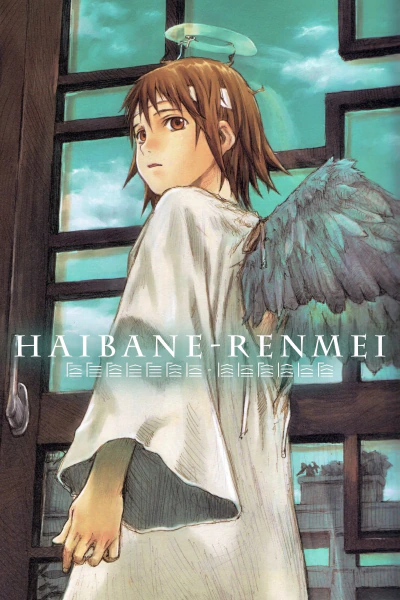
Name(s): Charcoal Feather Federation / Haibane Renmei / 灰羽連盟 / Ailes Grises : Haibane Renmei
Format: TV series (13 episodes)
Studio(s): Radix
With how great Serial Experiments Lain and Texhnolyze were, I decided to try something else with Yoshitoshi Abe‘s name on it (even though he only designed the characters for Texhnolyze). It turned out to be a good decision, as it lead me to Charcoal Feather Federation (CFF). Kind of a bittersweet watch though, both in thematic content and my own association with it. There are a lot of things I like about this show, but the end result didn’t leave a very strong impact on me, even though it’s one of the most cohesively-crafted shows I’ve seen in a while, with almost no flaws that I perceived—something I value greatly. It’s nice to be able to watch a show like Charcoal Feather Federation and not be able to question its execution. Everything is well-done.
My favorite parts of the show were the first few episodes, which I felt were incredibly strong. There was logical world-building as you could tell the creators questioned the implication of the fantasy elements within a normal human society, something I like a lot.
And the setting itself was very fascinating, which is perhaps even more important. The association of the world of the CFF with our own is one that poses a lot of curiosity and questions about what its purpose is, and the explanation behind the many mysteries, such as the Toga and all the seemingly arbitrary rules the Haibane are forced to follow.
The first few episodes take us continuously closer to these mysteries, but keep us at arm’s length from their explanations, presumably saving answers for the latter part of the show. This is where my main disappointment comes in, because it felt like a lot of the things that made Charcoal Feather Federation unique, such as the setting, ended up becoming a framework for the main storyline rather than something completely intertwined with it.
The middle episodes slow down building the world’s mythology for the other side of Charcoal Feather Federation, which is a breezy, cozy daily life show with the naïve Rakka having to feel her way through an unfamiliar town and people. When it’s unfamiliar to us, such as the unique rules, it’s totally enthralling, but when Rakka is otherwise adjusting to a normal life, such as helping around what’s basically an orphanage and finding a job, it can be very sweet and soothing to follow her curious perspective, but not as interesting.
I’m not saying that the show should’ve had a totally unambiguous approach to its world, but I do think that if more time were devoted to developing its mysteries, that I’d be more inclined to come up with my own interpretations with more material. As it stands now, my favorite elements of the show, its setting and melancholic tone, didn’t feel dolled out enough for me by the end. I’m certainly more interested in those than say, a dramatic subplot about Kuu leaving; someone barely featured in the show even before leaving.
The production values are very good. The soundtrack is among the best I’ve heard in an anime. It’s done by Kow Otani, who also composed the soundtrack for Shadow of the Colossus, so that’s bizarre. He also did Gundam Wing, but it didn’t have very notable music outside of its themes, except for maybe one instrumental track.
CCF‘s score is almost entirely a small chamber orchestra that’s as graceful and delicate as the Haibane’s Eden-like world, and there’s also a frequent use of a certain instrument I can’t quite pinpoint. It kind of sounds like an old organ, but I’m not sure.
The character models are a little bland, typical of the early digital era, and occasionally look awkward, but it’s not that bad. A thing like that can also just be offset by the general art direction, which is very on-point. The unsaturated colors paint a world without conflict or starkness, but they’re also somewhat downtrodden, which reflects the depression some of the Haibane feel even in this idealized, closed-off world. The painted backgrounds are also quite gorgeous and look very washed out, giving the world an ethereal, dream-like quality that aids the reverent, mesmerizing tone. Anyway, I think that covers my main points. I really liked the show, but I think it’s my least favorite of the three Abe series I’ve watched so far.
Leave a Reply