




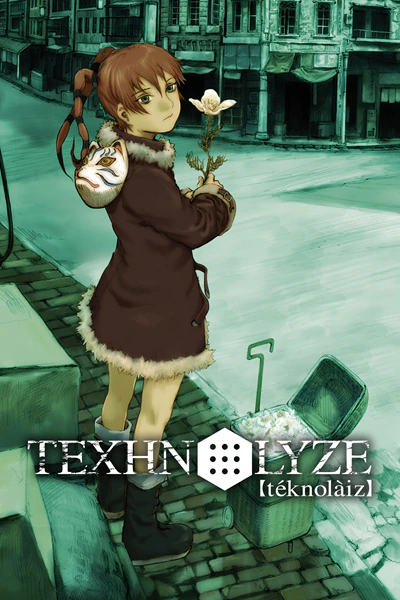
Name(s): Texhnolyze
Format: TV series (22 23-minute episodes)
Studio(s): Madhouse
NOTE: This “review” is comprised of a bunch of old off-the-cuff forum posts that have yet to be edited. There are also MAJOR SPOILERS throughout, so be warned!
I’m not feeling inspired enough to sit down for another few hours and do a formal review, so here’s a casual one I began typing last night but never completed.
I finished Texhnolyze. A great, truly unique series that was well-worth the time investment. In the event I lose my momentum and no review happens, summarily, I feel that it’s primarily an atmospheric work meant to arouse certain base sensations and not to necessarily connect to new ones. My attempt to focus so much on deciphering the storyline probably obscured that, since all plot developments end up being in service to it pushing its philosophy of nihilism and the inevitable stasis and death of the human race.
The plot itself dropped off for a bit after the midway point. Yoshi’s death impacts the show negatively, because no one really replaces the role he had as an active instigator that served as a foil to the wandering passiveness of Ichise. He added tension to scenes, while the rest of the cast were almost uniformly distant. Yoshi is succeeded with an almost time-skip feeling, as Ichise becomes an Organo member and the show gets bogged down in a lot of politics and scenes between suddenly-introduced “suit” characters who lack distinct characteristics.
The series becomes increasingly reliant on exposition dumps that convolute the plot and bring up questions about characters that aren’t really elaborated on, distracting from its themes. I felt that as the series went on it became less about setting up a mood, and more about adding more complexity to the actual story and characters, yet still not giving enough focus on character backgrounds or elaboration on the new plot reveals it brings up to really make me care about how it affects the cast.
The animation quality is above average. The character designs are great, but the actual drawings of them are the same bland digital crap I talked about in Baccano! with round, blotchy shading. It’s ten times more tolerable in this dark “lighting,” though, and that shading at least mixes well with the dark backgrounds, which are insanely detailed. There are a ton of unique frames and backgrounds that actually show true passion, and work was put into how the story was told. I think I lamented in the Escaflowne review how easy it is to find lazy anime that don’t bother with camera angles, different framings, and landscaping. Texhnolyze always does this, and it’s because of this constant visual engagement that the show’s extremely slow pacing does not actually feel slow. There’s always something in the background to be curious about and ruminate on during the dead space of no dialogue.
The rhythm of the show can be very hypnotic as well. The use of nonsequitur fade-out transitions reminds me a lot of David Lynch’s dreamlike editing. The progression between each episode’s story is intentionally offbeat, with focus on certain plot elements or characters being suddenly cut away before being given any temporary closure, then the view fades into another brief, almost entirely unrelated scene. Many transitions open in the middle of dialogue exchanges with no context, and this wandering perspective mimics the distant apathy that characterizes the city and the tone of Texhnolyze.
Probably the best thing about the show’s direction is its sound design, and how much the score carries the show. The background music can be considerably lengthy and dynamic, as opposed to most anime soundtracks that feature very short loops that only play for a traditionally-paced scene. Texhnolyze can go half-an-episode’s length without any dialogue, and the music always syncs up so perfectly to the rhythm of the editing and emotions being displayed in the plot, that it’s almost music video-esque in how deliberately choreographed it all is.
I think this about satisfies me for now. Texhnolyze is at odds with itself sometimes as a vague mood piece that gives in too much into explaining its storyline premise and character motivations while falling short of the attention required to make either perfectly sensible. I wish the latter half of the series stuck with the same “less is more” approach as the first half, because I think it gets caught between conveying base emotion and ambiguity and having to address an actual storyline, which I found less satisfying by the end.
I think if I had actually put in less effort into trying to piece together the plot it was dumping on me, I would’ve liked it more, in regards to it being a relentlessly nihilistic work that charts humanity’s eventual burning out and malaise. Its pessimism is powerfully conveyed through excellent direction. I just wish it didn’t attempt to take on a plot too big for the time and space its slow ambiance could fit.
Oh yeah, I forgot to mention how much I loved the opening. Kind of amazing how they found something that fit so perfectly. The pulsing, electronic beat that marries an organic body rhythm with something synthetic, and the occasional abrasive, metal-grinding sounds laid on top that hint at a conflict between mankind’s technology and their self-destructive nature. Beyond all that, the decision to choose an opening so fast-paced with such frenetic visuals allows the momentum of it to carry into each episode of the show, and allows the viewer to comfortably settle in with the actual slow pacing better than if each episode immediately flatlined with a slower song. I watched it almost every time.
When the second part rolled around, they started giving out the information they’d been withholding about the story. I often found things more interesting when I was inferring the possible meaning of it, rather than outright knowing. Written out, the plot of Texhnolyze isn’t particularly dense. It feels that way because of how far it’s stretched, and how slowly it’s defined. Getting the simple background stories on Lux and such in the latter-half felt lesser than what the show was teasing me to imagine beforehand.
I’m still trying to think of how to explain this shit. It’s like Texhnolyze is a mood piece that demonstrates its themes is, in my opinion, a lot better than the actual storyline underneath it all. I think the plot cheapens the mystique somewhat when it directly relates its themes to its story and characters that weren’t detailed enough throughout the show, rather than just letting the themes speak for themselves, made implicit in the series’s environment and tone.
I think you could remove a lot of exposition towards the end and your basic assumptions about what actually happened to cause Lux and what it all says about humanity would still be accurate, but I personally might’ve not been left with the feeling that the actual plot wasn’t entirely worth the effort I put into deciphering it. On a side note, the whole thing with Kano felt sort of unnecessary, and like they were forcing an antagonist for the narrative’s climax.
Leave a Reply