








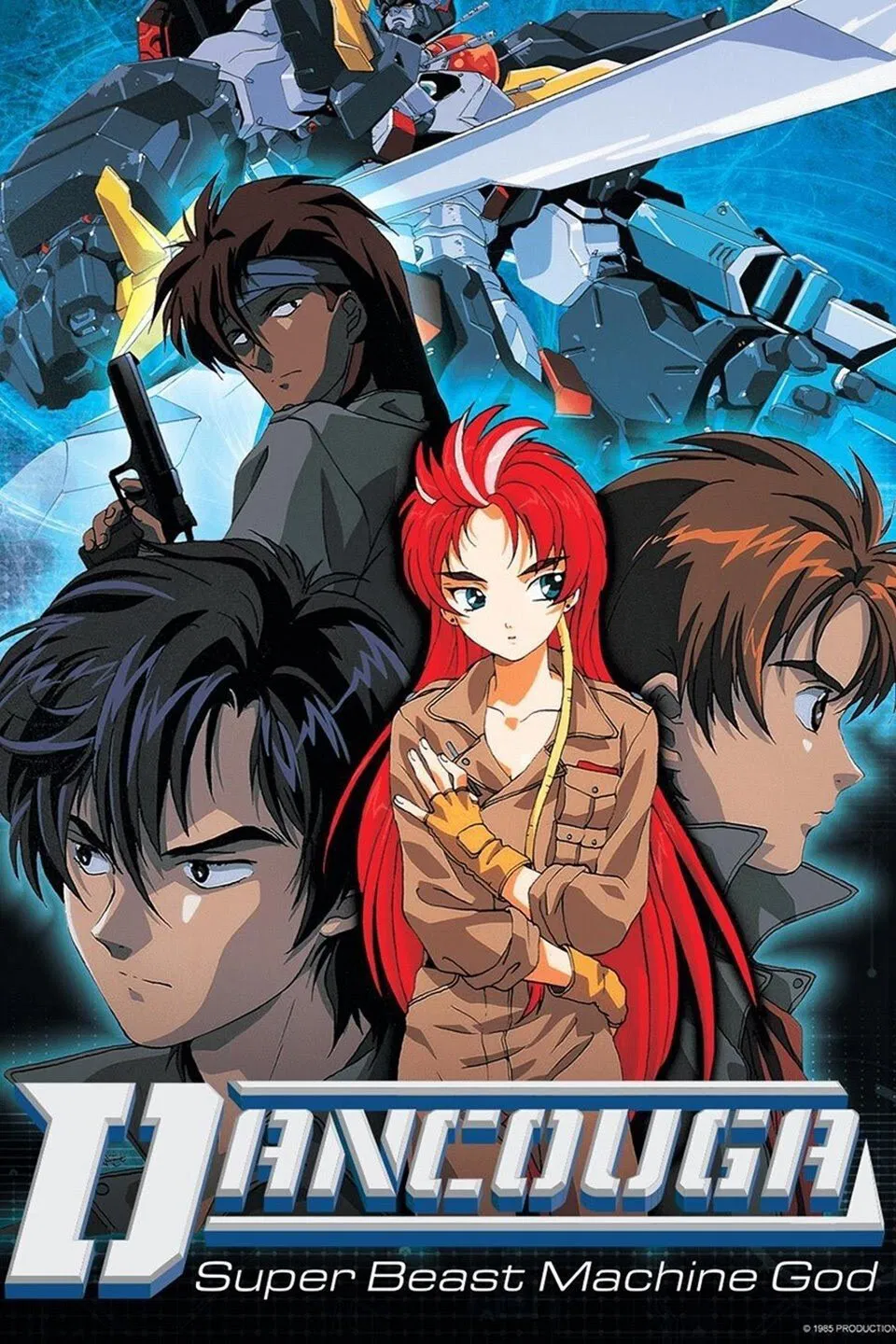
Name(s): Dancouga: Super Beast Machine God / Choujuu Kishin Dancougar
Studio(s): Ashi Productions
Published: September 5, 2014
Language: Japanese (Subbed)
Review
The mid ’80s were a volatile time for the mecha genre, but at the time some didn’t realize it. Mobile Suit Gundam ended prematurely in 1980, but it would nonetheless prove to be the kiss of death to the “super robot” (SR) subgenre, as the ratio of “real robot” (RR) anime to super robot anime would become increasingly unbalanced all the way to the present day.
Dancouga: Super Beast Machine God came out in 1985, the middle of the transitional period, and unlike many other SR shows that continued old trends, this series is a strange one that is completely of and yet away from its time. Dancouga remains an odd duck—a mecha anime that is defined by its titular super robot, yet surrounded by the influence of burgeoning real robot tropes.
When Earth finds itself suddenly attacked by an alien race known as the Zarbados its defenses prove incapable of repelling the invaders, and the majority of Earth’s forces and population are quickly wiped out. The survivors either form guerrilla groups or work with what’s left of the regular army, as it hides and rebuilds its strength. The regular army assembles a team of four soldiers known as the Cyber Beast Force (CBF), whom are chosen to pilot the army’s newest advances in weapon technology: you guessed it—the Cyber Beasts.
The series’s main character is Shinobu Fujiwara, an ace fighter pilot whose angry outbursts and confrontative attitude often draw the contempt of both subordinates and superiors. As the first CBF member, Shinobu struggles to balance his temper with being a capable leader. He is soon joined by old flight academy acquaintance, Sara Yuki, who is moderately less combative but still assertive, and much more compassionate.
The far more easygoing and playful Masato Shikibu follows. Last to join is the eldest, Ryo Shiba, who often rises to play a mentor role in the team due to being the most spiritual and calm—as well as being the only one who can smack since into Shinobu when it’s needed.
The Cyber Beast Force aren’t your typical super robot Combattler V team. These are all young adults, trained military soldiers, and individuals with their own senses of ego. Not straightforward heroes who are simply best friends, but situational allies who support each other just as much as they fight with each other (often even physically). For these reasons, Dancouga’s pilots have a true sense of humanity to them that old idealistic super robot heroes often lacked and it’s much more entertaining to follow them and watch their interactions.
Character development is sadly limited, but the banter is charming and it’s easy to root for any member of the team, as they all have likable personalities, often proving themselves capable, and no one feels like a weak link in the team. Without a doubt, the CBF are the toughest, coolest super robot team I’ve yet encountered, and their clashing personalities and dialogue are without a doubt the reason why I enjoy this show as much as I do.
Supporting cast includes the incredibly blunt and harsh General Igor, who seems like he might take the defeat of the Zarbados more seriously than the CBF’s lives, and his right-hand man Professor Kotaro Hazuki who designs the CBF’s technology and often advises during missions. There’s also Laura Sullivan, an orphaned American girl who comes to live at the regular army base after her rescue, and a mysterious Black Knight who sometimes shows up in his own mecha to save the Dancouga team—much to Shinobu’s chagrin.
Perhaps more important than any of the supporting cast is the true villain of the series, Shapiro Keats, Sara’s ex-boyfriend whose limitless ambition causes him to immediately abandon the Earth after believing them to be doomed at the superior might of the Zarbados. Though initially rejected by the Zarbados as well, Shapiro quickly earns their trust by leaking information and advice to them which allows him to rise up through the Zarbados ranks to become a commander. Shapiro sets himself up as a genuine threat to the CBF early on as his strategies outmatch other Zarbados generals and his knowledge of Earth and humans prove to be what they needed.
Shapiro’s extreme arrogance sets him up as some sort of proto-Dio Brando (JoJo’s Bizarre Adventure) and the viewer is left curious on how far he’ll take his manipulation of the Zarbados empire. He’s a good, truly evil villain, and one of the rare that satisfies the “love to hate” type. Sara (for some stupid reason) often finds herself torn between her former love of the sociopath and her duty as his new enemy. To cut things short, I’ll just say that the other members of the Zarbados army aren’t particularly interesting.
If there’s an aspect old super robot anime are notorious for, it’s the monster-of-the-week format (often just called “MotW”). This format is defined by an episodic nature where each episode would introduce a new one-off monster that would easily be dispatched at the end of the episode, only for the major villains to escape and things to go back to normal, no real progress being made on destroying the true enemy.
Regardless of whether there’s a literal new monster or not each episode, this format is used to denote any series with a lot of tasks that are inconsequential to the main goal. Though coming from a time when this was still common, Dancouga does a solid job at avoiding this with a plot that slowly progresses over the series rather than suddenly at the series finale.
While it’s still easy to come across an episode where it feels like no progress is made, these episodes are often justified through giving character backstory or focusing on a single character and helping them define their personality as well as showing that they’re a strong individual team member. The aforementioned realistic drama and character interactions also all go a long way towards keeping the series entertaining for its prematurely ended 38-episode run (probably for the best, now that we’ve got a sequel).
This odd blend of realistic drama and situations combined with supernatural super robot abilities is also the reason why Dancouga is sometimes referred to as a deconstruction of the super robot genre. While this is technically true, I doubt it was intended as such. Though, a major point of advice given to Shinobu being “battles are no longer going to be won through force but through scientific strategies” makes one wonder otherwise. Another thing is the team members confronting General Igor over being sent to take care of small problems rather than fighting the enemy directly; a reference and meta criticism to the MotW format. On top of this drama, there’s also the odd mechs themselves. Let’s get into that.
The Cyber Beasts have three forms plus their combined form, with the exception being Shinobu’s Eagle Fighter, as it doesn’t need to separate its default and beast form. The default forms are all tanks besides Shinobu’s fighter jet, and other than the fact that they fire laser bullets are completely standard military technology, hence they’re real robot mechs.
Things get iffier when they transform into their beast mode, each one representing an Eagle, Cougar, Liger, and Mammoth. These forms and beyond are powered by the pilot’s anger (another super robot trait: gaining power through emotions) and move like the animals they’re named after and even bite and rend enemies with their fangs and claws. Later, the team gains humanoid transformations, going back to real robots.
Breaking another super robot anime convention, the team doesn’t gain the ability to combine into Dancouga itself until about a third of the way into the series, allowing some build up to this major event you know will inevitably come. This immensely strong combined form makes it more traditionally super robot, but it still uses primarily ammo-based weaponry, melee attacks, and is dependent on an energy source.
On top of all this, the mechs are predominantly colored black and grey, standard military colors instead of a more elaborate cartoonish color scheme. This gives the Dancouga a more modern, sleeker look when compared to combining mechs before it. With many themes of the show being inspired by Taoism, the mechs also follow a subtle evolution motif, going from machine (weapon), to animal, to human, to God.
Music
If the big poofy haircuts and flashing lights during transformation sequences didn’t tip you off, then the heavily synthesized soundtrack will remind you that this is an ’80s anime. One Osamu Totsuka apparently did the music, and considering the series’ troublesome budget, he almost certainly wasn’t paid enough. The Dancouga series is regarded as having some of the best music from any mecha series.
Dancouga‘s theme songs “Burning Love” and “Ai yo Far Away,” as well as “Burning Rage” are possibly more well-known than the series’s actual storyline. Thanks to Super Robot Wars, they’re popular among people who’ve never even watched the series. Despite the synthesizers, there are plenty of organic instruments and electric guitars for variety, and there’s many highlights among the background tracks in addition to the vocal songs.
Now, being an old super robot anime, you can still be certain that Dancouga bears the scars of its era. For starters, the budget is absolutely horrible, leading to several nearly unbelievably hilarious moments in trash animation and constant stock footage. Though pretty much just a big detriment, these animation flubs can oftentimes make scenes a lot more charming and entertaining than they would’ve been otherwise, but that’s the only good thing to say here (well, the art itself is.. decent).
Secondly, too much of an episode’s time is often caught up in transformation and battle (again, often stock) footage, sometimes even showing aliens and regular grunts fighting for several minutes when we have no reason to give a damn about these faceless battles. Finally, though a step away from an episodic nature, story developments still happen slowly and many episodes primarily revolve around boring new characters who are quickly forgot about forever once the episode is over. Like I said before, it’s probably a good thing the series was forced to end early and put the important events on fast-forward. There’s no reason to complain, now that the series has been concluded in sequels.
Verdict
I’ve been singing a lot of Dancouga‘s praises because I completely love the team, mech, music, and would not hesitate to slap the “underrated” moniker on it, but it’s still a flawed show that could’ve done more with the great ideas I mentioned. It’s not something I would recommend to someone who’s not already a fan of old super robot anime, but it’s still a fairly unique show in an often stagnant genre which alone deserves respect, and it could make a solid entry point into old super robot anime.
In a way, Dancouga shows us an alternate future of the super robot genre, where it met halfway with the real robot drama that killed it, instead of modern super robot shows that simply take the old tropes and turn the dial up on them. My love for the Dancouga team got me through the series’s many troughs, so your mileage may vary. Anyone interested in the range and history of the super robot genre ought to get something out of this underrated classic.
Leave a Reply