




Sword Story
Name(s): Sword Story / Katanagatari / 刀語
Format: TV series (12 49-minute episodes)
Release Date(s): January 26, 2010 – December 11, 2010
Studio(s): White Fox
This review contains major SPOILERS.
Sword Story Review
I was going to move right onto my next anime, because I’m pretty excited to start something new. I still haven’t decided on what to watch next, however, so I’ll fill my last waking hour with this off-the-cuff review. If I take it more seriously, I might intimidate myself into not finishing it and/or writing nothing. This is the first thing I’ve seen by this author.
I was originally drawn to it by its short length and dashing art style, only to take a huge crank when I realized after downloading that each episode was an hour long. I don’t believe I’ve ever seen a TV-syndicated anime with such long episodes. It ended up taking longer to finish than I thought, as it was technically the longest anime runtime I’d completed in quite a while. Also, due to the pacing, each episode became an investment rather than the type of show that’s easily watched in a marathon. I had to get myself into the mindset to watch a movie, more or less.
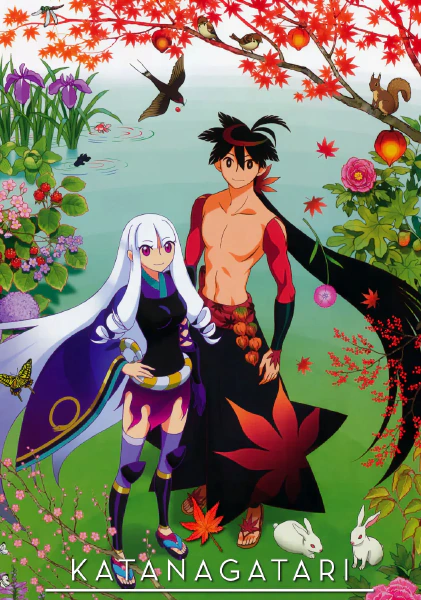
One thing that instantly pleased me was this was closer to the kind of tone I was hoping Samurai Champloo would be. It’s still a samurai story in a way, though obviously it’s a mythological portrayal of Japan rather than anything even romantically plausible. I have no problem with that. I think I’ve cited Rurouni Kenshin as a good samurai show, even though it’s also about superpowered people. The art style reminds me of Takehito Harada, one of my favorite anime style artists. This is a funny coincidence, as Harada typically works on Nippon Ichi Systems (NIS) games, and Katanagatari was published by their American branch, who otherwise just do typical-looking slice of life shows. That’s too bad.
On the other hand, I felt relief at its similarities. NIS went downhill hard after the PS2 generation. I’ve beaten all those games, so I had a void left that Katanagatari did a decent job at filling. Even the writing wasn’t far off from an NIS game. Going back to Harada, the character designs in Katanagatari are bright and colorful with sharp, geometric features. The outfits are particularly elaborate.
Shichika has the best design in the show, a clear motif that isn’t distracting enough to look unnatural. I’m talking about the way his hair falls and is colored like a brown leaf, and this pattern is replicated on his outfit. His eyes are shaped like insects, and all of this imagery is directly linked to nature, conjuring up his natural lifestyle and wild-child upbringing.
Not every design is as elegant as his, though. The animal-themed Maniwa Corps are kind of lame. Theming characters around animals is one of the most passe character design concepts. Even when they had the opportunity to make the animal traits in their outfits subtle, they went the opposite direction and slapped on duck bills and penguin costumes that look like what lower-middle class parents would dress their baby in upload pictures of it to Facebook.
This leads me into my main criticism, which is that Katanagatari is a series chockfull of inconsistencies. Some of this is a part of its character, such as some anachronisms and mythological fantasies. Other parts don’t inspire good faith from me and just seem poorly thought out. Take Togami, for example. At her core is a cold, calculating woman plotting revenge against the shogunate. Her affection for Shichika’s innocence brings out a conflict with her more empathetic, vulnerable half.
Fair enough, but the show can dip into stupid shtick to express this trait, cheapening her as a character and the dramatic authenticity of the surrounding plot. I heavily dislike the part of her that’s played as a typical tsundere. That only becomes worse as the anime drags. Especially after she’s already put her feelings out in the open, yet continually denies them for the sake of tired punchlines complete with stock squeals and wacky emoticons. An equally-tiring part of her eccentric nature is her “cheerio” interjections inserted to make her cute.
I almost universally hate running gags, so I didn’t find these things any funnier the twentieth time they happened. Most anachronistic dialogue in the show comes from her, and she has a tendency to disrupt the anime’s serene tone with her quirky “comedy” that gives into the vices of modern anime tropes. There’s a ton of frames emphasizing her ass, which is further evidence to make me think they’re exploiting her traits to the detriment of the show’s cohesion.
On a conceptual level, there’s a good character that foils well with Shichika, but I found the attempts at humor with her weak and not worth ruining the show’s flow over. If they wanted to demonstrate her internal conflict, I think they could’ve and should’ve found much more dignified ways to do so that don’t betray the maturity in her that’s called forth whenever the plot needs to progress. The humor of Katanagatari completely falling flat for me makes me think I’m safe if I choose to skip watching Bakemonogatari. Like, I can’t see bringing up the “cheerio” thing—something used only as a joke—during Togami’s death to be anything other than tone-deaf writing.
I also went into this show hearing it was very dialogue-heavy. This is true, but not always in a good way. If characters are going to talk a lot, then naturally, they should have a lot worth saying. Most of the time, Katanagatari fills its space well, but there’s a ton of typical, bad anime exposition and overstating what its characters are doing, what is happening, and what needs to be done that really does not need to exist.
I found myself wondering if this redundant jabbering was done to help each episode hit the 50-minute runtime. It makes me think the show might’ve benefited were it in an OVA format where each episode could’ve been only as long as it needed to be. Even if they needed to fill space, I would rather redundant exposition be cut out in favor of silent ambiance or landscape shots. After all, the show is capable of having great atmosphere when aided by its high quality art and soundtrack. As it is now, there’s an exhausting amount of recapping.
This is a good lead-in to talk about the plot itself. I enjoyed it, but didn’t find much profundity. Maybe some metaphors were lost in translation, but I have enough respect for myself to feel confident that a lot of the psychological musings were often obfuscating simplistic morality that the script could’ve been less pretentious with. Again, it could be a translation issue, but some of the script’s phrasing made about as much sense as a Tomino Gundam script.
Towards the end, the plot got so insane that I actually liked it more. It’s like it abandoned some intellectual pretense that otherwise only baffled me. Shichika was the most enjoyable part of the show. His discovery of humanity and demonstrated lack of it early on were handled extremely well. Shichika is antisocial and completely unaware of any nonpragmatic customs, but there’s enough subtlety in his distanced behaviors to not draw constant attention to how odd he is. His progression into a more emotional person is perfectly paced and gradual. He doesn’t instantly change after milestones, like I’ve seen a lot of lesser anime do. He’s constantly crawling, bit by bit, and it’s always observable.
The individual, episodic stories were full of ups and downs. Sometimes, I was completely engaged. Other times, I was groaning internally. It isn’t even a by-episode basis; it could fluctuate over one minute. The ninth episode was probably my least favorite. Everything was close to wrapping up, then more than half of it was standard ecchi jealous, romantic comedy that we’ve already been exposed to at this point—even in more-edible doses. The climactic fight is the weakest yet, as Togami simply names shogi moves until the opponent is so distracted that she just loses by default. It’s almost laughable somehow, even in an anime containing ninjas with animalistic superpowers.
The structure of constant dialogue until a fight ten minutes before the episode ends can get exhausting. The fights themselves are usually uncomplicated, not having much movement and being decided in single attacks like a bad shonen anime. This is unfortunate, because it’s underutilizing the show’s high production values, but they’re probably just following the source material. Still, since the episode structure spends so much time foreshadowing and building to a climactic conflict, it can sometimes burn out too quickly and be spread too thin. Still, because the anime is well-directed, the fights always have great dramatic tension, reliably inspiring some excitement.
Sword Story Verdict
I’m running out of things to say. I think Katanagatari is wildly inconsistent in any non-visual area. Even then, I wish it kept the ink-painting style it used in episode seven before dropping it. Its writing can be really good, then suddenly very dumb or cringeworthy. The fights can be intense, or they can be extremely simple. It’s all over the place. It ends up being good overall, because it’s something made with extreme passion and ambition. They didn’t necessarily know where was best for it to go, but it knew it had to go somewhere new and impressionable. It succeeds because that drive shows.
Leave a Reply