




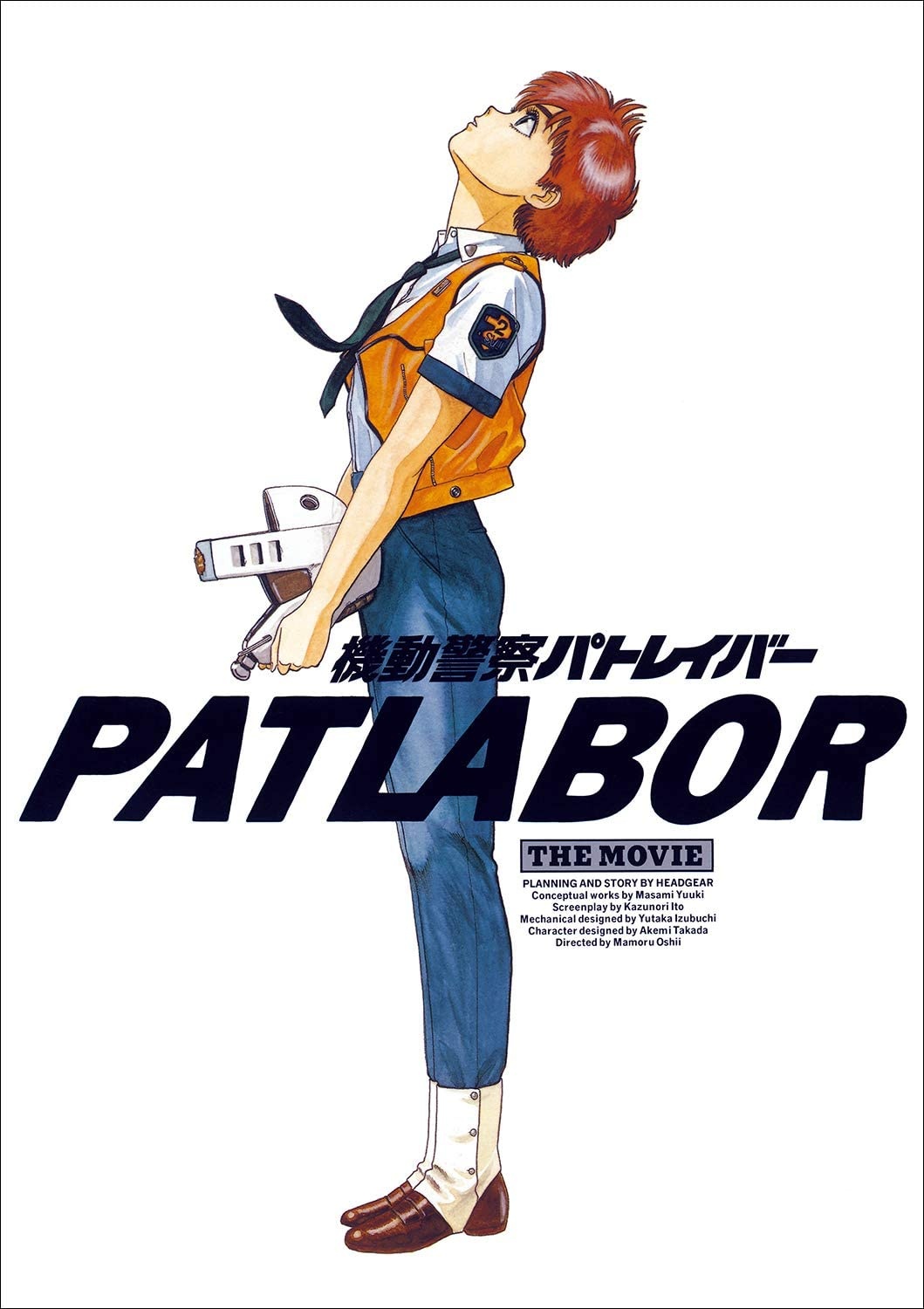
Mobile Police Patlabor: The Movie
Name(s): Mobile Police Patlabor: The Movie / Kidou Keisatsu Patlabor the Movie.
Format: Movie (98 minutes).
Release Date(s): July 15, 1989.
Studio(s): Production I.G / Studio Deen.
Related: Mobile Police Patlabor (1988–1989) / Mobile Police Patlabor 2: The Movie (1993).
Mobile Police Patlabor: The Movie Review
A month after the Mobile Police Patlabor: Early Days OVA ended, the staff delivered their coup de grace with this 100-minute movie. If you haven’t read my Early Days review, then I recommend that you do. This will reference it due to the fact it’s chronologically a sequel. This movie has the same members of Tokyo Mobile Police Force Section 2 combating their largest scale threat yet.
A new operating system installed on Labor units across Japan is causing machines to mysteriously go berserk. The programmer behind the OS is unavailable for interrogation on account of suicide. Section 2 begins a seemingly hopeless investigation into the mystery behind programmer Eiichi Hoba and his cutting-edge operating system. If the crew can’t prove political foul play, then Japan is at risk for an economy-destroying level of chaos.
Writing Style
Mobile Police Patlabor: The Movie is considerably more serious in tone than most of the Early Days OVA. It’s most comparable to episodes four and five, the epic two-parter that likewise got away from the more comedy-focused adventures of the series. It’s thankfully not a jarring shift. Although Section 2 finds themselves on a much bigger case, their core personalities haven’t changed. The focus is shifted to Asuma Shinohara this time around. Shinohara’s taken special interest in the case due to the impact the scandal could have on his father’s company.
Most of the movie is an investigation procedural. It’s surprisingly engaging considering how increasingly elaborate the mysterious plot turns out to be. There’s a good amount of political maneuvering that’s relayed by commander Kiichi Gotou. Careful consideration is given for the bureaucratic implications of Section 2’s movements, helping the audience buy into the story’s plausibility. Lazier writers could have hand-waved all of this complication.
Themes and Worldbuilding
This movie feels like a natural continuation of the themes the OVA hinted at over its run. It started as an episodic comedy about an under-achieving police force, but in their exploits the audience uncovers what’s actually a dystopian future rife with political corruption, environmental destruction, and terrorism. The naïve members of Section 2 hold on to their optimism by being mostly unawares of how this degradation gradually slipped under the noses, similar to real generalized society, and Gotou is the perpetual link to a more realistic albeit depressing perspective.
Another layer to Patlabor’s world is uncovered through the advancing of the Babylon Project. In the OVA, this was introduced as a construction project to build a wall to deal with rising sea levels. Here, it’s broadened its scope into creating artificial islands in order to confront shrinking land mass. I won’t spoil the plot, but the antagonist is the most interesting yet. We get a feel for how a world like Patlabor’s actually impacts the individual rather than broad civilization. There’s an anti-industrialization sentiment at the movie’s core. It seems to be commentating on contemporary Japan’s industrialization movement cutting into long-held traditions of sentimentality and individuality. Mamoru Oshii’s consistent theming on humans becoming insignificant cogs of the state tie the movie into his oeuvre.
Audio
Making big strides towards the quality his reputation demands, Kenji Kawai’s music is noticeably better here than in Early Days. There’s much of the same synthesizer and electric guitar combination that’s definitive of ’80s anime, but it all just sounds smoother than it ever did before and Kawai’s guitar riffs in particular are far more memorable and create appropriately powerful theme music. There’s more use of natural instruments this time around to suit the atmospheric ambiance of the investigation scenes, woodwinds in particular. A lot of the pulsing synthesizer work sounds similar to that of the original Terminator or a John Carpenter movie. The quality, variety, and synchronization of the music to the movie’s scenes has all greatly improved from Early Days.
Production Values
The production values are also suitably higher and certainly worthy of this larger production. The OVA was already impressive, so this is no small feat. There’s a scene in the middle somewhere where Asuma is looking up at the camera through a distorting fish-eye lens as a threatening message in red text flashes on his face repeatedly. I swear the same shot appears about a dozen times in Neon Genesis Evangelion.
Direction
For the most part, the direction doesn’t hyperbolize reality too much in order to portray its story realistically. It’s still consummate, with care given to frame composition so that you aren’t staring at the same cels for too long. There are exceptions to this, though. In certain parts, the camera hangs far too long on a completely still, single frame. It can look pretty awkward when one character spends twenty seconds talking and revealing important information and five other faces on screen never change their facial expression in the middle. Just odd tidbits like that. Otherwise, this is a very worthy and well-edited movie.
Mobile Police Patlabor: The Movie Verdict
Patlabor: The Movie is well worth watching for fans, but it falls short of excellence. The investigation buries the movie’s themes. They’re barren enough to the point they go past subtlety, underselling their weight and importance. The finale, which is otherwise extremely strong and the highlight of the movie, ends on a climax of plot resolution rather than addressing the themes the movie’s proposed. It’s too subtextual to be as profound as it could be, with the most relevant conversation taking place somewhere in the middle of the movie. With the themes pushed aside, you have a high-quality Patlabor plot that doesn’t become much greater than itself.
I completely recommend watching the Early Days OVA first, as it’s not only first chronologically but it introduces the entire cast which doesn’t get as much focus during the movie. Patlabor is mainly enjoyable due to its likable cast of bums, and the implicit knowledge behind characters who aren’t featured as much this time around makes it much more possible to root for Section 2’s success as a whole. Furthermore, there’s an actual thematic progression from the themes of the OVA to the movie’s. Watching the movies first would be a mistake, but in the end this first movie delivers on an impressive quality worthy of the OVA. One can argue, however, that it loses a bit of Patlabor’s character by getting away from the comedic malaise.
Leave a Reply