








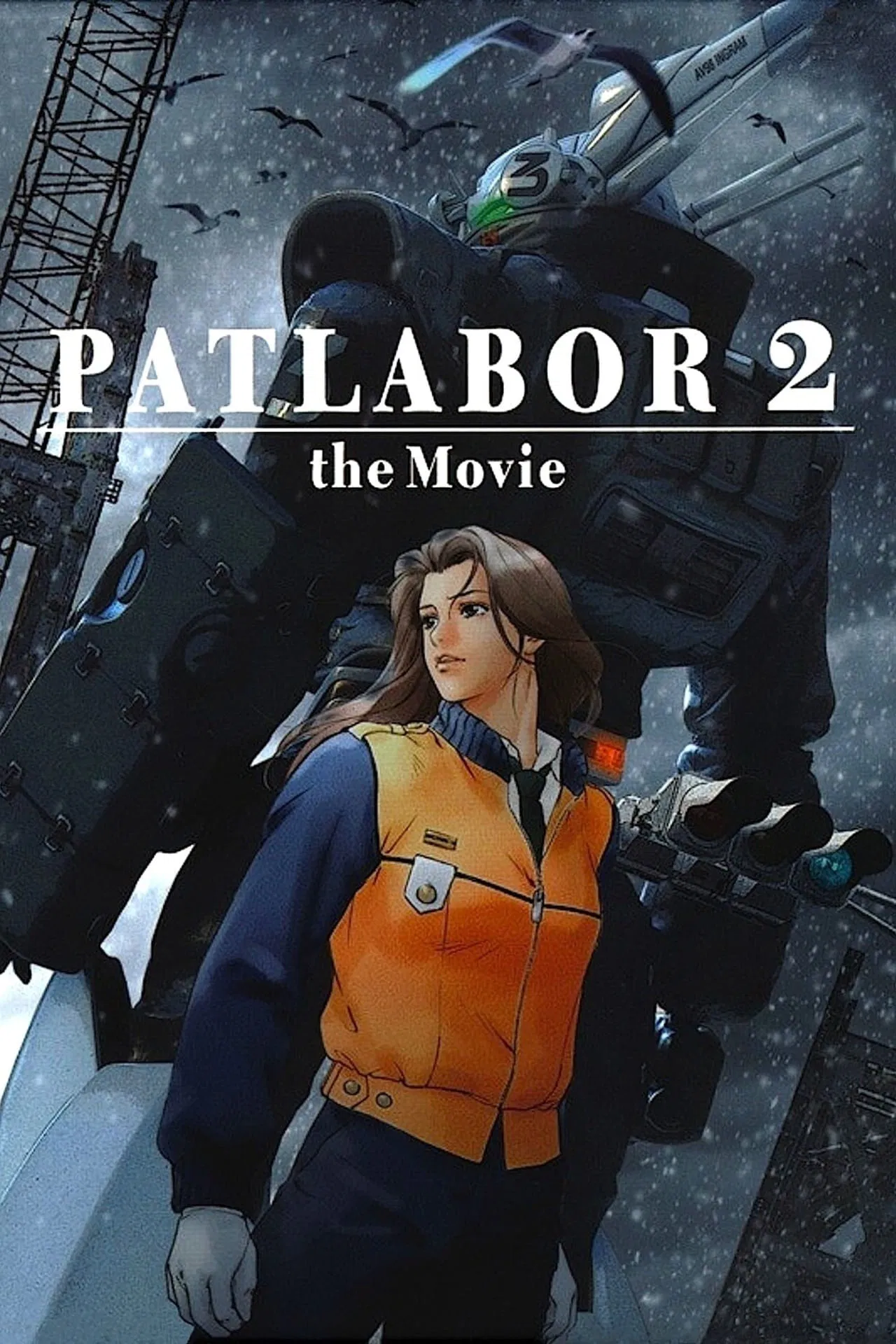
Name(s): Mobile Police Patlabor 2: The Movie / Kidou Keisatsu Patlabor 2 the Movie / Patlabor 2: The Movie / 機動警察パトレイバー2 the Movie / Patlabor 2: Der Film / Patlabor 2: La Película / Patlabor 2: Le Film
Format: Movie
Studio(s): Production I.G
Related: Mobile Police Patlabor (1988-1989) / Mobile Police Patlabor: The Movie (1989)
From the moment I learned about the Patlabor franchise, all of my watching it was for the purpose of reaching this movie. It’s widely regarded as the peak of Patlabor and one of Mamoru Oshii‘s greatest films. Being a major landmark in anime movies, the mecha genre, and allegedly one of Oshii’s best political thrillers made it an essential point for several reasons. Oddly, approaching this movie chronologically almost makes it seem out of place. The Patlabor: Early Days OVA was a character-driven mix of comedic slice-of-life police adventures with a dystopian undercurrent.
In my review for the first Patlabor movie, I noted how it went in a logical direction by continuing the more serious tone reached by the end of the OVA. I also expressed some disappointment how large the stride was, with the cast largely being pushed to the background to stage pure expository plot and that I thought it was getting away from the things that made Patlabor stand out. It doesn’t necessarily benefit it to become a convoluted political procedural, but Patlabor 2 brings it in that direction even further. Literally for both better and worse.
A significant improvement of Patlabor 2 over its predecessor is that while it remains a dense political drama it pushes its thematic weight to the forefront and deals with more ambiguous and more personal themes than the first movie’s which were quite buried (fairly acceptably, since it fell into the set-up of that dark underbelly mentioned in the OVA).
The most difficult aspect of Patlabor 2 is that personal business: it’s a movie made by Japan, specifically about Japan, and is understandably not too concerned with bridging the viewer’s understanding of the deepest mechanisms of contemporary Japan’s political status. Allusions are made in passing to previous real-life Japanese political turmoil in comparison with the movie’s events with the assumption that the meaning is all implicit. Heaps of expository dialogue are thrown at the viewer and are always outpacing itself, rapidly establishing the political context of the movie’s situation without spending the time to explain it because the setting wasn’t built up to a suitable extent by previous Patlabor works in order to house the movie’s plot and statements.
This leads into what feels so odd about Patlabor 2 when having come to it chronologically. It feels exactly like Mamoru Oshii, or perhaps the writers, wanted to make a political story expressing their thoughts on Japan and used Patlabor as a vehicle. It being an existing franchise presumably made it easier to get financial backers and talent on board. What made Patlabor “Patlabor” is pushed to the backdrop for these philosophical diatribes. The comedy is almost completely gone, the mecha barely used, and the previous cast is nearly nonexistent as the movie is forced to revolve around Gotou and Nagumo, the most serious characters.
After attachment has been built up for the others, it’s disappointing that they’re only forcibly brought to the head at the movie’s climax as some sort of quota but without closure. The climax of the movie is also the only place it truly becomes action-oriented, and I’d never begrudge the movie for wanting to focus more on drama, so I only bring up this up for the fact that the previous movie had a similar structure but its final set-piece was much larger in scope and with a more complex strategy dictating the events.
Patlabor 2 is centered around civil unrest that begins when a bridge bombing sets up suspicion among Japan’s numerous political bureaucracies. The country enters a cold war-like state with the police, ground forces, and air force all biding their time waiting for one branch to slip up so they can wrestle more political control out of the situation. This scheme is masterminded by Nagumo’s former captain and ex-lover, who was previously unmentioned. This brings the opportunity to develop the implied romantic tension between her and Gotou, but although they are the most prominently featured characters in the movie no development is made on this front despite the movie concluding this Patlabor timeline.
This demonstration seems to be done to criticize Japan’s distancing from global conflict for the sake of peace while simultaneously assisting said conflict by still trying to profit from it under the table economically and by allying themselves with those fighting the actual wars. This brings up the topic of a just war and unjust peace, with the idea that Japan has avoided war to be an illusion. It’s an interesting idea that bodes a lot of ambiguity about how to ethically handle Japan’s new position on the worldwide political spectrum, and it’s a theme that has increasing relevance for countries across the globe as indirect involvement in war keeps the public distanced and satisfied while the country still profits. It’s a tenuous peace at best with no true allies but with moral grandstanding.
The least surprising thing about Patlabor 2 is Mamoru Oshii’s direction. My favorite thing about the movie was its cinematography, with numerous shots of the cold, grey cities of Japan stuck in an empty stasis. Backgrounds are densely detailed with a nearly endless trading off of packed stills of zoomed out cityscapes. This glacially austere tone is assisted by Kenji Kawai’s icy electronic, new age score that glides by and only briefly shows signs of life with cooed vocals.
Strong background stills are this movie’s aesthetic backbone and it’s light on movement overall, but I recall liking several shots. One is how a sniper is concerned about shooting down birds that obstruct his target, but then is ordered to fire anyway and shoots them down, symbolic of how Tsuge is risking the public’s safety by luring them out of their illusion. The handcuff scene towards the end where Nagumo caresses Tsuge’s hand before cuffing it is a great trade-off between her attachment to her job’s responsibility replacing her attachment to the past.
When all’s said and done, Patlabor 2 is one of Oshii’s most literary works. The emphasis on its political drama and themes pushes the individual stories to the background which makes the former more of a success than say the unbalanced Jin-Roh, but it bears the unfortunate decision of attaching itself to the Patlabor name without really earning it. It’s an extremely wordy demonstrative political drama, a political thriller without much in the way of thrills because of its sterile handling of the human emotions underneath it.
Patlabor 2 is, in one sense, the most interesting part of the Patlabor franchise for its thematic diversity, and yet another sense it’s the least interesting by being the most ordinary and straightforward. There was nothing quite like Patlabor among its genre, yet Patlabor 2 feels like a straight-shooting political statement with the framework of something that had more personality. If Japan’s political issues don’t hold much relevance to you, this movie’s implied emotional undercurrent gained by association will barely expose itself.
Leave a Reply