








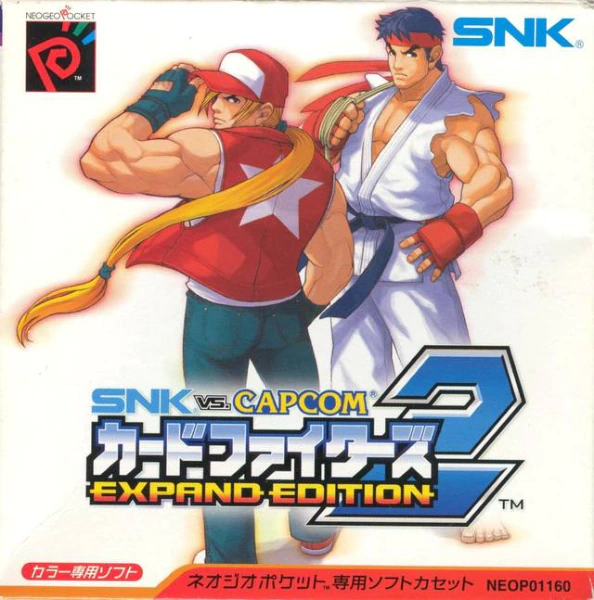
An all-purpose guide for SNK vs Capcom: Card Fighters 2 Expand Edition (CF2). You can check out my guide for the first game here. The first two games are very similar, and pretty much all of my advice for the first game applies to this as well. I’d recommend reading the first game’s guide, because I won’t be repeating information to save space. If there are notable differences, I’ll mention them as I go.
Want me to cover anything not currently in the guide? Please leave a comment at the bottom of the page!
Mechanical / Meta Changes From Card Fighters’ Clash
Card Fighters 2 is very similar to the first game, just with more cards and some adjustments to returning cards. All game rules remain the same, but there are emergent metagame changes that impact the general flow of matches.
Reaction Cards
Before getting into the metagame, the sole mechanical update to CF2 is the addition of a new card type: Reaction (RE) cards. RE cards can only be activated from the player’s hand when their opponent declares an attack. Any number of RE cards can be activated in one battle phase so long as their cost and conditions can be met. Their sudden and secretive playstyle makes them somewhat similar to Trap cards in Yu-Gi-Oh! I suspect RE cards were added to mitigate first-turn advantage and the prevalence of high-BP characters (CHA) that can quickly end games with overwhelming Unite attacks. Segue…
Meta Impacts
- High-BP CHAs have been nerfed across the board. Virtually every card with at least 1000 BP has a theoretical drawback attached to it. Krauser/Wild Zangief return from Clash with the same absurd statlines, but they both require KOing an ally CHA (if any) upon being played, making it more difficult to overwhelm the other player. This doesn’t mean high-BP cards are bad, just that it’s not quite as mindless to stuff them into any deck.
- Ring columns are now mechanically relevant. Several Abilities reference the opponent’s card in the same column. This means that cards you want to protect should be placed in a column already occupied by an enemy CHA. You’ll notice the AI using this same strategy when they’re going second; they’ll always place their first CHA in the same column as yours. Likewise, you want to encourage your opponent to place CHAs in empty columns just in case you have the chance to use a column-based Ability.
Card Analysis
Many returning cards from Card Fighters’ Clash have completely identical attributes, and I won’t be covering those in this guide. Instead, check out my guide for the first game. Many meta-viable cards in Clash are still just as good here, like Andy and Sougetsu.
Character (CHA) Cards
AKARI (S)
600 BP
SP +3
SNK
The Last Blade
Ability:
Upon activation, select any CHA in the Ring; their BP is either raised or lowered by 300. This is completely random.
It’s almost heartwarming how mediocre this card is. Fine BP, fine SP, and a utility effect that will more often than not go unused. As far as I know, the effect is a straight 50/50 chance, which means it’s a net negative overall. You have to spend a CHA summon, wait a turn, and expend Akari (S)’s action by using her Ability. If you get a bad outcome, you create up to a 300 BP difference between your field and the opponent’s, and you can’t even attack with Akari (S) in an immediate attempt to close the gap. Don’t take on all that risk; just use Akari (S) as a beat-stick.
B. JENET
300 BP
SP +1
SNK
Garou: Mark of the Wolves
Ability:
Upon play, search your deck for a CHA with 300 or less BP and add it to your hand. Shuffle your deck.
B. Jenet is best thought of as a Galford capable of searching some specific cards at the expense of generating one less SP. There are plenty of worthwhile cards within her search range, but their Abilities are often situational, so B. Jenet isn’t necessarily optimal for every deck. Her stats are too low to justify using her only for resource generation and field presence along the lines of M. Bison and Q. Bee. Regardless, like Galford, she is an excellent generic card before one acquires enough high-value cards to fill an entire deck.
It’s worth noting that B. Jenet has a mutual Back-Up with Tron Bonne, a meta-viable card, thus raising B. Jenet’s own stock. Beyond that, B. Jenet may be best utilized in a deck centered around low-BP CHAs, which has become a functional strategy in Expand Edition.
CAMMY (A)
600 BP
SP +3
Capcom
Street Fighter Alpha
Ability:
Upon play, look at opponent’s hand and place one card on either the top or bottom of their deck.
Cammy (A) has received an enormous buff from Card Fighters’ Clash, justifying her graduation to an S-rarity card. Her Ability is essentially Andy’s on steroids. Though she has 200 less BP, she can both reveal the opponent’s hand and choose exactly what she wants to discard. With her 3 SP generation, following this up with a Stifler can be devastating.
Effects that reduce the opponent’s number of cards are exceptionally powerful, and it’s rarely a bad idea to capitalize on as many of them as possible. For Cammy (A), although you can’t be certain your opponent’s next drawn card isn’t equal or superior to what you moved, they’ll still have one less card in their hand than they would’ve had otherwise, draining their resources. Cammy (A) is a strong card in any possible deck.
GILL
700 BP
SP +4
Capcom
Street Fighter
Ability:
Upon activation, discard an AC card to KO one CHA that has no Ability.
Bit of a weird one. That Ability may read as versatile, but Abilities are everywhere in Expand Edition. Even highest-BP CHAs tend to have Abilities with drawbacks on them, preventing Gill from working when you’d want him most. Past a point—usually correlated with rising BP values—CHAs almost always have an Ability. Gill is a card best played for his decent stats, with his Ability just being gravy. Also, as you acquire better AC cards, the cost becomes harder to justify. I should note that you can synergize Gill with effects that remove Abilities, as that makes them vulnerable to his Ability, but that gimmicky strategy is more trouble than it’s worth.
GRIFFON MASK
600 BP
SP +2
SNK
Garou: Mark of the Wolves
Ability:
Upon play, all Ring CHAs with the current lowest BP have their BP raised to 600. This counts Griffon Mask, so it’s only possible to change BPs under 600. If multiple CHAs share the lowest BP at the time, all of them have their BP raised.
What a fascinating Ability. Griffon Mask has the potential to boost two of your weakest cards to a respectable 600 BP, and with proper timing, this is almost like playing three 600 BP CHAs at once. That combined value nearly reaches the default player HP values, so it’s entirely possible to quickly overwhelm the opponent.
Having a Griffon Mask in hand completely changes how one should be playing their cards. It becomes important to maintain BP values via summoned CHAs and counterattacks so that your CHAs have matching, preferably minimal BP while ensuring your opponent’s CHAs remain out of range of Griffon Mask’s effect. Griffon Mask’s +2 SP is mediocre, but it can provide enough to immediately go into a 1200 BP Unite attack with your other two characters. Also, Griffon Mask can be used to simply increase the longevity of CHAs with beneficial square and circle Abilities.
Griffon Mask is an excellent card that opens up many new strategies, particularly those centered around CHAs with strong Abilities but low endurance. Even without them, he extends the value of weakened beat-sticks. This card should be heavily considered in any deck. In PvP, players should try and keep their lowest BPs equal to their opponent’s in order to prevent them from getting the maximum value out of a potential Griffon Mask.
RAIDEN
800 BP
SP +4
SNK
Fatal Fury
Ability:
While active, either player draws one card when giving one of their CHAs Back-Up.
Another fairly well-balanced utility card. 800 BP/+4 SP is a very respectable statline, and Raiden’s Ability is nothing to scoff at either. While it’s tempting to salivate at anything that says “draw cards,” the practicality of Raiden’s Ability is hindered somewhat by Raiden himself. His only Back-Ups are Ramon and Zangief, neither of whom are worth playing in an optimal deck. This means you’ll often need a combination of three specific cards at any point to trigger Raiden’s Ability (as opposed to two), and two of those cards have to be played on separate turns.
That’s kind of a tall order, and your opponent has the potential to benefit from this Ability during or after you’ve set everything up. I think Raiden is best played for his stats and that his Ability should be seen as a nice extra if it ever comes up. What really stings is that Raiden can Back-Up Griffin Mask, an excellent card, but Griffin Mask can’t Back-Up Raiden to trigger his Ability (unless you have two Raidens at once). If you don’t have consistent access to Back-Ups, you may want to avoid using Raiden just to eliminate the possibility of your opponent using his Ability against you.
ROCK (M)
700 BP
SP +0
Capcom
Mega Man Legends
Ability:
Upon activation, KOs Rock (M) and inflicts 300 damage to every CHA in the Ring, including allies. This can KO.
For an S-rarity card, Rock (M) is shockingly bad. It stings all the more knowing that he’s the premiere Mega Man Legends representative. But he’s just… nonsensical on every level. His stats are low for his rarity, with the 0 SP being extremely unjustified. You ideally want him to be as close to 0 BP as possible before using his Ability, and 700 means you’ll probably get to KO one CHA at most before he self-destructs. And, of course, he damages your own CHAs too.
The final nail in the coffin is that Rock (M) is just a worse version of K’. One wonders what the game designers’ rationale was. Perhaps they simply didn’t make the connection. K’ is lower-rarity, gives 3 SP, and his Ability activates instantly and causes no harm to himself. Rock (M)’s Ability being manual has no practical benefit; it’s just slower and costs you at least one CHA. I really don’t understand this card.
ROLL (M)
500 BP
SP +3
Capcom
Mega Man Legends
Ability:
Upon play, add one RE card in your discard pile to your hand.
It’s exceptionally rare to find a triangle Ability that adds something from your discard pile to your hand. In fact, I’m struggling to think of another CHA that does so, putting Roll (M) at a premium. She’s an immediate gain in card economy, and her average stats are actually above what I’d normally expect for this kind of utility.
Roll (M)’s real drawback is that she’s limited to RE cards, which have dubious meta relevance. For deck strategies dependent on REs, she’s obviously helpful, but I don’t yet know how good such strategies are. In a broader context, she can recover something generically useful like Overheat.
SAMANOSUKE
300 BP
SP +2
Capcom
Onimusha
Ability:
Upon play, reveal your hand and increase Samanosuke’s BP by 300 for every CHA with 300 or less BP.
This defender of the commonfolk gains strength from protecting the weak. Samanosuke’s BP can skyrocket quickly; hypothetically, he can have 1500 BP on the first turn. There are plenty of good cards with 300 BP, and Samanosuke is perhaps best in a dedicated low-BP deck. Cards like B. Jenet can fill out your hand in preparation for Samanosuke (or search him out). It’s too bad his SP generation doesn’t escalate in the same way.
SHIKI (S)
300 BP
SP +3
SNK
Samurai Shodown
Ability:
Upon play, all Ring CHAs currently at 300 or less BP have their BP raised by 300. This also applies to Shiki (S), making her effectively a 600 BP CHA (provided nothing nullifies her Ability).
Shiki receives a new card in Expand Edition, and it’s possibly her strongest showing yet. This is one of many new effects aimed at supporting low-BP CHAs, but it works for any battle-weary CHA. Shiki (S) is essentially a weaker Griffon Mask, only able to set BPs to a maximum of 600 rather than having that value be the default. Regardless, Griffon Mask’s Ability is so powerful that “extra” copies of him is nothing to scoff at.
Shiki (S) is also uniquely searchable via B. Jenet, and if her timing is optimal, she achieves Griffon Mask’s effect while providing one extra SP. Of the S-rarity rewards from Battle Mode, Shiki (S) is one of the best options to immediately pursue.
SON SON
300 BP
SP +2
Capcom
Marvel vs. Capcom
Ability:
Upon play, draw cards until your hand quantity equals your opponent’s. Naturally, this has no effect if your hand is equal to or greater than your opponent’s.
Wow, finally, a practical counter to decks that aggressively gather resources or discard your cards. Watch out, Lucky Kitty and Rosa. Son Son’s potential as a meta counter is obvious, but I still think she’s somewhat underpowered. If you’re not in a situation where you can abuse her Ability—which is very possible, because you should also be using Lucky Kitty—you’re left with an extremely weak CHA. I can’t help but feel that at least one of her stats should have been double the value.
Son Son can be searched via B. Jenet and Saki, mitigating the risk of drawing her when she’s not useful, but that also telegraphs your plan to your opponent. Granted, that only matters in PvP. Son Son could also be considered for a gimmicky deck centered around card effects that discard for cost, like Terry B.
TERRY B.
700 BP
SP +4
SNK
Fatal Fury
Ability:
Upon activation, discard any card from your hand to KO one CHA with 800+ BP.
Wow, a well-balanced utility CHA. Love to see it. Terry B. has a statline just high enough to make use of in a variety of situations, and it’s otherwise a worthwhile concession when considering his easy-to-use Ability. While being a square Ability does limit its practicality, you’re not punished too hard by playing Terry B. preemptively, since he has decent stats. If your opponent doesn’t end up playing an 800+ BP CHA, you’re probably fine. If they do, Terry B. can immediately dispatch it. The discard cost isn’t meaningless, but you’ll probably have some cards to spare.
Terry B. isn’t an amazing card—square Abilities are just too slow in the metagame—but he’s pretty good. It’s worth noting that your opponent has to either sacrifice their own 700 BP character or put a susceptible 800+ BP CHA down in order to one-shot a full-health Terry B.
TIFFANY
400 BP
SP +3
Capcom
Rival Schools
Ability:
Upon play, opponent discards one random card from their hand.
Oh, boy. Someone thought it was a good idea to add an Andy-lite. Andy is already one of the best CHAs in Card Fighters, and while Tiffany only has half his BP, it could be as low as zero with an Ability this good. Obviously, Andy is superior if you only want one of them, but it’s extremely easy to argue for running three copies of each. Hope your opponent didn’t plan on using any cards.
TRON BONNE
600 BP
SP +1
Capcom
Mega Man Legends
Ability:
While active, draw an additional card during each of your draw phases. Stacks with multiple Tron Bonne cards for a maximum of three extra cards each draw phase.
Wow. Not only do we have a meta-viable Mega Man card for once, but it’s exceptionally good. It shouldn’t take Tron Bonne’s level of genius to realize why. Going first and playing Tron Bonne is enough to outpace your opponent’s card economy as early as the second turn. Even going second, Tron Bonne’s BP is just high enough to potentially intercept an attack and survive. If she has any BP remaining, you can have her sit there and get you more cards until you need to KO her for more Ring space.
On top of all this, Tron Bonne’s Ability only triggering at the start of your turn means that it’s not disabled following a Unite attack, which circle-Ability CHAs are encouraged to do to protect themselves. Putting all of that together and considering her low rarity, Tron Bonne should be one of the first cards any player seeks out.
ZAKI
300 BP
SP +0
Capcom
Rival Schools
Ability:
Upon play, gain 10 SP if your SP is exactly 0.
Wow! Talk about a power plant. Zaki has the highest SP gain of any card in the game, and her condition is incredibly easy to fulfill. If you’re not playing her on your first turn, you can just use Unite attacks and various other cards to exhaust your SP. The real question is if Zaki’s 10 SP is worth spending your once-per-turn summon on such a weak card. You’ll have to hustle to quickly get value out of that SP to make up for a delayed offense. This can be somewhat mitigated through support effects like those seen on Griffon Mask and Shiki (S).
Reaction (RE) Cards
OVERHEAT
SP -2
Effect:
Opponent discards two random cards.
Yeesh. Only 2 SP to make an opponent lose nearly half of a starting hand’s size? Yeah, Overheat is easily one of the best RE cards in Expand Edition. With enough luck, you can play multiple Overheat in one turn and basically make the match unwinnable for your opponent (unless they have Son Son or something).
It’s pretty easy to justify running three copies of Overheat in any deck; its effect is just that good. Like all RE cards, it can occasionally be annoying to trigger, particularly against the AI which randomly gets cold feet during their turns.
Changes to Cards From Card Fighters’ Clash
Most returning cards are identical to their previous incarnation, but many have had various changes applied. Here’s a currently noncomprehensive list of those changes.
Stat Changes
Buffs
- Wild Leona: BP increased from 500 to 800.
Nerfs
- Hiryu: BP lowered from 900 to 700.
Ability Changes
Buffs
- Cammy (A): Reveals and targets a card in the opponent’s hand to place it on the top or bottom of their deck. Before, the targeted card was the top card of the opponent’s deck.
- Rimururu (C): Changed from a square Ability to a circle Ability, meaning you’ll actually see it used now.
Nerfs
- Geese/Cyber Akuma: New triangle Ability that discards any and all AC and RE cards in the player’s hand upon play.
- Krauser/Mech Zangief: New triangle Ability that KOs one ally CHA upon play. If you have no other CHAs, this has no effect.
- Yashiro: Hand-returning effect now only targets CHAs in the same column as Yashiro when played. This also means it’s impossible for a player to return their own cards to their hand using Yashiro.
Leave a Reply