








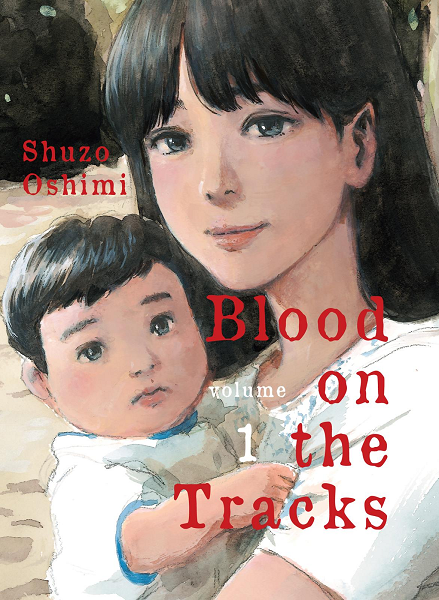
I was hoping for Blood on the Tracks (BotT) to be something on the level of Flowers of Evil, and at the beginning I was confident it would deliver. Unfortunately, I’m reminded of Happiness more than anything else. There’s undeniably some brilliant and powerful stuff here, but Shuzo Oshimi struggles to hold onto those moments, and it’s hard to speculate on what might have gone wrong. He’s too consistent across works for me to think he’s past his prime or anything of the sort, so my best guess is the pressure of serialization drags down his quality, because BotT exhibits many negative trends and flaws I’ve perceived in his contemporary works.
Namely, BotT feels simultaneously slow as hell and extremely rushed. Plot developments happen very suddenly and with dramatic consequences, but their depictions can drag on for a redundant eternity. It feels bad to say such a thing, as I quite like slow burns, but you still need that sparseness to suggest something of substance. And it always does, in a way, but becomes the same shit after a while.
Oshimi has particularly shown leaps in developing his art style, and BotT features much of his expressionist portrayals of its characters’ psyches much like Happiness, but it borders on self-indulgence with its frequency, tendency to dominate entire chapters, and lack of additional contribution to the story to justify its focus. We know our main character has trauma, the definition of their world is breaking down, etc., etc., etc. How long does it take for visual storytelling to possess the same pointless circular structure and redundancy that verbal exposition is often maligned for?
It’s almost like Oshimi starts slamming on the gas pedal to reach the next traumatic incident so he can go all Edvard Munch on us. Like damn, settle down. It reaches a point where Seiko’s breakdowns are so idiosyncratic that some of the natural horror of her being a realistic pathological narcissist is lost. She feels increasingly fictitious throughout the course of the work, which undermines what made the premise so powerful throughout the first half or so of the series.
I don’t want to downplay the manga’s good qualities, though. This is worth experiencing just for the most viscerally uncomfortable moments, but I feel that in hindsight they’ll come across better as vignettes rather than a cohesive, well-delivered narrative. Still better than the vast majority of manga you’ll come across, and always brisk and captivating, but I can’t help but feel like this series wasted a ton of potential.
Leave a Reply