








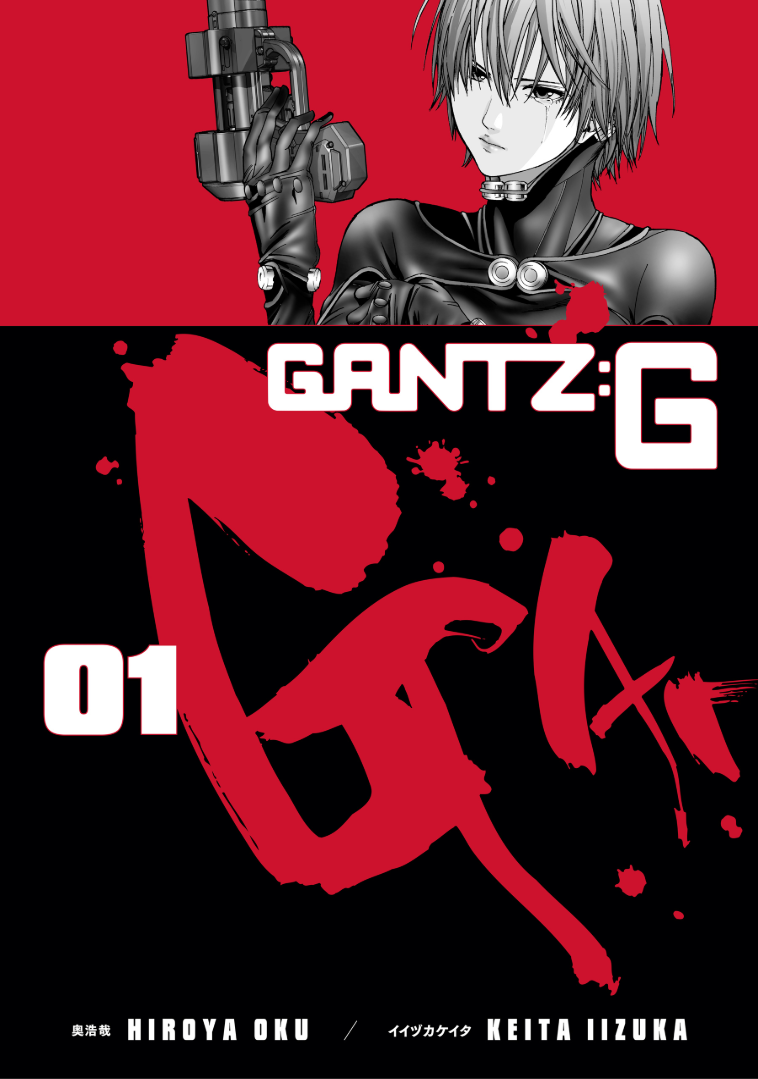
Gantz: G
Release Date(s): November 17, 2015 – March 17, 2017
Gantz: G Review
I don’t really get the point of Gantz: G. The original manga was still ongoing at this point, but lord knows it would end up having a boatload of unanswered questions. A spinoff could have provided the opportunity to elucidate any of those mysteries. Instead we got something of no consequence: Gantz but more. Probably fair enough to call it a cash-grab, though it has a couple compelling bits.
Our main character is Kei Kurona, who looks identical to Kei Kishimoto from the main series, and whose name is remarkably close to the original protagonist, Kei Kurono. It’s an incredibly tacky self-indulgence that’s laughable at best, and at worst begs some acknowledgment because Gantz:G indeed takes place in the same universe as the original. How would Kurono react to his first crush having an unrelated clone with the same name as him who also fights for Gantz? I think I would question my own existence.
Anyway, Kurona fights alongside her wimpy friend, Naiki. It’s revealed far too late that these two are childhood friends, which is a bizarre detail as they act like complete strangers outside of being in the same class when they’re introduced. Said class all die and end up in a Gantz game.
The enemy aliens couldn’t be less interesting, merely being chimeras of zoo animals that lack any humanizing elements other aliens had in the main series. They’re merely fodder here, which highlights one of the problems of Gantz: G. Gantz may have bit off way more mystery than it could chew, but at least it had some. Learning more about its chaotic world was the entire plot, and it was necessary to maintain momentum when the game format would put the framework’s progression on halt until those isolated incidents were finished.
Gantz: G offers a situation identical to one the reader will already be familiar with from the main series. The reader already knows the details of the game, and isn’t along for the ride along with the characters, but is rather just waiting for them to reach the same conclusions. One of the more endearing aspects of Gantz was seeing people of radically different personalities and origins react to the same situation, but since Gantz: G‘s characters are all from the same high school class, this is greatly diluted.
This is more like what people wrongly characterize Gantz as: violence for the sake of violence. Any subtlety in world building is virtually gone, and what’s left is raw action that’s not even the gore fest the original series was. Gantz:G is limp in nearly all elements.
But as I said, there are some compelling bits. After the stock initial game, the manga reveals some more ambition. Gantz: G is largely focused on character drama, and spends a significant portion of its chapters outside of the battles and shows the characters dealing with their daily problems. For the most part, the game has no direct impact on these issues, which is somewhat interesting. The encounter with aliens in a life-or-death struggle doesn’t change how characters treat their daily lives, but they do get caught up with interpersonal struggles of things such as jealousy and inadequacy as a result of the game.
In a way, this isn’t cohesive. Ideally you would have some character motivation outside of the game, because that’s what makes them the most relatable, but tying at least some of that motivation to the game makes the game feel less like a separate dream-like reality and more of something with real, fatal consequences, which is obviously a threat that needs to be genuine in order for the myriad of deaths to feel tragic. Gantz: G‘s separation of high school character drama and the killing game may not be ideal, but that drama is still entertaining enough.
On the other hand, it’s possibly to construe character archetypes in Gantz: G as a result of sexism. I know, misogyny in Gantz? Perish the thought. But it always bears discussion anyway. Ignoring the forced fanservice as always with skin tight suits and the like, the Gantz: G team’s catfight between its female high school students when they’re facing death if they don’t cooperate strikes me as extreme, even when considering how much teenagers suck. It’s an uncharitable depiction of teen drama that I would expect from someone raised on Western media. This is a nitpick, and sure, some of what’s conveyed here is realistic, but when combined with everything else, the story loses some leeway from me for its stereotyping.
For some reason, several students in this class are already career professionals or bordering on becoming one. There’s a beauty queen who stars in commercials. Okay, fair enough, celebrities go to school too. Then there’s an independent pop idol trying to become famous who has her own group and live shows in front of full crowds. Quite a coincidence, there. Lastly, we have the token helpless, shy girl who is on the cusp of getting her manga professionally published. Jesus Christ, should I have accomplished one of these before I left high school? I really must be a failure.
Silliness aside, point is they’re all careers generally depicted as belonging to women, other than the manga artist. The first two are the pettiest of the group and instigate much of the catfighting in addition to just being generally vain and concerned with popularity. At one point, one of them is so jealous over Kurona upstaging them in the game that they leave social media messages saying she’s a slut and some such.
You’re gonna be needing this person to possibly save you from dying in the next match, and you’re trying to lead them to depression? Seems counterintuitive. Again, I don’t expect realistically-written high school characters to always be rational, but when all of the previous stereotypes are taken together, and are things associated with negative traits of women in particular, it raises some red flags.
Keita Iizuka‘s art is much blander and more inconsistent than Hiroya Oku’s, but it’s not bad. At the very least, it’s more comprehensible than the gallons of spilt ink Gantz‘s art eventually became. Much like Gantz, there’s a fair amount of fanservice sexualization, but don’t expect as much of it. One character, Kaji, is a bombshell Gyaru with a frequently-mentioned large bust but is practically the only character not shown topless. Hiroya Oku probably never would’ve allowed for that, so I guess Gantz: G is technically an improvement with regards to superfluous perverted junk.
Gantz: G Verdict
Well, that’s probably a good place to call this review. Gantz: G is a mildly entertaining side story of no relevance to the main series and lacks many of its best qualities. With only three volumes, it sets up character drama interesting enough to be worthy of the few chapters it gets and nothing more. I don’t necessarily think it’s worth your time, but it’s not a total waste, either.
Leave a Reply