





The Horrors of Noroi Michiru Review
Background
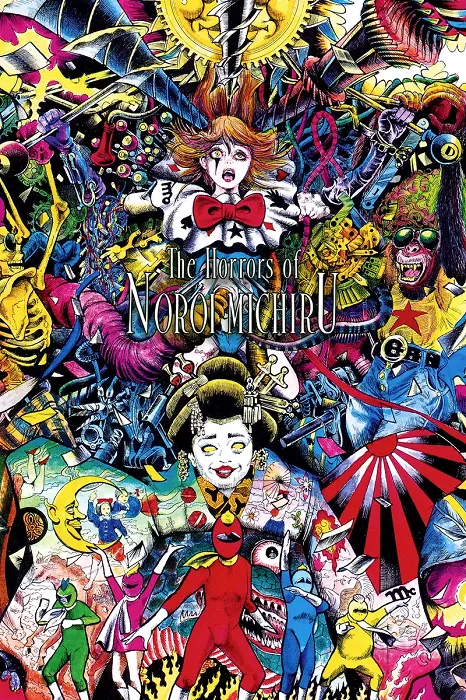
While browsing for high-quality manga cover art to make my category list look nice, I came across the website for Azuki, a digital manga host. I was unfamiliar with them, so I decided to browse their selection. I recalled how similar explorations through the sites of publishers like Kodansha were fruitful when it came to introducing me to promising new titles. I’m glad I took a look, because they have a lot of interesting stuff. Dozens of niche series from English publishers I’d never seen before. I took note of a few, but no cover demanded my attention quite as much as The Horrors of Noroi Michiru.
If you looked at the featured image for this post shown above, you can probably understand why. A practically tie-dye explosion of colors and chaotic creatures is not exactly the palette I expect to see from something advertising its fear factor. The sheer carnival-esque eccentricity of it all combined with the title made me imagine some Cirque de Soleil barker by way of P.T. Barnhum. Speaking of, while googling Barnhum’s name to spellcheck, Google’s one sentence description of him was, “Former Connecticut State Representative.” Yep, that’s certainly the first way I would describe him. There’s a search engine ruined every minute.
Regardless, the barker won: I felt like I had to read The Horrors of Noroi Michiru. Plus, Azuki’s description hyped it up as being as good as Junji Ito. It’s a cheap comparison for any Japanese horror manga, but when filtering for “horror” in manga apps returns results like fucking Chainsaw Man, you take what you can get. There was just one problem.
A Public Plea for More of The Horrors of Noroi Michiru
I couldn’t find the damn thing. I can’t remember the last time I looked up a manga author and got virtually nothing in results—let alone in English. It was only until writing this article that I discovered why. It seems that the publisher, Star Fruit Books, only physically released the manga in October 2024.
Azuki’s site listed chapter publication dates as far back as June 2024, so I suppose the digital release was earlier. Other sources listed this collection as being released years ago, potentially because it may be a localization of a similarly-titled Noroi Michiru compilation in Japan. In any case, this looks to be a relatively recent official release and a niche one at that. Not the kind of thing people rush to share.
The Horrors of Noroi Michiru
I was able to find one chapter, however—the first—and that’s what I’m here for today. I’m pretty hard up for money right now, as I’m a writer, so I’ll have to put off the rest of the collection for now. If you’re interested in reading The Horrors of Noroi Michiru for yourself, you can subscribe to Azuki through their website, or you can place an order for the physical manga on Star Fruit Books’ website. If you want a quick, spoiler-free recommendation: I thought the first chapter was pretty cool, and I’d certainly like to read more. Should you like, you could always donate to my site and mention you’d like me to read and review this in full.
For now, come one, come all! Witness horrors the likes of which you’ve never seen! It is said there is naught more terrifying than what the mind is forced to conjure, and so you will be shocked by having to imagine what the remaining ten chapters of this compilation might be! This is… The Horrors of Noroi Michiru—partially.
Chapter 1: Luger – The Dwarf
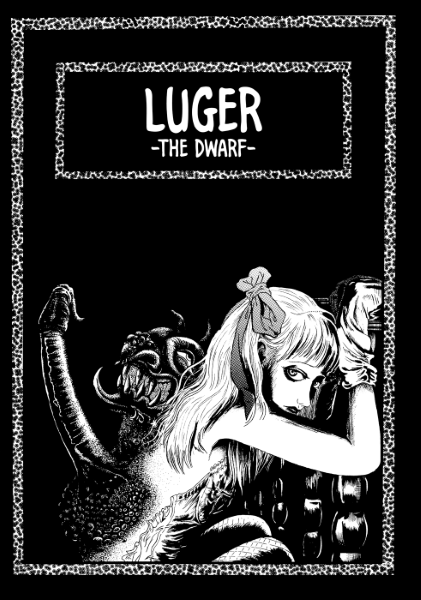
Hold on. Apparently I read a seven year-old fan translation? That just happened to be from the similarly-named compilation? That just happened to be its first chapter? And that just happened to be abandoned after one chapter, thus making it appear as if it was a scraped copy of Azuki’s free preview chapter of The Horrors of Noroi Michiru? Oh, I don’t even care anymore.
Our heroine, Midori, is a girl in two realities. She claims to be able to hear the voices of nature and inanimate objects such as dolls, and idles her childhood away by playing with them. This dreamlike fantasy contrasts with her family life. Though born into a wealthy family complete with a mansion, she is verbally and physically abused by her demanding father. As punishment for failing to meet his standards, Midori is sometimes locked within the attic where her “sixth sense” turns against her, conjuring up terrifying visions from the archaic relics in the darkness around her.
It’s here she encounters a demon, the titular “dwarf” named Luger. Luger is quick to offer Midori his great demonic powers, but only if she does exactly as he says. While we all know this is an amazing deal that could have no downsides, Midori is hesitant for whatever reason and waits until she’s 16 years old to finally take up Luger’s offer. What tasks await Midori? What is this “demonic power” Luger spoke of? Why does Luger have a giant monster dong? You’ll have to read it to find out. Or scroll to my spoiler section a few paragraphs below, obviously.
Themes and Objectionable Content
Something you may wish to know before reading is whether this is pornographic in any way. I had the same concerns upon seeing the title artwork. Rest assured, however: it is not. While I can’t speak for the Michiru works I haven’t read, I will confidently state that Luger is not exploitative in the slightest. There are sexually suggestive themes, but there’s no highlighting of private areas, and no sensationalizing of power dynamics. Unless you’re utterly opposed to sexual themes at all, I find it unlikely one would object to the story’s content on those grounds.
As for those themes, they’re what the heart of this story truly is. The devil’s bargain tale is a trope in and of itself, so I’m happy to share that it’s used to deliver a story with a much more personalized touch. I found myself intrigued throughout the basic narrative, surprised by the conclusion, and my appreciation for Luger has only grown since I’ve thought about it further.
There’s a surprising amount to chew on in these 16 pages, which speaks to Michiru’s capacity to write layered stories rich with symbolism and unexpected depth. I’m optimistic about the rest of his work. Luger is, I think, ultimately a feminist work about the depths women have to go to compete with patriarchy. To say anything further would give too much of the game away. I just wanted to give one last morsel for anyone on the fence about reading Luger. Again, I recommend it.
Thoughts on Artwork
Michiru’s art is still difficult for me to get a handle on. Not in the sense it’s lackluster, but in that I struggle to define it. I would describe it as “grittier” than Junji Ito’s artwork, but if I’m comparing it to Ito’s earliest works, then Michiru’s Luger art would be the more polished of the two. Both Michiru and Ito made their careers in publishing for shoujo magazines. In Ito’s artwork, you can perhaps see the influence by the way he draws women.
While not objectifying them, Ito draws women as pristine and beautiful almost to the point of sterility. They have flawless skin, figures, and hair, but always simple, nondescript features. In a way, they often have a doll-like countenance to them. They’re simultaneously ordinary and relatable, yet precious enough to feel like particularly tragic victims.
By contrast, Midori literally looks like a doll. She has large, expressive eyes more associated with standard anime designs, and the subtle changes to them throughout the story are the main source of her character growth. She feels more individualized than Ito’s protagonists, but this could very well be bias due to my lack of familiarity with Michiru’s characters. The grotesque design of Luger is particularly impressive due to his asymmetry and exposed flesh, and certain details of his design can be further appreciated upon reflection.
Spoiler-Heavy Analysis
With that out of the way, click here to read my SPOILER content for this work.
Whether you’ve read the story by now or not, it should be made clear that Luger is a metaphorical story. To what extent Midori’s fantasies are supernatural is debatable, but I don’t think that matters much relative to the symbolism at play. The literal interpretation of what happened could be as thus: Midori finds an old Luger pistol in her family’s attic.
In her childish innocence and tendency to escape her abusive reality, she personifies the gun as a demon. She may have a subconscious or partial understanding that guns are dangerous, resulting in Luger’s appearance and behavior. Guns are inherently a risky item to use under any circumstances, so one could see choosing to wield one as a “devil’s bargain” in and of itself. You have incredible power, but misuse can result in permanent harm you didn’t desire.
Midori then begins reconstructing the pistol, Luger, as it’s missing many parts, or “organs” as the demon describes them. The sulfuric acid bath on first blush appears to be simple thematic association. Demons are evil and impure. Water is the source of life for humans and often a symbol of purity, therefore a demon could be expected to bathe in something destructive like acid. What kind of acid is commonly understood to be among the most dangerous? Sulfuric, naturally. In truth, it’s a powerful acid that metal can resist, making it appropriate to clean off metal with decades of grime.
In hindsight, many aspects of Luger’s appearance are tied to the actual Luger pistol shown in the final page. His circular eye rims are the pistol’s knurled knobs. Obviously, his penis and testicles represent the barrel and handle. The comparison of a gun to a penis has been done countless times in artistic works. The odd tip of Luger’s penis as well as the strange-looking “glans” are also derived from the pistol’s sight and barrel, when at first they appear to just be another arbitrary distinction of his monstrous, unnatural nature. Lastly, I believe the final process of “completing” Luger, Midori inserting Luger’s teeth, is her loading the bullets into the gun. I wanted to compare the number of teeth to a Luger’s clip size as evidence, but it seems Lugers vary too much.
The turning point of the story is Midori’s murder of her father. The associated page is significant for providing us further details on their relationship. Midori and her father are shown not wearing any clothing and surrounded by toppled household items, implying a likely struggle as a result of her father’s raping of her and her shooting him in self-defense with the completed Luger. I think this also may provide significance to the ages at which Midori encountered Luger in the attic. The first appears to follow the aftermath of a violent outburst with regards to her school grades. The second is not shown prefaced by anything, but it happens when Midori is 16. This may have been, or was close to, when her father began raping her.
I think this implication is intended, as there’s otherwise no narrative purpose in disclosing Midori’s age. Her age at the story’s start was never given—it only needed to be obvious that she was a small child. Midori’s older appearance would be harder to narrow down, despite it being of more importance. Anime characters in their teens or early adulthood can be difficult to distinguish depending on the art style, and Midori’s agency changes drastically if one considers her as even two years older at 18. She’s then assumed to be more capable of, practically and legally, leaving her abusive household. This could prompt the reader to respond with her murder as being unjust, as she could have ran away.
Now, of course, this would be completely unfair. Midori did not deserve to be assaulted no matter what age she was, and self-defense would always have been justified. But I think Michiru’s decision to define her at 16 was an intelligent one that sidesteps some moral ambiguity. Midori’s at her peak vulnerability and powerlessness here due to her father’s presumably recent sexual interest in her as she has matured. She’s as victimized as she could possibly be while unable to act on it, and we understand the escalating violence in her household that resulted in drastic actions being taken after a breaking point. In those days, there was no other way out.
Midori is said to have been locked in the attic numerous times, yet she made a note of having only met Luger twice. For this to be explainable, it could be that when Midori’s circumstances are at their most extreme that her mind turns to dark temptations. It’s also noteworthy that in their second meeting, Midori appears to be looking for Luger. It appears she entered the attic of her own will with the explicit purpose to find Luger and arm herself. She’s resolved herself to this solution now, and her eyes are narrower and colder than when she’s drawn as a child. It seems as though something broke her, made all the more likely if something in her environment changed for the worse, and it’s what makes me further suspect the night of the murder wasn’t the first rape by her father.
There’s significance here in that, for their first meeting, the dark thoughts that conjured Luger appeared to be intrusive. By the time Midori is 16, they are active thoughts. In many devil’s bargain stories, the devil is a very real entity that influences the protagonist down the wrong path. If Luger is Midori’s creation, then that necessitates her character progression occurs before the bargain progresses, otherwise there would be no mental impetus to conjure Luger. In this regard, Luger becomes a psychological defense mechanism to take responsibility away from Midori’s actions. Given her established tendencies to escape reality with her dolls, we know she’s capable of this behavior. Whether it’s employed in a positive or negative way is down to her environment, which is obviously not conducive to comfort.
This can be further observed with how Midori characterizes the Luger as being a part of her physical body. It’s now something she literally can’t be without. This distances Midori from her actions by considering the Luger to be its own entity she’s inseparable of, essentially compartmentalizing the freedom she feels at her newfound power and control that some part of her recognizes was obtained immorally. In a psychotic break, Midori cuts her own hair down to a pixie cut length and “murders” her dolls which have been trying to coerce her from the path of Luger. These represent the last shreds of Midori’s childhood innocence and conscience, and with them gone she undergoes another drastic and final character change.
Midori, seemingly now an adult, has acquired some infamy during her aimless wandering. She remarks how she can use her Luger to convince any man, no matter how powerful, to do as she pleases. While she characterizes this as an arcane right, in practice she’s still dressing up her true reality as a common criminal. From what little we see of her actions, we know she at the very least shakes people down for money under the threat of violence. She also seems to enjoy the act of simply making powerful men humiliate themselves by prostrating before her gun, perhaps an endless act of revenge against her abusive father.
The remainder of the story is the twist that recontextualizes everything. While relaying her story to an egotistical actor while at a bar, she asks him to feel “how hard” she is, with the final panel revealing that they’re gripping a literal Luger pistol.
There’s a lot that can be said about this story’s themes, and I’ve touched on some of them, but I think the main crux is the extremes some people have to go through to subvert power dynamics. Because of her gender, Midori was even more disadvantaged against her father than she would be otherwise. In theory, a young teenage boy could overcome their aging father physically, but getting that kind of strength as a teenage girl is obviously more difficult.
This story could have worked with a male main character, but it would have lost a lot of texture. Part of why Midori’s transformation is so impactful is because of the contrast it serves with her old appearance and demeanor. She essentially usurps the role of patriarch in her household in the only language of power she’s known, which is her father. She generally becomes more masculine, such as in her more aggressive behavior, rejection of her interest in dolls, and cutting her hair short, a style she notably keeps after time passes.
And, most importantly—she literally grows a penis. Well, not literally. Figuratively. But to her it’s literal. You get the point, I hope. Midori’s idea of power is so tied to men that she sees her only way to acquire power as becoming a man herself. That symbol of masculinity, synonymous with violence and power, becomes a source of security for her. In order to maintain her power, she has to perpetuate her feeling of control, and this cycle forever bonds Luger to her female form.
I’ve been on the internet long enough to know some people will read this interpretation and think, “pshaw, are you saying Michiru is telling women that they should go buy guns so they have power?” People have a bad tendency to think that a story exploring an idea is the same as advocating for that idea. I think Michiru wanted to make a horror story that incorporated how power is viewed in some cultures and how power can be gender-coded. He used metaphor in lieu of expositing about abstract concepts and theory (like what I just did.) Metaphors and symbolism have been used for that purpose since… I don’t know. Nearly the dawn of fiction? Nobody is meant to read this story and think “wow, guns rock!”
I don’t think anyone will, either. Midori gives up her sense of self to be able to use the gun, and she’s shown utterly dependent on it. Her sense of power isn’t real, because her definition of power was formed by her horrible patriarch. As adults, we should be able to understand that a parent abusing their child is a sign of ultimate weakness on the parent’s behalf. It’s a lack of control over their feelings, as well as their difficulty to process them, which results in projecting those feelings through violence or the blame of others. Midori did not grow up in an environment that’s likely to produce a rational mindset, because the most important figure in her life behaved irrationally. And because that figure would use sex while expressing their power, the two became inextricably linked within her mind.
That sucks, dawg. It’s tragic and really sad. No one should have been in that situation. Look at the pain that culture caused from people internalizing the wrong things. It’s good to be aware of that negative potential so we don’t pass it on to the ones we influence ourselves.
Before I go, there is just one element of this story I couldn’t get a good read on. At multiple points, Luger or Midori mention that the “power of Hell” (i.e. the gun) is for Midori alone. Luger states, as a matter of fact, that no one else in the world has that power. Obviously, this cannot be the case. Guns are everywhere. But why even have this line, let alone a couple of times? Even if it were not there, prior to the reveal that the power is a gun, we would likely assume the power is supernatural. It stands to reason that Midori would be the only recipient of the power, unless wheeling and dealing imps are commonplace in this world.
For them to state the obvious so many times, there ought to be a reason. But I just can’t come up with an explanation that fits well with my other interpretations. Is Midori so sheltered that she doesn’t even know what a gun is? She knew enough to personify it as a threat, and at some point she would need to have enough knowledge to rebuild the damaged Luger. Midori is delusional, so this could just be another escapist fantasy. Something along the lines of, “she’s so special that she gets her own power.” The “chosen one,” or a “Harry Potter complex.”
I think that would be a fine explanation were it otherwise established at any point that Midori was special within her own fantasy. If she believed herself to be a magical princess, that would be something. But she doesn’t. I’m genuinely unsure as to what function the detail that her power is unique to her serves in the narrative. Its absence would seemingly impact nothing. Hmm.
Well, I’m dipping out for now. I hope you found this a fun read, because it took me a long time to write, as usual. Once again, if you’d like for me to review other media, please consider donating so I can afford it. Until next time.
Leave a Reply