




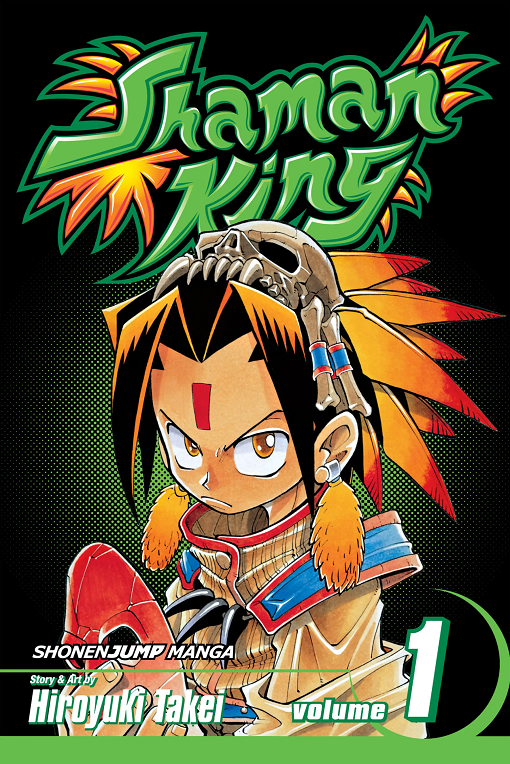
Shaman King
Name(s): Shaman King
Originally Published: March 17, 2018 2:53 pm EST
I, like many others, first encountered Shaman King in the western version of the manga magazine Shonen Jump. The series had the prestigious honor of being one of the first titles to premier in the anthology. While not appearing in the very first issue, Shaman King started publication in the magazine’s first year alongside established heavyweights such as Dragon Ball Z and Naruto. Quite an honor to be one of the first Japanese-only shonen series Viz was willing to take a chance on.
It ended up being one of my more well-liked titles, and evidently this sentiment was matched by enough others to ensure all 32 volumes of the original series received syndication. Shaman King had a charisma fitting its warm reception with an unusually lackadaisical post-Gen X main character, and a distinctive, graffiti-influenced art style. It also explored superpowers in the form of hovering “spirit allies” (which would ironically be America’s first widespread taste of its origin concept, JoJo’s Bizarre Adventure‘s “Stands”).
When I eventually stopped following Shonen Jump monthly, I made a note to myself to one day get back into Shaman King. What I thought would be a pleasant task ended up taking me almost exactly an entire year to get through. This is the result of frustration at its length and missed potential, only salvaged by the goodwill from its aforementioned initial qualities.
To say Shaman King is inconsistent is an understatement, yet also the most accurate single-word description. It would be more accurate to say it’s inconsistently inconsistent. The manga’s overall quality, focus, tone, and style jumps around like a child with ADD. Or (probably) more precise, an author who’s trying to shove the next cliffhanger out the door in order to receive his next paycheck.
I sympathize with the pressure of weekly serializations. I truly do. I bear no ill will towards author Hiroyuki Takei for what I perceive as a failure to deliver a quality story, but it just ceased to be enjoyable for me at a point. That’s me being honest, and I sincerely suspect that not all of that declining quality was out of Takei’s hands.
It’s not necessarily a shame that Shaman King is structurally derivative. That is, despite its unique framework in its subject matter of shamans, it’s still by-and-large a typical battle shonen format. For various reasons, main character Yoh Asakura and allies are constantly being pushed towards the next one-on-one fight. You have the typical tournament arc, power ups, friends becoming allies, ki, the whole shebang.
But just when it seems the manga has enough of its own voice to overcome its tropes, it falls apart by committing the same genre “sins” so many shonen works do with such reckless abandon that it has to be assumed Takei was merely considering getting readers to the next chapter rather than setting up and delivering cohesive concepts and stories. Evidently, even your average reader can pick up on what seems like cynicism and lack of author interest – Shaman King was cancelled right before its apparent conclusion after a devastating last third of failing to grip the reader despite every desperate attempt to do so.
The broad strokes of why Shaman King ended up being a flop are obvious and combine to imply that Takei’s writing just caused the bulk of his audience to lose faith in the story. The drama of the story falls completely flat over time because of amateurish mistakes and shortcuts in crafting a story. These errors are countless and not unique to Shaman King, but combined and in such frequency are incredibly disappointing.
For starters, Shaman King is fairly quick to make death of characters a complete non-triviality. Several characters eventually get the power to resurrect the dead for virtually no cost. The cast even make a joke of this later on, claiming that they can kill anyone they want because they can just be resurrected afterwards. When a major character dies at the end of a chapter and is almost immediately resuscitated, it’s a cheap shot at drama only mitigated by relief at the popular character’s return, but Takei fully indulges in this lame tactic of page-turning to get readers asking for what happens next with little thought or effort.
After dozens of chapters ending in deaths and the story asking for us to feel a reaction about it, the idea that nothing really matters starts to sink in. You don’t need to see what happens in that next chapter—you already know. There will be no consequences. Sure, you might assume in a typical hero story that they’ll always make it out alive, but when even the “why” starts to be insignificant, empathizing with the characters’ plight becomes extraordinarily difficult.
This problem goes deeper than just being lazy, predictable writing. The idea of the series treating death so frivolously makes an absolute joke out of the central Taoist-esque themes of pacifism and respecting all life. The series’ tendency to turn enemies into allies so quickly is often sudden and not really believable, but Yoh Asakura’s sacrifices to maintain his no-death policy eventually end up not mattering and he rightfully gives up not batting an eyelash when any of his friends kill someone right in front of him.
The results of the fights could be forgiven if the methodology of getting there were interesting, but Takei finds similar ways to defuse the promise of any interesting battle. There gets to be a point where the bulk of conflicts aren’t in the details of their action, but in everything surrounding them. It becomes all set up with no payoff.
An early mistake Takei makes is quantifying mana; the power levels of the characters. This is a common trope since Dragon Ball Z’s energy scouters, and Takei quickly writes himself into a corner after quantifying the main villain’s power as hundreds of thousands of times greater than the heroes’. This immediately means that the main characters will eventually have to get sudden boosts in power, as opposed to gradually growing over time in order for them to stand a believable chance against the opposing threat. Takei, instead of simply showing us the difference of power in characters by their actions or skills prefers to have characters stand around rattling off numbers. Paraphrasing, “you can’t possibly win because X is a greater number than Y” is a favorite line of Takei’s.
This cold, mathematical view of spirit energy is also in direct conflict with the central theme of spirituality. In Shaman King’s universe, it is said countless times that a character’s mana is the strength of their spirit. This implies that personal character growth is tied to power, a fine concept, but one that’s not compatible with the number crunching necessary to push the characters forward against stronger opponents. Quantifying a power that’s supposedly tied to mentality makes no sense and is a nihilistic philosophy tied to a spiritual one.
This contradiction always cheapens the other element, with characters going through sudden huge boosts of power that are tied to basic character development. It’s a lot of repetition over the same themes of strength of will and maturity, and when you start trying to tie both together to each character’s power with how they’re portrayed mentally it constantly doesn’t match up. A more confident, righteous character is weaker than one with hesitation because the story demands it, and vice-versa. The number system is a lazy way to establish the threat of conflict and its connection to the personal themes of the series with its character development cheapens the outcome of those conflicts as well.
While you start off with decent action scenes, the bulk of the series ends up hyping up big battles that rarely ever deliver. The formula usually consists of characters standing, facing each other while rattling off numbers until one has some spiritual epiphany and decides everything in a huge never-before-seen attack that compromises the direction of future action scenes.
A particularly bad example of what I’m talking about is Yoh’s team facing the Ice Men team in the tournament arc. The Ice Men have a synergy among their Nordic powers of nature that sound potentially interesting and a capable threat to Yoh. End chapter. The fight begins, and the Ice Men’s assault is effortlessly shot down by one of the most embarrassing cases of “special snowflake” shonen main character grandstanding I’ve seen in a while.
For whatever poorly explained reason, Yoh’s team is now capable of summoning absolutely enormous versions of their spirit allies. The following material is his team rattling off how inexperienced the Ice Men are compared to Yoh and friends, and how their goals are worthless compared to their own loft ambitions while showing off their huge dick spirits used for multi-page spreads and impressive looking stills that are used for extremely little narratively. The chapter ends after each character summons their giant spirit, basically stand still, and intimidate the Ice Men into surrendering.
Immediately, any promise of an interesting fight is betrayed by establishing who can only be the possible victors, and Takei has lazily set up a way where he can make a battle seem epic without it actually being one. Before, you may have expected dynamic action scenes, characters moving around a lot, exchanging blows, that sort of thing. But it takes a lot of effort to choreograph that, and it’s far easier to just draw a bunch of stills and find reasons for the fight to end quickly and painlessly.
This ends up characterizing the vast majority of Shaman King’s fights. Characters talk about numbers, summon gigantic page-filling spirits, and then the bigger one wins. That’s not a fight, it’s the equivalent of a Looney Tunes skit where each character keeps bringing out a bigger cannon until the comically large one wins. The fact that Takei has now set up our main characters’ abilities as being enormous will now also kill any interest he has in having to draw those monstrosities multiple times in the event of a longer fight, which is more assurance that such a fight will never happen.
It’s an efficient way to move through the plot. After all, what if readers lose interest during the middle of a long fight? If that was Takei’s concern rather than just taking the easy way out, then that issue is solved as well. Finishing fights quickly lets you hype and set up the next cliffhanger you won’t deliver on and (hopefully) keeps readers buying those magazines. Oh no! The chapter ends with our hero up against the entire enemy army! What will happen!?
Nothing. The fight can’t happen because there’s no plausible way it could be made a fair fight. This entire scene only happened to draw imposing stills to get people to read the next chapter. It’s almost like a scam. This never-ending betrayal of expectations and taking the easiest way out of any situation in the plot is the precise reason why Shaman King failed. You can’t endlessly set-up cliffhangers without payoff. That trick only works a few times in succession, but Takei rides on it all the way to the end. Once you lose faith in what’s going to happen, the set-up hardly matters anymore, doesn’t it?
Shaman King is marred by additional issues that suggest its inconsistency is the result of pure indulgence by the author. It’s very evident multiple times throughout the manga that Takei is just absolutely sick of writing it and is wishing he could be doing anything else. So, in addition to rushing through the plot while also insuring it never ends, he throws in any concept he wants regardless of consideration of the reader’s own interest.
In one part of the manga, it becomes painfully obvious Takei has cars on the brain. Another conflict instantly ends as Takei suddenly decides he wants to draw cars. The battling spirits are revealed to actually be transformable cars, and what follows are multiple, detailed shots of real cars and their engines. Later in the same volume is an unrelated one-shot manga about street racing. An eventual author’s note from Takei states that he wrote cars into Shaman King to practice drawing for this one-shot.
Instead of entertaining the reader, Takei shoved that thought away and prioritized his art as a vector to practice drawing cars. After all, you already bought that month’s issue, and surely you’ll buy the next one if the final page reveals a new villain is just about to enter the scene (and certain to have no permanent effect on anything).
Shaman King quickly devolves into endless running around in circles with conflicts made as uninteresting as possible with virtually no consequences to the status quo. Additional characters are piled on instead of using established ones well, and they randomly disappear and reappear sometimes volumes apart. Shaman King is a ton of large, seemingly impressive cardboard stands, but there’s nothing behind this flat, hollow bombast.
Even the presentation—the basic rendering of those big pages and empty promises—isn’t enough to imply substance where the story fails. Takei’s initially stylized artwork takes a big hit in quality around the same time the rest of the manga does, and the heavily-stylized graffiti style barely exists any longer. Shaman King ended with a whimper after a pathetic cancellation, and although this may seem like the final nail in the coffin, it’s honestly a blessing that we were saved from further disappointment.
…Or we would’ve been, if not for the release of Complete Collection (Kanzenban).
Shaman King: Complete Collection
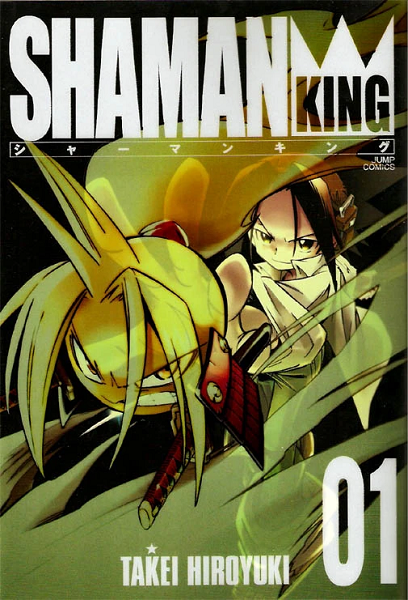
In the wake of the cancelled serialization of ‘Shaman King,’ author Hiroyuki Takei attempts a do-over of the manga’s final arc—proper ending included.
Originally Published: April 2, 2018 2:26 am EST
REVIEW CONTAINS FULL SPOILERS FOR SHAMAN KING AND SHAMAN KING: COMPLETE COLLECTION
At the end of my review for the original printing of Shaman King, I wrote that it was perhaps a blessing that Takei wasn’t able to give the series a proper ending under the assumption that it would only lead to further disappointment from the manga’s declining quality. Four years after Shaman King ended, Takei resurrected the series with Complete Collection (Kanzenban) and proved me right.
Shaman King’s downward spiral picks up right where it left off—if anything, it accelerates. This makes the rushed, progressive train wreck of the manga’s second half look like a Machiavellian masterpiece. There’s so much to go over here in the broad strokes, but to avoid laying down the same bricks, just apply absolutely everything I said negatively about the original series to this one, and then add the following.
The most immediate assault from this manga on your senses is, of course, directed at your eyes. Takei’s initial graffiti-inspired art style of the original manga deteriorated over the course of its run into something blander, but it remained distinctive and pleasant to look at. In these additional chapters, it’s as if Takei’s hands have gotten amnesia.
It’s one thing to lose your tempo a bit after not drawing these characters for a few years, but this art looks like it was drawn by an entirely different person. It’s practically sketchbook quality; something you’d find on storyboards rather than a final publication. The shading, if it can be called such, is truly horrendous. Nearly every page is illustrated in only pitch black and the blinding whites of the background. The old images of Shaman King look like “bootleg” variations now, and seeing the fights we missed is actually a curse considering their incomprehensible “ink blot” choreography.
If one thing hasn’t changed, it’s that describing these action sequences as “fights” is still very generous. Takei gets the great opportunity to not have to rush the finale of his popular manga, and he takes full advantage of that opportunity by rushing it harder than ever before. It’s downright comical at this point how rote this series has become for its author, with foreshadowed conflicts being settled in a single chapter or skipped in their entirety.
The payoff in this revised climax is every bit as unsatisfying as it was originally, only far longer in its delivery. Numerous supporting cast characters never get their motivations or previous actions properly explained, if at all, and bearing special mention is the central villain. Hao’s entire motivation being explained in a side chapter is an absolute joke, and his actions in the final chapters of this series contradict a hundred things he said or did prior. Hao’s subtle guidance or support of Yoh and any possible nuance to his morality is thrown out the window in order to indulge in a stock, maniacally evil antagonist.
The final battle between Hao and Yoh’s group after he has literally become God, and the justification for how everything is resolved doesn’t even deserve to be called “nonsense.” We have plenty of time to realize how undeserved and forced it all is as we see Takei draw every single character in the entire series, looking uglier than ever, spouting platitudes about the power of love defeating actual omnipotence. It’s a true family reunion.
This is truly awful. If I can’t persuade someone to not read the entirety of the Shaman King manga, hopefully I can at least persuade them to not read the Complete Collection. It’s not worth it. This fails to live up to any standards of the original series. It’s ugly, stupid, meandering, redundant, and a complete waste of an opportunity to set things right. It’s impossible for me to believe Takei put the passion behind this that he claims in the afterword, as it fails and cuts corners in every way conceivable. Any goodwill I had towards the original manga for its likable cast and better moments is utterly sapped by this addendum. Don’t spend your valuable time on this one. After all, the author seemingly didn’t.
Despite my borderline hatred for this entry, props to Mankin-Trad for picking up Viz’s slack and translating the remainder of the franchise. It’s a fine translation, though far from ideal. It was frustrating going from Viz’s high-quality localization to this. After 32 officially translated volumes, it was somehow found fit to throw readers a curveball by using completely different terminology, name spellings, and untranslated bits such as honorifics. Sound effects are left untranslated, which makes following the hideous action scenes even more difficult. But above all else, the most egregious thing was the embarrassing addition of harsh swearing to all of the characters. And with all that goddamn shit, I’m fucking out.
Leave a Reply