






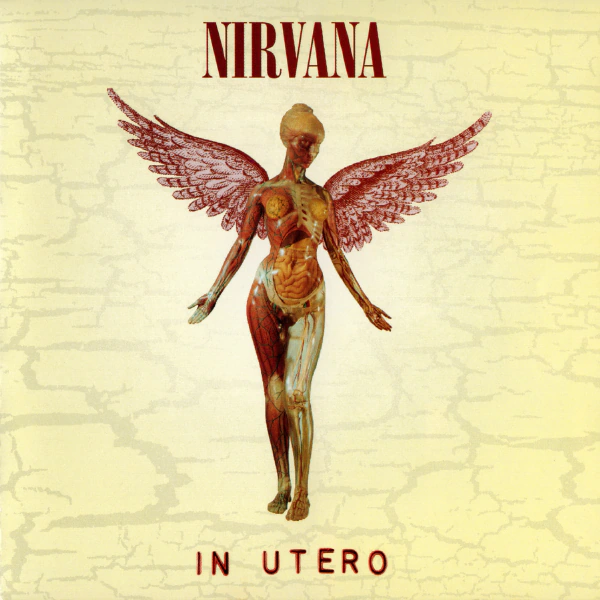
In Utero Review
Before covering In Utero, let me state that I’m a huge Nirvana fan. I’ve heard just about everything they’ve done, from the studio albums, the B-sides and other rarities, and even all those questionable quality demos on With the Lights Out. Even still, I generally think that even the biggest fans of an artist don’t like everything they put out. There is a lot of Nirvana material I would not mind much at all to never hear again other than for the reason that they’re one of my all-time favorite bands and I feel inclined to own their whole discography.
In all honesty, I didn’t really like Nirvana that much at first; just one of the singles off In Utero, “Heart-Shaped Box.” I did what many people seem to do these days and neglected delving deeper into their work under the assumption that it would be similar to all the heavy, screamy, overly-stylish emo rock music Nirvana would (unintentionally) inspire.
It was a stupid and presumptuous thing of me to do, I now realize, but that didn’t change until I listened to In Utero, my first-ever Nirvana album and was so intrigued I had to hear everything the band had ever done. Because little did I realize, I had now become the emo, emotionally and sexually frustrated, alienated teenager that Kurt Cobain’s music speaks to.
When you’re in that confusing, rebellious stage, finding anything you can relate to is a miracle. So I became a big Nirvana devotee for a good while and learned to appreciate just about everything they’ve done. But I don’t want to drag on too much with my personal history, just giving you a little background into what In Utero, and Nirvana at large, mean to me.
In Utero was an attempt by Kurt Cobain to intentionally alienate his fanbase that had come to idolize the band through their first huge success, Nevermind. Whereas Nevermind was a tastefully produced, though heavy and honest pop/rock album, In Utero promised to be more abrasive, getting back to the band’s “rawer” roots in garage rock, noise rock, and even a bit of sludge metal. Kurt Cobain had gotten tired of writing new generation Beatles-influenced pop songs, and like The Beatles, he didn’t want to be cute anymore.
So does In Utero deliver the abrasive, alienating, shocking sound that its background story and mastermind hinted at? Well, yes and no. From the moment Steve Alibini was revealed to be the album’s producer rather than Nevermind‘s Butch Vig, it was clear to anyone familiar with Albini’s work that In Utero was going to sound a lot different from Nevermind, at least on the surface.
While the guitars grind and screech more than ever, and reverberate never, this is still token Nirvana. Every song has some kind of strong melody, and a definite structure with most songs displaying the typical soft verse, heavy chorus the band is known for. Listening to the opening track, “Serve the Servants,” one could easily make the assumption that In Utero is just about as accessible as Nevermind.
And they would be right. Because In Utero is a pop/rock album. Unless you are very easily offended, in which case In Utero still has the same roots in pop/rock that Nevermind has. The only consistent trait separating it in structure from Nevermind is that In Utero is slightly noisier, slightly angrier. The verse-loud chorus-verse format is still there, the token, endearingly sloppy guitar solos are all there, and there’s still a lot of attention paid to melody and catchy riffs.
“Serve the Servants” starts off the album with a clangy, grinding guitar verse, then regularly shifts into a melodic, relatively soft chorus that would definitely be more accentuated by Nevermind‘s production, and with very slight tweaking fit on said album, structurally, if not thematically. Steve Alibini’s production values may make the pop aspects of In Utero seem less apparent but they are still there.
The album continues with “Scentless Apprentice,” which I believe was the first ever song credited to all three regular members of the band. While in the scope of Nirvana’s entire catalog, “Scentless Apprentice” is a decent song, on In Utero it’s easily one of the worst individual tracks, featuring a prominent and very generic scaling riff insisted upon by Dave Grohl. Kurt Cobain himself even commented that the riff was very typical and unimpressive, and primarily went along with the song as to not hurt Dave Grohl’s feelings. And when Kurt Cobain criticizes your guitar riffs for being too simple, then you know it’s a problem.
It is well-documented that during In Utero, Kurt Cobain was losing a lot of passion for his songwriting career and wanted less pressure taken off him writing songs, and encouraged the other band members to help write songs. However, neither of them were as good of songwriters as Cobain, and it shows. Even the lyrics are supposedly inspired from the horror novel Perfume. but even considering the book’s theme, the lyrics are mostly nonsensical and impersonal. Lacking a great melody, riff, or emotional lyrics, “Scentless Apprentice” lacks all of Nirvana’s greatest traits (yet for some reason is often claimed as one of the best tracks on the album).
Continuing, “Heart-Shaped Box” is the most recognizable song from this album and one of Nirvana’s biggest hits. Like I said in my introduction, it’s the song that got me (and many others) into Nirvana. And it’s just as gripping today. The delicate riff in the softly-sung verse is a perfect mood setter as the song gets increasingly angry and explodes into a roaring sing-along chorus. “Heart-Shaped Box” lyrically details some of Kurt Cobain’s feelings on his failing relationship with his wife, Courtney Love. Powerful both musically and thematically, “Heart-Shaped Box” is deservedly the star track on In Utero.
Rape Me is a decent song, but strikes me as a deliberate attempt to be lyrically abrasive, almost attention-seeking (which is ironic because in a way it’s supposed to insult oppressive-minded people who respond to that behavior). I do like the bridge, however. Speaking of bridges, “Dumb” very possibly has the best bridge Nirvana has ever done and the prominent backing cello adds a lot to the song (previously used on “Something in the Way” on Nevermind), but unfortunately the bridge is by far better than rest of the song. I guess I would call “Dumb” the “Polly” of In Utero, comparing it to the song on Nevermind.
“Frances Farmer Will Have Her Revenge on Seattle” and “Radio Friendly Unit Shifter” are heavy as hell and monolithic, though both songs go on for about a minute too long. Nevertheless, both are great songs, especially “Frances Farmer,” being one of the best on the album.
“Pennyroyal Tea” is another fairly conventionally structured song that at its best sounds much too similar to a lot of other songs Nirvana have done that are far better than it (see “Heart-Shaped Box,” which is on this very album), and at its worst reveals another weakness of In Utero in that the album’s songs are often too reliant on their choruses. “Radio Friendly Unit Shifter” displays that same weakness.
“Very Ape” and “Tourette’s” are two songs that when taken individually are the worst on this album (practically throwaways where Nevermind had none), but in the context of the rest of the album contribute far more to it than “Scentless Apprentice,” primarily due to their short length and aggressiveness, further driving home the almost schizophrenic feel of In Utero. “Milk It” is the closest In Utero comes to straight-up noise rock, and despite being a bit too long, it’s another highlight and one of the most memorable songs on the album.
And then there’s the fitting closer, the near-acoustic “All Apologies.” A very mellow and heart-wrenching song, often considered to be one of Kurt Cobain’s final “goodbyes” before his eventual suicide. Intimate, like all the greatest Nirvana songs, but more confessional than any without the usual contentiousness of the heavy guitars and mangled screams.
The few problems I have with In Utero are that it’s often very repetitive lyrically (see: “Dumb,” “Rape Me,” “Radio Friendly Unit Shifter”) and the noisier instrumental segments thrown in by Kurt Cobain at random simply and bitterly to alienate and annoy his fanbase are unpleasant, bothersome, and rarely do anything more than drag a song’s playing time out longer than it should be.
Nirvana were always a band that valued pop songwriting above anything else, and no amount of noise feedback or screeching guitars can disguise that simple fact. For the same reason, Nirvana were at their best when they had an album like Nevermind that capitalized on their songwriting talents, and Nevermind definitely contains the band’s best songwriting of their short career, containing none of the weak moments in its track list that In Utero sometimes comes across.
And again, noise feedback does not make up for a poorly-written song by a band that are noted for their skill at writing memorable hooks as well as dynamics that can take you wherever the band please, where In Utero often sacrifices dynamics to be able to thrash out for the majority of the song. It’s for these reasons that Nevermind is rightfully viewed as the band’s defining and greatest album.
In Utero Verdict
Nevermind and In Utero are like two sides of the same coin. One side favors melody and concise song structures, while another side favors the heaviness and unrestrained energy underneath. But all of those qualities are in both albums, just with a different amount of focus. Whether you prefer Nevermind or In Utero depends on which of those qualities you generally prefer in your music, and to completely devalue either one of the albums while enjoying the other strikes me as narrow-minded, presuming that it’s only over an aesthetic difference, because structurally they belong with each other. In the end, I’m happy we got two fantastic, memorable alternative rock albums that both show off the strongest attributes of this seminal band before their short career was over.
Leave a Reply