








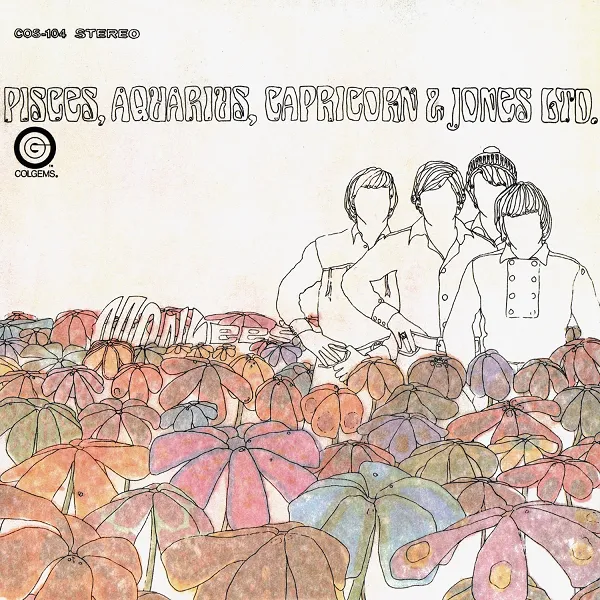
Oh man, you remember The Monkees, don’t you? That happy little American ’60s band that crafted a bunch of fun pop tunes for the whole good family, such as “Last Train to Clarksville” and “I’m a Believer?” The kind of band you buy a Greatest Hits of for some innocent nostalgic fun because you doubt there’s much more to them than that.
Well, you’d be wrong. I know I was. Pisces, Aquarius, Capricorn & Jones Ltd. (horrible title, by the way) is this legendary pop band’s fourth album. Around the time of their previous effort, Headquarters, The Monkees were starting to grow more ambitious and began playing their own instruments, no longer content with just being manufactured pop band idols. And as great as Headquarters was, that ambition finally pays off with PAC&JLtd. (god, what an unapproachable title. I’m just going to start calling it “The 4th”).
In its totality, The 4th is little more than just a fantastic set of psychedelic pop/rock tunes, but so are a lot of the greatest ’60s albums. While a few of the songs on The 4th have more in common with early ’60s R&B pop/rock songs (“Salesman,” “She Hangs Out”—as great as those songs are, too), the album shines the most when it brings in the hypnotic and resonant psychedelic influences, such as “The Door Into Summer,” “Words,” and “Love Is Only Sleeping.” The last of those is my favorite from the album, and perhaps from The Monkees in general.
The eclecticism doesn’t stop there, however. The closing track, “Star Collector,” features a Moog synthesizer (one of the first uses of a synthesizer on a rock album ever). The Moog synthesizer sounds just as goofy now as it did back then, but it adds a lot of fun to the upbeat song. “Pleasant Valley Sunday” is one of the group’s strongest singles and one of the happiest ’60s pop songs ever made (and the rest of them are on this album, too). The only true dud here is the introduction to said song, written on the album as “Peter Percival Patterson’s Pet Pig Porky.” Every bit as stupid as it sounds, it’s a seconds-long vocal-only silly story about… well, you’ll find out. It makes the album more interesting, as stupid as it is.
The semifinal track “Don’t Call on Me” is a beautiful acoustic ballad written and excellently sung by Michael Nesmith. The song’s intro introduces Nesmith as a fictional performer, playing a song to a crowd of classy people at “the elegant Pump Room of the magnificent Palmer House, high over Chicago” and sets the mood for the song perfectly. A stunning track and creative decision, and after the song finishes we are returned to the “elegant Pump Room” as the carefree audience gives a lukewarm reception, carrying on with their business. The lack of attention paid to the singer drives home the emotion of the song, the feeling of loneliness and the confessional, brutally honest nature of the lyrics that seemed to go right over the fictional audience’s heads. Absolutely gorgeous. Scratch what I said about “Love Is Only Sleeping,” “Don’t Call on Me” is the highlight of this album.
Highly recommended for ’60s rock fans.
Leave a Reply