








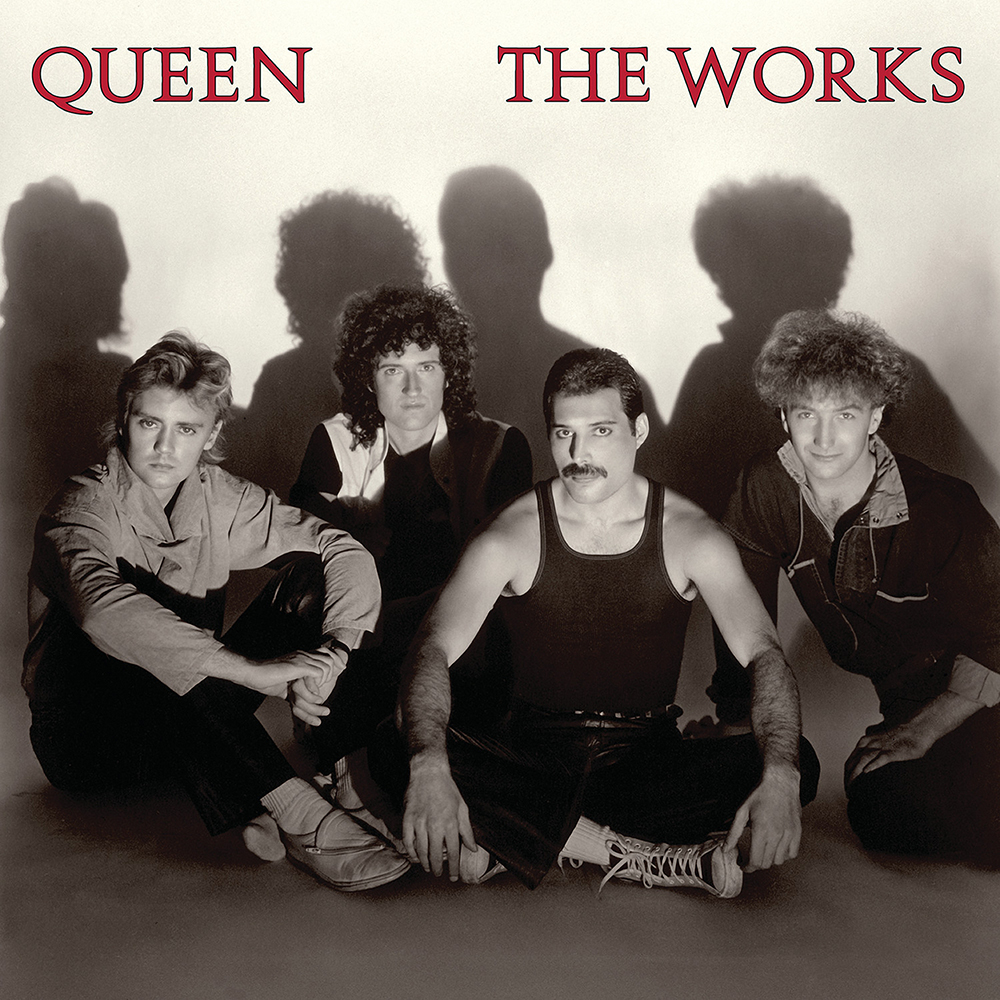
The most “eh” album Queen ever made, maybe. The Works is rarely anything impressive, never anything that repulsive. They’re less reliant on synthesizers than on Hot Space. And thank god for that, because now they’re tactful enough to know when to use them in the songcraft. As a little fun fact, this is the only Queen album where every single song has been released as a single (including B-sides). If you’ve ever wondered why this album is covered the most on their various compilations, then that’s the reason why.
“Radio Ga Ga” is the album’s required runaway single, and its primitive bubbling and glistening synth bits sell the romanticized bygone era. The chorus is a bit… juvenile, to say the least. What would you expect from a line inspired by Roger Taylor’s newborn child? I do still really like the verses though, so I’d call it a single worth having.
Most of the reason my response to this is so “eh” probably has a lot to do with the fact I can’t give one damn about any other popular song on here. I have no idea why “I Want to Break Free” has so much continuing success. It has the clumsiest use of synthesizer on the album and the solo sounds positively drunk. I do like a lot of Freddie Mercury’s vocal melodies and inflections on the song, like his emphasis on “Walk OUT the door!,” but Freddie always delivers these quirks. That’s why he’s one of the best, and why you can get it paired with some better Queen songs. “Is This the World We Created…?” is another popular deep cut, but Queen rarely ever have the posture to pull off something minimal and heartfelt. This call to have the world look inwardly at their far-reaching political decisions is neither musically compelling to draw people to its message, nor is its message delivered with enough nuance or detail to not sound like a platitude.
In fact, The Works marks an important turning point in Freddie Mercury’s lyrics. Where he used to swap between inwardly-focused confessional songs (“Love of My Life”) and surrealistic cultural melting-pot fantasies (“Killer Queen,” pretty much anything, really), Freddie now began to write songs about the world around him when the reality is that his eccentric soul was far more interesting than the outside world. That’s what drew people to Queen: the romance. The confidence. The shutting out of the outside world through sheer volume. Now Freddie would be writing songs about other peoples’ relationships and the state of the world without any perspective. And perspective is a very large part of art’s importance, no?
One exception I make to these blatantly political songs is “Hammer to Fall,” another reasonably popular single and easily my favorite track on the album. Not only is it the most “rock” song on here by some margin (the one thing Queen obviously were experienced with), but it just happens to be a damn good one and doesn’t require a powerful force behind its message – its right there in the music. The song itself is about the danger of inevitable nuclear war (the mentioned “hammer”) and focuses about how no one is protected from it. Brian May’s coldly mechanical riff is followed by a powerful drum hit that literally mimics the song’s title like iron clashing on iron. It’s enough alone to etch this song into memory, but they also stick to familiar effective trades like May and Taylor’s choral-like backing. The part where Freddie opens with “Lock your doors the rain is pouring…” has such pleasantly smooth production and he rides on top of those backing “ooohs”. “Hammer to Fall” is such a cool, catchy, blue song—and I love anything that sounds blue.
The rest? Well, “Man on the Prowl” is an obvious attempt at recreating “Crazy Little Thing Called Love,” similar to Blondie‘s many attempts at recreating “The Tide Is High.” The reason “Man on the Prowl” isn’t very electrifying is because, despite the music being on-point enough with its rockabilly era, Freddie isn’t wholly committed to the persona like on the previous single. His Elvis impression is too obviously tongue-in-cheek (you can hear it in his “ooh-ahs”, etc.) and when he breaks the persona entirely to yell the song’s title it takes you out of the pastiche and yet again it feels like Freddie is writing about someone else rather than indulging himself in the fantasy. Though the song isn’t very successful, its gimmick alone gives it some charm and Freddie’s piano playing on the track has its moments.
“Machines (or ‘Back to Humans’)” is one of the weirdest experiments Queen’s ever attempted and it’s so out-there I don’t even feel like it’s worth parsing it. The obvious explanation is that they got too up their own arse with the obvious sci-fi imagery provided by the new era of electronic music like Kraftwerk and were too busy being amused than to write a good melody or hook. At best its cutely dystopian with its vocoder robot vocals and programmed drums, but who the hell wants “cute dystopian?” “Keep Passing the Open Windows” is a song whose lyrics meant a lot to me for exactly one day and one day only, and then I never cared about it again, nor do I know what the hell “Keep Passing the Open Windows” means. Knowing Freddie he’s probably literally saying to depressed people not to jump out of a window. “It’s a Hard Life” is my second favorite track on the album because it’s Queen being operatic for the first time in quite a while, though the complexity of those previous mini-operas isn’t there.
This modest album proved, if nothing else, that Queen hadn’t totally lost it after the misstep of Hot Space. But it’s damning for its own reasons because they didn’t recover to the level of The Game, and indeed they wouldn’t until 1991.
Leave a Reply