






Ahh, Fire Emblem. One of my favorite video game series. Fire Emblem actually wasn’t my first strategy RPG. That was Shining Force, which I had played on Sega Smash Pack II for the PC. I loved it, though. I don’t think it was until later that I got a GameCube and played Super Smash Bros. Melee. Two of the unlockable characters were Marth and Roy, and no one in America at the time knew who the fuck they were, because no Fire Emblem games had ever been officially translated into English.
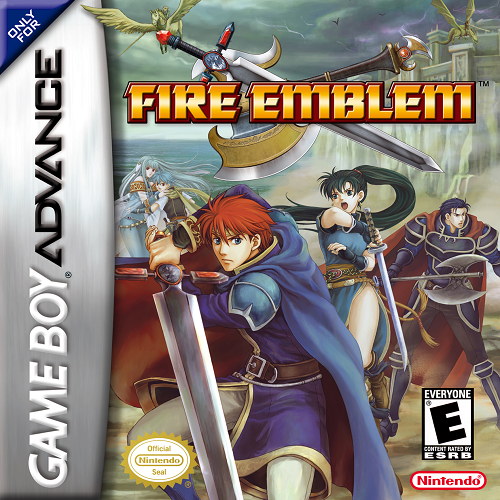
I remember the demand from fans wanting a Fire Emblem game in English was outrageous, and Nintendo complied, deciding to translate the next game in the series. The seventh installment of the Fire Emblem series, known in Japan as Fire Emblem: The Blazing Blade, and in other countries simply as Fire Emblem was released in November 2003 for Game Boy Advance.
Where do I begin? Like I said, this was the seventh game in the series, even if those outside of Japan weren’t made aware of it. The series had made a lot of steps forward since its beginning days on the NES as the first strategy RPG game ever made. Fire Emblem 7 (FE7), as I will call it in this review, is the truest fruition of all the trial-and-error and steps forward the series had made over the year. As such, Fire Emblem 7 still remains one of the best of the series and the rest of the world couldn’t have asked for a better introduction to the long-running franchise.
I’m going to break down the general gameplay of the Fire Emblem series next and explain the gameplay advancements unique to Fire Emblem 7. Just about every Fire Emblem game has moderately different mechanics from another in the series, so I’ll go over the particulars of each game as I write about those. But for now, a general look at how the games are played and how Fire Emblem 7 itself is played.
Fire Emblem is a SRPG series (strategy role-playing game) where you take turns with the enemy force commanding a squadron of fighters, or “units,” trying to accomplish an objective specific to that stage. Stages are usually referred to as “chapters” in the series.
Your typical goal in each stage is to either defeat all enemy units, or conquer their throne/castle/whatever, usually by defeating a boss unit guarding it and using your main character to “seize” the spot they were on. You move units one-by-one on a grid.
Each unit has a different class, such as a Fighter or a Mage, which determines what weapons they can equip and how they fight. For example, a Fighter generally only uses axes in the series, which are mostly short-range weapons with low hit but high attack power.
Mages can use Anima magic tomes, which can attack up to two spaces ahead. There are other kinds of magic users who use different types of magic in Fire Emblem 7, such as Monks who use Light magic, which has a lower hit than the Anima magic Mages use, but generally has a higher attack power and chance of a critical hit. There are also Shamans who have the most powerful magic of all, but it is also the heaviest and hardest to hit with. To also help make up for this, Dark Magic tomes usually have special effects attached to them, like being able to sap enemy HP, for example. There are many more classes in the game than this, but you get the general idea without me explaining every one of them.
Each class, or rather each character, has their own statistical growth. Characters fight and defeat enemies until their experience points hit 100 which causes that character to level up. In the Fire Emblem series, stat growth is determined randomly. Each character has a certain percentage chance of having that particular stat increase with each level. One character might have a 40% chance of strength increasing with each level, while another might have 60% chance, or even lower, or anything really.
A character’s growth rates cannot be changed and are specific to the character, but there are usually general similarities between characters of a certain class. Like how Myrmidons are characterized as fast and skillful sword fighters, so generally characters of that class have high skill and speed growths with lower growths in strength and defense. Of course, still no two characters are the same.
The bad thing about the random growths is that it’s all luck. You can have a character with the best growth rates in the game turn out terrible just because of bad luck. But the same can also happen so every player should have no problem finding a team of characters that turn out good enough for them to use the whole game. The plus side of random growths is that it makes each play through the game unique, and gives each player character their own playing style and “personality,” if you will.
Once a character hits level 10 or higher, they can be promoted into a new class and receive stat bonuses. The new class is usually an upgraded version of the old class with higher maximum stat levels. Promoted classes also sometimes have special skills or access to more weapons. A Myrmidon promotes into a Swordmaster, which can still only use swords but have a bonus chance of scoring a critical hit with every attack. Fighters promote to Warriors, which have no special skills, but they can wield bows in addition to axes. In Fire Emblem 7 the max level of both classes is 20. Your level resets when you promote, so it is recommended you don’t promote until level 20, in order to get the most level ups possible and the most stat increases.
Now, let’s talk about combat. Each character and class fight differently, as we’ve already been over. When you go up to an enemy character and have a weapon equipped and are in close enough range to use that weapon, you have the option to attack. Select that and a window pops up showing you a prediction of the battle, which is pretty helpful. You can see the damage you and your enemy will deal to each other in battle before it happens, as well as your chance of hitting the enemy, chance of avoiding them, and chance of scoring a critical hit. Use those prediction menus well in order to not make a mistake fighting an enemy that will hurt you more than you hurt them.
When battle starts, the person initiating the battle moves first to make an attack, and the person being attacked then counter-attacks, if they are able to. If a character’s speed stat is at least four points higher than the other character’s, then that unit will attack again at the end of the round. This, in addition to increasing your evade ability, is what makes the speed stat the most important stat in the series.
In battle, you might have a small chance of scoring a critical hit on the enemy, which deals triple the normal damage. Your critical hit chance depends on how high your skill stat is and if the weapon you’re wielding increases your chances of scoring a critical hit. There is also a luck stat, which in addition to increasing your dodge rate just like speed does decreases the odds of the other character dealing a critical hit by 1 for each point of luck you have. As said before, character class can also affect critical hit odds. There is also the defense and resistance stats. Defense is self-explanatory and decreases the damage you take by 1 for each point of defense you have, and resistance does the same thing, only it is your defense against magic attacks.
Let’s talk about weapons. The kind of weapons a character can equip depends solely on their class. Physical weapons work as follows: swords generally have the highest hit and lowest attack, axes have the lowest hit and highest attack, and lances are in the middle. There are also bows, which can only attack from a range of 2 spaces ahead (3 for the Longbow weapon). This means bow users usually don’t have to worry about counter-attacks, but it also usually means that if a bow user is attacked short-range, they won’t be able to counter-attack themselves.
The other three weapon types generally can only be used against adjacent units, but there are special, usually rarer/more expensive weapons that can attack from up to two spaces away, such as javelins for spears or hand axes for axes. These usually have a very low chance of hitting, but are always worth having for convenience. There are also magic users, and magic works in a similar fashion. Stat-wise, Anima magic is comparable to swords, Light to lances, and Dark to axes.
Instead of bows, some magic users have access to staves. Staves cannot be used to attack, but can be used to heal friendly units or hit enemies with special status effects like Sleep or Berserk, where the unit will attack anything in sight, friend or foe. Each weapon in Fire Emblem 7 also has a weight stat. In Fire Emblem 7, a character’s ability to wield heavy weapons depends on their constitution stat, which cannot be increased without items or a class promotion.
Say a heavy weapon, such as an axe, has a weight of 10. If the character’s constitution stat is 10 or above, the unit can wield the weapon perfectly. If their constitution stat is lower than 10, then they suffer a speed penalty based on the difference between the weapon’s weight and the character’s constitution. A character with only 8 constitution will then suffer a 2 point loss in speed. In general I don’t like this mechanic. In Fire Emblem 6-8 this is how it’s always handled, and a character can be screwed over simply by naturally having a low constitution.
It’s an unfair advantage that some units have (usually males) over others, and the ones that have low constitution don’t generally have particularly high stat growths to make up for their loss of speed. In Fire Emblem 9, a character’s strength determines how well they wield heavy weapons. But then, all units who are physical fighters will eventually get high enough strength to render weapon weight completely irrelevant, so axes unquestionably become the best weapon type in the game.
The best way to handle this mechanic was how the earliest Fire Emblem games did (3 and prior), where your constitution also had a chance of increasing on a level up, albeit a very low one. I’m getting off-topic, but I didn’t want to forget about that mechanic later.
Both set of weapons have a “weapon triangle,” where each weapon has an innate advantage over another. The weapon triangle for physical weapons goes: Swords > Axes > Lances, with lances wrapping around and being better against swords. Magic goes Anima > Light > Dark. Units with a weapon triangle advantage will deal slightly more damage as well as having a better chance to hit the enemy. Bows are neutral towards every weapon type and as such suffer no advantages or penalties against any weapon, similar to what happens when two sword users fight, etc.
Naturally, a weapon triangle disadvantage can be overcome by having naturally high stats, or simply equipping a different kind of weapon if possible. If the weapon triangle were too powerful, then it could make combat a glorified version of rock-paper-scissors, but the advantages gained by the weapon triangle aren’t strong enough to break the game like that.
At its best, the weapon triangle just adds another layer to planning out what units to send out to fight the enemy. Usually enemies are grouped with a bunch of different class types, so one weapon type can’t dominate all the fights. Weapons also have durability that depends on the specific kind of weapon. An iron axe has 45 uses, meaning after that axe hits something 45 times it will break and you will have to find a new one. There is a special staff that can restore weapons to full uses, but it can only be used three times itself and should be saved for very rare weapons.
There are also weapon ranks. Each weapon has a rank the character needs in that weapon type to use it. Weapon rank rises by attacking a lot with that weapon type. When a unit’s HP hits 0, they are dead and are removed from the map.
Let’s talk about that real quick. Characters in Fire Emblem permanently die. If one of your character’s HP hits zero, they are gone. You have no second chance unless you are in the tutorial part of Fire Emblem 7, which is the only entry that does this, where any characters who died there will return later in the game. When a character dies, you can never use them again and you lose all the items they were holding. In Fire Emblem 4 for the SNES, there is a special staff you can get that can revive a dead character, but it can only be used once and is extremely expensive to repair and use again.
The perma-death aspect of the Fire Emblem series is by far the biggest criticism of it, and also the dumbest. Let’s be honest. Most Japanese strategy RPGs are not very strategic. They are like most JRPG battle systems where it is just a power struggle, spam your strongest attacks and you win with no thinking involved. Part of this lack of thinking comes from there being no consequence from your actions.
In other strategy RPGs, when characters die you can simply revive them, either for free or for some usually negligible price. There is very little risk involved in not planning out your strategy in most strategy RPGs because even if you fuck up, it’s pretty easy to undo all damage when you beat the enemy on complete offense and move on. Characters dying in Fire Emblem forces you to actually use strategy in a strategy game and play defensively! Gasp! Those fucking bastards. How cheap.
Oh wait, it isn’t cheap in Fire Emblem 7. How could it be? You can view every enemy’s attack and movement range on your turn to prepare yourself for when they move and avoid any danger if you put in the thought to. Before attacking you can see the outcome of the battle before the actual fight, so you shouldn’t dive headfirst into a fight that will fuck you over more than you hurt the enemy. Even if an enemy is out of range, it only takes simple math by looking at their stats and yours to predict the outcome of the battle yourself when they come in range.
So hopefully, you now agree that perma-death in the Fire Emblem series is a good thing, if you didn’t already. It actually forces you to think, because the consequences are dire if you don’t. Even if a character does die, there are many, many more you can use in their place. “B-b-but when a character dies I can’t stand the thought of having an imperfect game so I have to restart the chapter and do it all over again!” Tough luck.
Again, the fact the character died was your fault. And also, that is your personal problem if you have an OCD that prevents you from letting anyone die, not the game’s. The game isn’t forcing you to go back, you are.
With all that said, I understand being frustrated. Shit happens sometimes. Even with the calculated odds of an enemy scoring a critical hit or even a regular hit being low, they can still sometimes do it and kill you. But the same luck can also happen for you at times, and usually more often, because player characters have better stats than the enemy.
Besides, this is how video games are. If there was no challenge at all, no consequence, then it would be less rewarding to win. Everyone knows that. There is a certain luck factor in Fire Emblem that can catch anyone off guard, but that’s what keeps the stages constantly tense and exciting, not boring and mechanical. And even then, you could just avoid taking any and all risks if you wanted.
To conclude, even though perma-death has pissed everyone off at some point, it is still a good game mechanic when you actually think about it at all. I also really can’t think of a Fire Emblem game being challenging at all if perma-death was removed. It just doesn’t work for the rest of the gameplay. I’m sure it’s possible, but stages would be have to be designed a lot differently than what we’re used to.
I can’t imagine any of the Fire Emblem games currently out being difficult at all on any difficulty mode if characters did not die or there was no consequence to losing a character. The latest Fire Emblem games coming out have a “casual mode” where characters do not permanently die. Oh well, at least it will shut people up and the rest of us can play on the normal mode.
Finally, we talk about the map itself. Movement is grid-based, meaning you move in squares. Each unit has a different range they can move per turn once again depending on their class. Mounted units, such as Cavaliers, can travel much farther than other units because they are on a horse. Flying mounted units, like Pegasus or Wyvern Knights can move even further, and can fly over pretty much every terrain.
Let’s talk about terrain. Not only does some terrain impede movement, like how characters move slower through forests and how most characters can’t cross deep water, but it also gives bonus effects to characters on the terrain. Forest terrain boosts a unit’s defense on it by two points and gives them a bonus 20% chance of dodging enemy attacks. Obviously, that is a huge help, so positioning your units right at the end of turns and before attacking is a large part of your strategy.
Some stages have houses you can go inside and either get a special item or information. Certain enemy types like Brigands or Pirates will aim to reach the houses before you do and destroy them, robbing you of the item (I swear half of the game’s difficulty comes from trying to reach these houses as fast as possible). There are certain buildings you can go inside and but items, like the armory or vendor.
A couple stages have an arena where you fight enemy units in battle and gain experience and gold for winning. Just be careful not to die. There’s other stage gimmicks here and there (not enough, in my opinion) like in caves where lava can spurt out from the ground and hurt units on top of it. There’s breakable walls units can attack, or trees units can knock over and cross water with.
Sometimes, there’s treasure chests that the Thief class can open with a lockpick or anyone else who has a treasure chest key. Locked doors, which can also be unlocked with Thieves or door keys, and I think that covers it. Just move around all the obstacles and kill all the enemies or whatever it is the game and wants you to do and moves out in advance and use the terrain to play defensively.
And that covers the general gameplay of the Fire Emblem series. Now we are going to talk about game mechanics specific to FE7. Each game has slight differences, but those are the general mechanics that have stuck with the series either since the beginning or since they were introduced (the weapon triangle wasn’t introduced until FE4). There are a few things Fire Emblem 7 (or rather FE6, the first GBA game in the series) got rid of that were in previous games.
The biggest one that comes to mind are individual special skills for each character. This was introduced in FE4 and helped characters feel more unique and gave them more personality. The GBA games got rid of those and instead assigned only a very small amount of bonuses to certain promoted classes, like said earlier such as the critical bonus for Swordmasters. Boring.
Fire Emblem 7 refined a lot of old game mechanics and balanced them better them ever, but it didn’t introduce too many brand new mechanics. FE6 introduced the Support system which FE7 made better, for example. Each unit has certain units they can “support.” By placing these units next to each other in battle and ending the turn with them adjacent with each other, they will gain support points.
Once a pair reaches the right amount of support points (varies based on the pair), they can have a support conversation on the map. These conversations between the characters often explain more of the character’s back-story or personality, which in turn make you care a lot more about them and the Fire Emblem army and world in general. A lot of information about the plot and world of the game are not explained anywhere else and are explained in support conversations.
A character can have up to three support conversations with one character. The higher the level, the more the characters will receive a stat bonus when placed within three spaces of each other on the map. The stats increased are hidden and depend on the character’s elemental affinity that can be viewed in their status screen.
A character can have up to a maximum of five support conversations, and you can combine them any way you want. A character can have one A rank support level with one character and one B rank level with another, for example. Or even five C rank supports. If two characters end on an A rank support, then their epilogue in the ending might change, like they end up getting married or something.
I think this whole system is cool and really adds to the game. Fire Emblem 7 gave the support conversations much more depth than in FE6 as well as simply increased the number of them. My one complaint about this system is not being able to see the stat bonuses and that your characters have to be right next to each other to gain support points. They should at least be able to get them by being a certain number of spaces away. If a player doesn’t know how to get support conversations, then its very likely they can play the whole game without finding any.
After beating the game, the game saves all support conversations you’ve viewed in a Support Conversation reader mode where you can re-read any convos you’ve seen before. A nice addition that FE9 got rid of for some fucking reason.
Fire Emblem gameplay has a great foundation, but even good ideas can make for a bad game if they aren’t used properly. So how well-balanced is the gameplay of Fire Emblem 7? Actually, it’s one of the most balanced games in the series. Chapters are consistently challenging in the sense that they gradually rise in difficulty as you progress, which it should. Considering each character’s average growth rates, most units are perfectly usable in every map and are effective fighters.
There are obviously going to be characters that are better than others on average, but the differences aren’t too big, so you can play with your favorites. I still wish every character was more equally viable (Fire Emblem 9 came the closest to that), but FE7 comes close to that. Most of the “bad” units are pre-promoted units. Pre-promoted units are units that join and are already at a higher class/level than your other units will be at that time. These units are kind of handicaps at the time they join because they are so much stronger than your other characters, but they generally have low growth rates and will end up with lower stats at their maximum level than a character who started out unpromoted but had better growths and more levels to gain.
While this does help balance things out, would it be so much to ask to just not make the pre-promotes too overpowered and give them decent growths so the player could still use them if they just personally liked that unit? There are some pre-promotes in FE7 that end up pretty bad compared to just about anyone else. Compare this to Fire Emblem 9, where pre-promotes are mildly weaker than unpromoted units, but still have good enough stats to fit into any well-balanced team.
This way, there was still a benefit to giving EXP to low-level characters because they usually end up the strongest, but if they were killed off or you simply liked a pre-promote more, you could use them without consequence. I hate it when I get a character I think looks cool but is utter shit in battle, like many of Fire Emblem 6’s characters. Often times when that happens, I hack the game and give them normal growths. I admit it. I don’t consider it cheating myself (and I do it after I beat the game, so whatever).
There’s also the “Jagen.” The beginner’s trap of every Fire Emblem game. Jagen was the name of a pre-promoted Paladin that joined at the start of the game in the first Fire Emblem. A new player would see how much better Jagen was and use him to happily mop up all the enemies by himself. This is fine at first, but because Jagen’s growths are terrible, the enemies get stronger at a faster rate than he does, and eventually your only good fighter will be Jagen who will sooner or later not be able to put up a fight.
What do you do then? You are totally fucked and have to restart the entire game. That’s so fucking cruel, and they kept doing it until Fire Emblem 8, where the Jagen was a good pre-promote. In Fire Emblem 7, your Jagen is a Paladin named Marcus. When I first played the game, I made the same crucial mistake and used only him, only to not be able to beat one of the later chapters and had to restart until I learned that the more time-consuming lower-level units were ultimately worth it. Fuck Marcus.
It’s nice to give the player a handicap, but there’s only two ways they designers expect it to go: 1) The player uses the pre-promoted unit in moderation, but the unit is still strong enough to render any challenge in the beginning of the game obsolete, which would make the game too easy and boring. 2) The player uses the pre-promoted unit a lot and then everyone else becomes way under-leveled and beating the game becomes impossible. There’s also the possibility that they don’t use the pre-promoted unit, but if the developers intended for that, why put the fucking Jagen into the game? It’s just a trap or an unnecessary handicap.
Now we talk about class balance. To be fair, these are balance issues present in most of the Fire Emblem games. For starters, the Cavalier/Paladin classes are way too fucking overpowered. You generally get plenty of them, and not only is their movement way higher than other characters, but they can use any unused movement at the end of their turn after they perform an action, allowing them to hit-and-run and always stay ahead of the pack or in safe areas.
Paladins in Fire Emblem 7 have access to all three types of melee weapons which means they’re never at a disadvantage in the weapon triangle when properly-equipped. Also, their maximum stat caps are pretty good and so are the growths of Fire Emblem 7’s Cavaliers, so it is clear that the Cavalier/Paladin classes are the best in the game when it comes to overall usefulness. In Fire Emblem 4, the Cavaliers still had all these nice perks, but some of them could only use one to two weapon types and they all only had average stats, so they couldn’t fly ahead and mop up everything. They didn’t have the stamina for it.
And then there’s the Archer/Sniper class. On the other end of the spectrum, this is unquestionably the worst class in the game. Again, problems with classes aren’t related to the characters growth rates. Rebecca has fantastic growth rates and is an Archer, but she is unfairly crippled by her horrible class. Archers can only attack from a distance of two spaces away.
Compare this to magic users who can attack from one to two spaces away at all times. Because every other class in the game can fight in close combat, it means that on the enemy phase, an Archer can’t counterattack any enemy. The enemy will only attack from two spaces away if it’s all they can do. Compare this to other units who can always counter-attack, they will end up killing more enemies and will be more useful units.
Considering even every melee weapon type has a long-range weapon, there’s no point to Archers/Snipers even existing. Their movement is average, they can only use Bows which are the worst weapon type in the game, and they get no special class bonuses. Snipers should have been the class to get a +15% critical bonus at least, and even that wouldn’t be enough to make up for not being able to kill anything on an enemy phase.
“But Snipers are really good at evading,” you might say. Well, so are magic users, but they can hit from one to two spaces and counter-attack, which also eliminates the chance of them becoming cornered. A number of melee fighters are also fine dodgers. I like a lot of Archer/Sniper characters, but let’s face it, they are obviously underpowered I’m confused by how this hasn’t been fixed yet. Supposedly, newer games give them a critical bonus and an attack range of two to three spaces. I could be wrong about that, but if I’m not, then great. I think they should also have one more space to move, but that’s just me.
Bows sucking is also what makes the Warrior class kind of mediocre. The other promoted axe class, the Berserker, has no second weapon type but increases critical hit chance like the Swordmaster class does. Considering Bows are going to be inferior to Axes in almost any given situation, the critical hit boost makes the Berserker class more useful. But only Pirates can promote to it, not Fighters.
One of the things Fire Emblem 7 fixed that Fire Emblem 6 had a problem with was allowing the Thief class to promote again. Now Thieves can promote into the Assassin class. Which I also feel is underpowered. Assassins can still use the Lockpick item to open doors and chests, but lose their ability to steal (why?). In return, they have higher stats and a 50% chance to auto-kill an enemy during a critical hit.
First of all, that’s not really that great. When you critical an enemy, generally you’re going to kill them simply with the tripled damage boost. Unless you’re the Assassin class, which has a low strength cap and uses swords which are the weakest weapon in the game. Other units don’t need to rely on critical hits to kill, with the possible exception of the Swordmaster class, which gets a helpful critical bonus and is also able to promote way earlier in the game.
Characters in Fire Emblem 7 need special items to promote, depending on the class. First of all, I hate this because it stands in the way of the player getting to use all the units they want because there’s a limited number for promotion items. It’s also inconvenient, and I’m glad it’s not in the non-GBA games. Thieves need an item called the Fell Contract to promote. The earliest this item can be obtained is from a drop from a boss character in a secret side-chapter near the end of the game. I think the the chapter is 25x and there’s only 30-31 chapters in the game.
By the time you promote your Thief, you barely get enough time to enjoy them, let alone fucking level them. That is bullshit. It’s not like Assassins are some super-powerful class that should only be given to the player at the end of the game. That’s ridiculous. And if you miss that drop, then your only other opportunity for a Fell Contract is in a secret shop in the second-to-last chapter of the game. Fuck off.
As an aside, I also think Fire Emblem bosses in general are way too fucking easy. They are never memorable. Most bosses don’t move from the spot they’re on, so you can pick them off from long-range or have a character fight them then retreat so you can heal them, and their stats aren’t high enough to worry about. Bosses are basically heavy doors to the next chapter of the game you bust down in a second and forget all about. Very anti-climactic. The final boss battles aren’t any better, sadly.
…I think that addresses all my complaints about Fire Emblem 7. Again, most of those complaints are general problems with the series, like Archers sucking. But Fire Emblem 7 is still pretty well-balanced. The maps are designed with several ways to strategically position your units, and the terrain is placed in ways that make the environments look natural. There are a lot of memorable stages in Fire Emblem 7, and while just a couple can be tedious at times, like with rain/snow slowing your movement in some chapters, they are usually fun to play, exciting and tense.
Fire Emblem 7 is also the first game in the series to have a tutorial mode, probably because they were translating the series for the first time. This tutorial segment is 10 chapters long and has you playing as Lyn, a young nomadic girl who learns she is next in line to become the marquess of the continent, Caelin. She sets off with two knights of Caelin named Kent and Sain in order to stop the marquess’s corrupt cousin Lundgren from usurping the throne.
While this tutorial is awesome for a first time player, it isn’t skippable the first time through the game, which is pretty annoying, as it moves quite slowly. After you clear the tutorial the real game starts and you begin playing as Eliwood, who is the future father of Roy from Fire Emblem 5 and Super Smash Bros. Melee (yep, this game is a prequel). Eliwood goes off in search of his father, the marquess of Pherae who mysteriously left the castle on undisclosed business.
Along the way he meets up with Lyn and her squadron again, along with his best friend Hector, the heir to the throne of Ostia. The young lords eventually uncover a dark plot to take control of the entire continent of Elibe and have to stop it. I should also mention now that if any of the main characters die, the game is instantly over. Kind of annoying, but whatever.
The storyline of Fire Emblem 7 is nothing too mind-blowing or unique, but it’s one of the best in the series and certainly above average for a JRPG. It should be enough to keep anyone’s attention and involve them. Another thing that helps engross the player into the story is the superb soundtrack (again, one of the best in the series) and great character and background art.
The progression of the game goes like this. Story -> Battle Preparations -> Battle -> Story -> Next Chapter. In the battle preparations menu you can re-organize the inventory of characters and things like that. Upon beating the game you get a music player mode where you can play any of the tracks in the game you’ve heard. Some are hidden, so finding them all adds replay value. You can also view special cutscene images you’ve seen throughout the game, and again, some of these are hidden.
There’s a Link Arena where you can make a team of five characters and battle either another player via link cable or the AI. The AI however is fucking stupid in Link Arena which really takes a lot of the fun out of it. Too bad. I also would have preferred a multiplayer mode where you play on pre-generated maps, like a strategy game, but I guess that’s too much to ask! As mentioned before, you can re-read all support conversations you’ve found, and there’s a ton, so that’ll keep you busy.
Best of all, though, upon beating Eliwood’s mode, not only do you unlock the harder version, but you unlock Hector mode as well, which is mostly the same game from Hector’s perspective. The story dialogue and cutscenes change slightly, and there a few brand new stages and two new characters that can be obtained. I remember finding out about this mode when I beat the game and being so fucking excited.
What a great edition. All the incentive anyone needs to play through the game, and they didn’t even have to change much. The old maps are the same layout, but the enemies are positioned differently and are a bit stronger.
Another thing Fire Emblem 7 did to add more replay value and increase the length of a normal game is have sub-chapters. These are secret, optional chapters the player can choose to do or not upon beating the chapter before it and fulfilling a certain requirement, like clearing the stage in a certain amount of turns or some other hidden objective.
Finding all of these can take multiple playthroughs, and on a casual playthrough it’s likely you won’t play through all the same stages, so each playthrough will be a little different and hopefully have enough surprises to keep you busy for a while.
Sub-chapters not only offer more enemies to kill and get more EXP, but also explain more details about the story that aren’t explored in regular chapters. To learn everything about Fire Emblem 7’s story, you’ll have to play all the sub-chapters and read certain support conversations.
If it isn’t clear by now, Fire Emblem 7 is arguably the best game in the series. I suppose it’s just a coincidence that the first translated game in the series turned out to be one of the best and a great starting point, but I’ll take it. The only competition I think FE7 has for being the best Fire Emblem is 9, otherwise known as Fire Emblem: Path of Radiance for the GameCube. I think that game had a better plot, art, and soundtrack, as well as better balance, but it was too easy and the stages weren’t as well-designed or as memorable.
Whichever you prefer, Fire Emblem 7 is a fantastic game with a ton of replay value for a strategy RPG and I would recommend it to any fan of the genre. It is one of the best exclusively portable games I have ever played, and it is possibly the best Game Boy Advance game. It certainly doesn’t have much competition. I apologize if this came across as a little unorganized. I love this series and have beaten this game enough times to talk about it for-fucking-ever, so I went into a lot of detail and this write-up ended up being several pages long. Anyways, Fire Emblem—play it.
Leave a Reply