








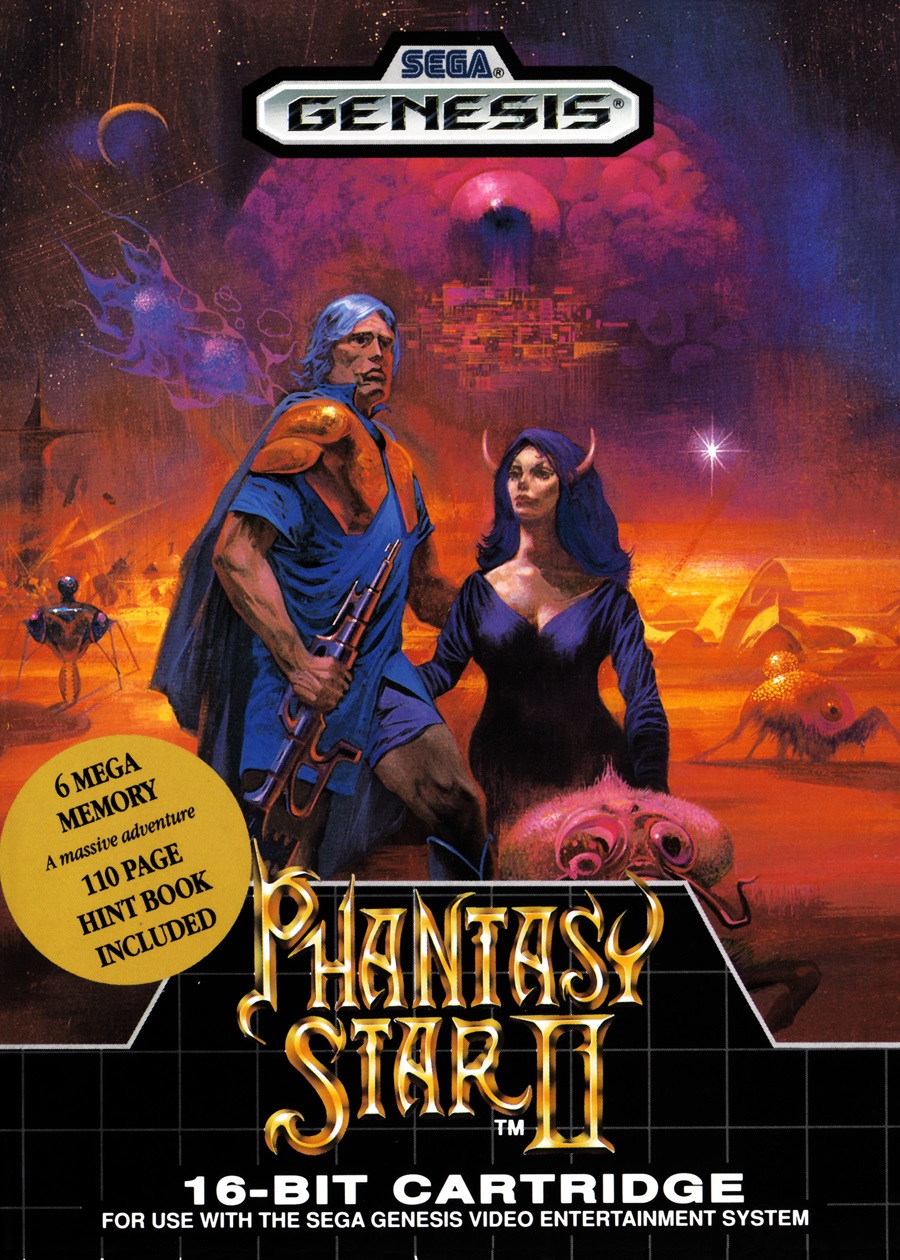
Phantasy Star II
NAME(S): Phantasy Star II: At the End of the Restoration / ファンタシースターII 還らざる時の終わりに
PLATFORM(S): Sega Genesis / Game Boy Advance / Switch
DEVELOPER(S): Sega
PUBLISHER(S): Sega
GENRE(S): JRPG
RELEASED: March 21, 1989 [JP] / March 1990 [NA] / November 30, 1990 [EU]
RELATED: Phantasy Star IV: The End of the Millennium
Background on Phantasy Star II
Phantasy Star II is the second game in Sega’s own flagship RPG series. Released in March of 1990, Phantasy Star II was the first 16-bit RPG released in the west, and in Japan it predated even Final Fantasy III on the NES. Like its predecessor, Phantasy Star II creates many new standards for the genre. Perhaps the most significant thing about Phantasy Star II is that it was one of the first RPGs to have interchangeable party members that could be swapped out freely at the player’s home.
In Phantasy Star II you take the role of Rolf, who is assigned a mission by the government to investigate why the world’s overseeing supercomputer, Mother Brain, has started to malfunction and cause chaos within society. While exploring the world, Rolf will come across eight other companions each with their own set of skills to help aid him on his journey.
Gameplay of Phantasy Star II
Everything you’re used to. Walk around towns, talk to people, walk around the world map to get to the next dungeon, clear dungeon and repeat. Buy new equipment sometimes. In battle you can attack physically or use magic spells or items.
The Good
The setting! It’s gotta be said. Even by the 16-bit era the magic and medieval fantasy setting was beginning to become very played out. Phantasy Star II is a full-on sci-fi fantasy game with futuristic cities, guns and laser swords for weapons, robots for enemies, and giant factories for dungeons. It’s a real breath of fresh air, and a step forward from the original Phantasy Star that only had minor sci-fi elements (you still fought with steel swords and the dungeons were literal dungeons with brick walls).
Lots of very bright colors and detailed sprites as far as Genesis RPGs go. I’m especially impressed with how good both the characters and monsters look in battle.
The music has kind of a “cheap” and tinny quality to it, but somehow still sounds very cute and charming. I find the town, start menu, and battle themes to be very catchy. Also, since the Genesis has such an electrifying sound chip, it really suits the futuristic world governed by electronics.
The variety of party members. It’s a standard now, but even in 16-bit RPGs it was uncommon to find a game that would let you change party members. In Phantasy Star II, each character has a specific role they’re suited for. The more interesting ones are the characters that are good for fighting specific types of monsters, such as robots or bio-creatures.
An auto-battle option. But there’s a cost (see below).
A building that allows you to warp from town to town is in every town. Very convenient and ahead of its time, and even more useful when you consider there’s no world map.
The Bad
The story has an original premise for RPGs, but it’s told terribly. When you’re in buildings, cutscenes consist of portraits of the characters talking and the dialogue boxes below them, but when you’re in a dungeon you only get dialogue boxes which can make it very confusing as to who’s talking and to whom. They also really mince words in these scenes and it always feels like enough isn’t explained.
Being one of the earliest 16-bit RPGs, Phantasy Star II doesn’t really feel of its time. In many ways, it looks and sounds like a game that could’ve been done on the Sega Master System without sacrificing much. In other words, expect something that feels “older” than even most 16-bit RPGs.
Very little visual variety in towns or dungeons. Every town looks the same with the same building sprites just rearranged. The only time this changes is during the second planet, but there’s only three towns there and they all look identical to each other as well. Dungeons are also the same textures, but at least they’re usually colored differently from place to place. Many townspeople say the same lines of dialogue no matter which town you’re at.
The only way Phantasy Star II is inferior to the first game is that there’s no dynamic battle backgrounds. No matter where you are, every battle in Phantasy Star II apparently takes place in some wireframe virtual reality arena that stretches into the abyss.
No world map of any kind, no dungeon map. The world map part isn’t such a big deal because you never need to revisit a dungeon and you can warp to any town you’ve been to, but it would still be nice to have a map. The dungeon map is the biggest problem. Phantasy Star II‘s dungeons are huge mazes with no rhyme or reason to them, so it’s trial and error to get through them. Many roads lead to nothing or send you in circles, and there are a ton of warping puzzles.
In addition to the above, dungeons have this ceiling overlay graphic, such as a network of pipes that moves along as your characters walk. It gives the sensation that you’re looking down on your characters from above. At first, this seems very cool. But considering Phantasy Star II‘s dungeon mazes, it only makes them even more confusing. It’s extremely annoying to have most of your view obscured by the ceiling graphic and it’s disorienting at times when you can’t tell where a wall is either because it’s blocked by the overlay or you get confused and see the overlay as a wall when there’s not really one there. If you’re easily susceptible to headaches, I don’t recommend this game.
Unbalanced party members. Some characters in Phantasy Star II are near useless. One of the characters is strong against bio-monsters, but most of the game you fight robots which are significantly stronger and give reason to use the character strong against them. There aren’t enough bio-monsters and they’re fairly weak so the character strong against them is kind of worthless.
There’s a character who can steal from shops, but the stuff they can steal is limited and the same regardless of what town you’re in, and their level doesn’t seem to impact their success rate of stealing, so there’s no reason to fight with them other than to spam healing items in the first attack because of their high speed.
Even though Rolf is the main character, he is far too much stronger than everyone else and for most of the game is the only one with enough TP to afford using spells outside of bosses. Also, replacing party members isn’t so simply done because only members in your active party gain EXP, so you’re much better off picking a party off the start and sticking to it considering how much grinding you’ll have to do. Speaking of bosses, there are barely any in Phantasy Star II. Most dungeons have you simply retrieve an item at the end. No boss.
The battle interface is cumbersome. Instead of simply choosing a command for each character per round, you have to first select the “Order” option, then the character, then what you want them to do, then repeat this for every other party member. When you select fight, the characters then repeat the selected action over and over until you press B to change them again. You also can’t choose which enemy your characters attack, so whether you survive or not in a battle can be down to luck.
High difficulty. This is an old-school RPG right down to the bone. Grinding is absolutely necessary if you want to stand a chance, and because of the above random attacking you’ll have to go through dungeons a lot before you’re lucky enough in battles to make it to the end.
Leave a Reply