








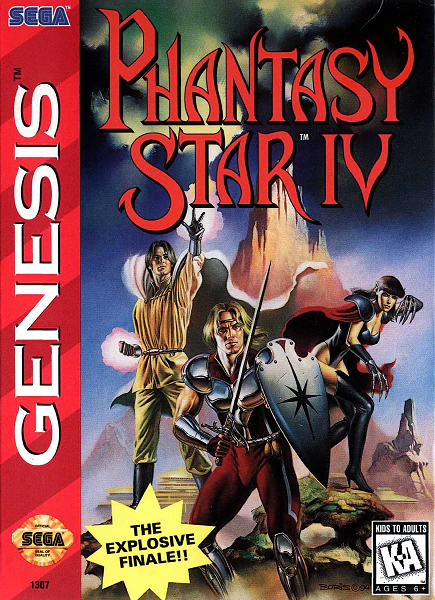
NAME(S): Phantasy Star IV / ファンタシースター 千年紀の終りに / Fantashī Sutā Sennenki no Owari Ni
PLATFORM(S): Genesis
DEVELOPER(S): Sega
PUBLISHER(S): Sega
GENRE(S): RPG
RELEASED: December 17, 1993 (Japan) / February ??, 1995 (North America) / December 8, 1995 (Europe)
RELATED: Phantasy Star II
Phantasy Star IV is frequently called one of the best 16-bit RPGs, but there’s one problem: it’s on the damn Sega Genesis. That thing had like, five RPGs total, and no one talked about them. Sure, the Genesis granted us Shining Force, which is one of the coolest games there is—but no one gave a damn. I’ve always been fascinated by these overlooked RPGs, because this particular genre is one where if anything new is tried, reviews slam it for “missed potential,” blissfully ignoring the same flaws within standard RPGs. Those are dull in addition to being uninventive.
Phantasy Star was Sega’s answer to Final Fantasy. They were kind of a big deal, in many ways being a step or two above Final Fantasy, but in most ways being a bit behind. Phantasy Star II had swappable party members with individual personalities and characteristics, which was a big deal, for example. A while ago I sat down and said I was gonna beat all the Phantasy Star games on Genesis in a row. I thought the first would be a ten-hour long game but I played it for fucking days. Shit didn’t end. The first-person dungeons really tried my patience. I beat it and went on to Phantasy Star II, which I was greatly looking forward to because I had it on Sega Smash Pack, but Sega were incompetent and every game would crash after playing too long.
It was random and made progress in an RPG impossible. I thought it was gonna be some hidden masterpiece like shining force and had its songs stuck in my head constantly, but after beating it although I love its bright colors and techno aesthetic the dungeons were bare, the story was barely there, and the NPCs and towns were practically cut and pasted with dialogue repeating constantly. I went onto Phantasy Star III, saw how it looked even fucking older than the first game and said fuck it in five minutes. then I skipped it and moved onto the good one
This is by a wide margin the best Phantasy Star on Genesis. it has learned from more balanced 16-bit JRPGs like Final Fantasy IV and smoothed out a lot of awkwardness while also innovating like usual. the only thing about this game I don’t like compared to Phantasy Star II is the tone. I’m supposing that by focusing more on graphical detail everything looks a lot darker because the Genesis doesn’t have a big range of colors. or that’s probably bullshit because there are some beautiful Genesis games considering the time this came out and they just went for a lame aesthetic. the setting uses too many dark colors and neutral shades like brown.
Only your character sprites with their weird outfits and hair stand out, and there are too many towns that look too similar. Phantasy Star IV looks more fantasy than sci-fi which is a bummer for a sci-fi fan such as myself. The towns are full of brick buildings rather than the technological cities of Phantasy Star II, and I’m getting more depressed as I type this out lol. They gave justification for this in the story but they could’ve easily had some parts of Motavia be more advanced. they were real lazy with the towns and world design in general. the music is also significantly more genesis, having that electro sound its known for rather than Phantasy Star II‘s early stage bright beeps. I prefer the latter, but Phantasy Star IV‘s soundtrack is easily more consistent in quality.
The animations are excellent. I can’t think of another 16-bit JRPG series where all enemies had unique idle animations. Your own characters all vary greatly in attack animations too, unlike Final Fantasy, where they’re all based on the same sprite model. Chaz’s two sword basic attack swipe is extremely smooth for example and very impressive. The backgrounds look awesome and it’s like all the graphical focus went into the battle screen and not the field.
The manga-like illustrations in every major cutscene are extremely, superbly impressive. This makes Phantasy Star IV far and away the best-presented story of the 16-bit era. These cutscenes seem like a natural precursor to dynamic, 3D cutscenes, but this game is the only one to do them. To see that only a team of four did these illustrations makes your average RPG of the time look embarrassing by comparison. What seems like an obvious idea in retrospect may only have been realized by the Phantasy Star IV team.
The actual story, however, isn’t too great. It’s paced extremely well and finds reason to move the player from town to dungeon quickly with little reason to backtrack, but there’s also a lack of non-expository dialogue after the beginning because you’re solely advancing the plot. There isn’t much time for the characters to interact on a personal level; it’s all contextualized by a simple forces of good vs. the forces evil tale.
The Talk command allowing you to freely communicate with your party helps some, but it rarely changes, and some of this dialogue is very basic. On the other hand, Phantasy Star IV billed itself as a conclusion to the series, and it succeeds there magnificently. The attention to lore from the previous games is astounding and makes playing the earlier games really pay off. Every game prior is acknowledged and heralded in the narrative, yet the significance of their background is talked about enough in the game to have its story work on its own. The game really does feel like a grand finale and reflects constantly on the previous games.
The dialogue is very simple, but innocent and cute. Talking to the airheaded NPCs was always fun, and I liked examining everything in the background. There’s a simple charm to the writing that reminds me of more robust games like Skies of Arcadia and Final Fantasy IX. The plot itself is not something I will likely remember, but I will remember the awe at every cutscene’s graphics that kept my attention when the plot itself couldn’t. That alone makes it a more affecting narrative than most 16-bit RPGs. The game also shows a remarkable amount of flair at certain points, like the traveling vehicles having their own HUD and theme in battle. There’s no reason for Sega to have done so, but they did it and it’s fucking radical.
For its time, the battle system is surprisingly strategic. Turn order is important, status boosters help greatly against bosses, and hitting weaknesses makes a big difference. Unlike Phantasy Star II, the party members are very well-balanced with no character being useless. You can also cast spells without worrying about running out of TP instantly like Phantasy Star II. Every party member has a variety of skills in addition to magic that are mostly unique to them. They can cast special effects a certain number of times instead of consuming TP.
These go a long way in helping give characters personalities and gives physical attackers who don’t have magic more strategic depth which is something a lot of RPGs of this time ignored. Though the solutions to problems posed in battle are still simple with a lot of room for negligence and little in the way of improvisation, an RPG of this time requiring any brain cells at all is rare.
There are also combination attacks that happen when certain techniques are used in an uninterrupted, specific order. However, because these are so specific and turn order is slightly random, running into these on accident is extremely unlikely. They aren’t recorded anywhere after they’re encountered like in Persona 2, making it easy to forget what you can do, as you constantly have your party changed. These combination attacks might as well not exist.
Helping somewhat is the addition of macros, a great feature that should still be in every RPG today. These let you set up to eight attack patterns that will be executed whenever you choose them. Not only does this save a lot of time, but unique to macros is you can make your turn order specific, making it more likely a combination attack will go off. However, an enemy can potentially move in the middle of your turns. This also allows you to put a healer’s turn at the front or back, or a support ability.
It’s quite nice, and I loved setting new macros up whenever my party changed. I would have a basic attack macro all the time, and I’d also have one that specialized in multi-target attacks, and so on. Even without macros, battles are paced briskly, and have the benefit of looking much more cinematic than a Final Fantasy game at the small price of each attack being almost unnoticeably longer. I still often liked to use my emulator’s fast-forward function, but the fact I didn’t for entire dungeons at a time speaks for itself. Walking speed should be faster or the encounter rate lowered, but it’s not that bothersome.
One of the bigger flaws with the game is the same that’s in every Phantasy Star. The game uses its own fictional vocabulary for magic attacks and skills, and it’s impossible to tell what anything does by its name, and using it doesn’t always make that clear. There needs to be descriptions for every single attack, but there’s none. I had to consult a guide and memorize what everything did, and that really sucked. There’s also no way to organize your inventory, and you can’t see the stats of equipment from shops, which are both very annoying.
The sidequests aren’t much, but they get an opportunity to hear your characters talk more. Most games of this era had no sidequests at all, so I won’t complain. The soundtrack is very catchy and extremely “Genesis.” This game is probably as “Genesis” as an RPG could possibly get, so it fills a really nice stylistic niche.
Phantasy Star IV is a great game with a ton of flash and next to no bloat. There are no miserable parts of the game, and nothing feels too slow. Random battles and bosses aren’t pushovers where you can spam basic attacks. The electro soundtrack and science fantasy setting are fairly uncommon and their elements much more balanced than a game like Star Ocean. The interface is mostly fast and smooth, and the story is charming in its unpretentiousness and beautiful presentation.
It’s just easygoing fun while the game lasts, and the care put into its style ensures it’s not easily forgotten. Phantasy Star IV is one of the only still-convincing games of the 16-bit RPG canon. It’s a game that actually may make you feel these older games were onto something the newer, bigger RPGs couldn’t replicate.
Leave a Reply