








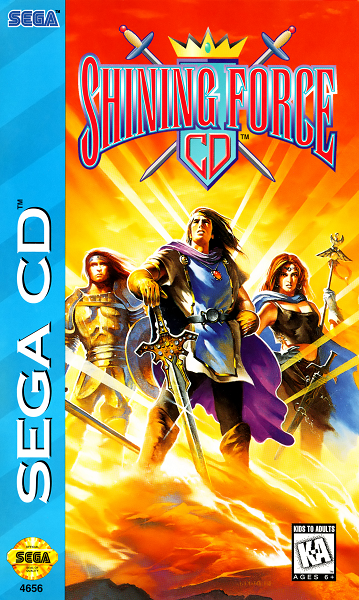
NAME(S): Shining Force CD / シャイニングフォースCD / SFCD
PLATFORM(S): Sega CD (SCD)
DEVELOPER(S): Sonic! Software Planning
PUBLISHER(S): Sega
GENRE(S): Strategy RPG
RELEASED: July 22, 1994 (Japan) / March 22, 1995 (North America) / April ??, 1995 (PAL)
RELATED: Shining Force: The Sword of Hajya
It’s not easy being a Shining Force fan. To start with, I’d only heard of Sega’s niche RPG series thanks to its inclusion on Sega Smash Pack II—of which I was only able to play due to its later PC port. Upon learning of a sequel, my only hope was to find an actual Genesis cart. But the game was fairly rare, and as a child I had no hope of buying online, nor did I have any knowledge of emulation. Eventually I was able to play the game, but found an even greater challenge in playing the majority of the games that remained. The Sega CD, Game Gear, and Sega Saturn were all extremely hard to come by, which is to say nothing of retail copies of the Shining Force games on each of them.
But to be certain, the hardest part of being a Shining Force fan, other than the series basically having died while still young, is that only half of the games are still worth that effort to seek them out. Shining Force CD isn’t in that half. Bear with me though, as it’s far from a poor game if not anything exemplary like the main trilogy, and its similarity to them is enough for a completionist fan like me to get some vicarious nostalgia from it to carry me through the game’s faults.
There’s little question that even the greatest Shining Force games show heavy signs of aging, but their ambition and originality for their time are still plain to see. Shining Force should’ve laid some of the groundwork for the strategy RPG genre, but did it really? As a fan of the genre, I’ve been repeatedly frustrated by the low standard of regularly not having any sort of overworld when Shining Force did decades ago with a low budget while the genre was still fresh. It’s nothing short of laziness on the developers’ parts, and part of that is because no standard was set to ever live up to. This is good news for Shining Force, as although the series may have faded into obscurity, the things that defined it then are what define it today and have held them up as two of the greatest RPGs of their era.
Where does that leave Shining Force CD? The compilation game that contains a remade Shining Force Gaiden and Shining Force Gaiden II, Game Gear games that used their lower platform as an excuse to remove the central exploration element that makes the main Shining Force games so special? Take away Shining Force‘s quirks without adding a single thing and you’ll find the most basic strategy RPG possible that makes you question if the term is even rightly applied to it that looks very bright and pretty and has an innocent charm to it, but not enough to stand up to other strategy RPGs in its wake that possess far more expanded storylines and at least a modicum of more strategy depth.
Let that be my reasoning as to why I’m not going to go any further as to the aspects of what make this a Shining Force game, as opposed to the aspects that don’t. If you, the reader, are inquiring about this series then don’t bother with this review and go play the first game. Then it’ll be determined whether you’re serious about giving Shining Force CD a try. Everything in SFCD is exactly the same as the Genesis games, except for what its missing.
Like I already said, the big thing here is the complete lack of any exploration. The entirety of Shining Force CD is battle after battle, with a simple camp intermission that always looks and functions the same where you can manage your team like usual and a shop to buy the same weapons and items. Once you take care of your business, of which there’s never much because this is the very simple Shining Force series, it’s off to another brainless battle.
One very appreciated addition to the game (the only one, probably) is being able to set certain characters to fight automatically. This makes any leveling needed to be done very simple, and combined with an emulator’s turbo function can get you past some of the game’s duller moments. On the downside, your AI could use just as much work as the enemy’s, and for some reason they all only move in proximity to the main character, who can’t be put on auto battle. If he doesn’t move, no one else will.
There’s no new spells or classes to be found in Shining Force CD, and the storylines are every bit as unoriginal. The Genesis games aren’t great in that regard either, but the first game at least possessed a great sense of humor and some interesting settings, and the second game had a higher focus on the story than other RPGs of its time. In the first game (or “Book”), you play as a mute kid with a mysterious past who’s drafted to rescue Queen Anri before some ancient monster is resurrected. In the second game, you play as a mute kid with a mysterious past who’s rafted to rescue Prince Nick before some ancient monster is resurrected. The dialogue is every bit as avant-garde, and you’ll be amazed at how little is said in the 10 dialogue boxes that separate each scenario.
It’s very, very disappointing that Sega had half of Shining Force CD made for them already and yet didn’t take the time to add to the script or gameplay whatsoever. Maybe asking for added exploration would be much (it’s not, and it should’ve been in), but at the very least they could’ve made it not so every line of dialogue is a simple, characterless statement of what’s happening on screen. They also could’ve at least given the two Books their own music. After all, I assume the original games had different music. But in Shining Force CD, you’ll be hearing the same themes over the course of 40 battles. Like I said, it’s not easy to be a Shining Force fan.
Other letdowns are the worst character designs of the series, with half of the casts in each game being baby-faced children I will never use, as well as the extremely low difficulty. I played on Normal mode as it’s what the developers deemed an acceptable challenge, and almost never found enemies dealing more than 3 points of damage to me throughout the entirety of the two books. While this is more of a fault of the original games (though it still could’ve been repaired somewhat), I also have to note that Shining Force Gaiden has even worse map design than Shining Force II, being comprised of a ton of open fields and lacking terrain, chokepoints, or unique locales. Gaiden II improves this, but with such a low level of challenge it’s difficult to notice the map design having any sort of positive impact.
However, Sega did go above the call of duty by what they did to connect the two games. If you finish Gaiden and start a new game of Gaiden II, you can select your save file and the characters that return will get a boost to their stats depending on what they were at the end of Gaiden. If you beat both Books, you unlock a Book 3, a short but entirely original scenario that lets you carry over character stats from the first two Books in their entirety, while the weak characters are automatically brought back up to a default level.
Possibly due to Book 3 being an original mode, it actually attempts to live up to the standards of the console it’s on. I was shocked to see and play some of the most fun and challenging maps of the Shining Force series, and to see cutscenes before each of them with fluid dialogue and a constantly goofy sense of humor. Truly, Book 3 has some of the greatest qualities of the series, but it’s tragically only six maps long.
On top of that, the storyline is more of an epilogue than anything with actual weight to it, and there are no new weapons or items to buy. Instead, everything is found in hidden squares on each map—and there are a LOT of hidden items. Since there’s no other way to get items, and because these squares containing them aren’t marked on the maps, there’s a frustrating conflict of wanting to get stronger items for these challenging maps and just wanting to say “screw it” because it’s not worth checking every square (and all of these new maps are very big). In addition, many (most, even) of the items you can find are complete joke items that are entirely worthless anyway.
Back to the subject, the maps in Book 3 are a blast. They’re all visually distinct from each other with graphics, enemies, and music seen nowhere in either Gaiden, and each have a special gimmick to them to make them more interesting. My favorite map was the third one, where you could see a pond in the middle of an oriental garden with sticks sticking out, then in the middle of the battle these sticks would actually be revealed to be enemies hiding under water that spring on you and hit you with a variety of spells and status effects attached to their regular attacks, something I’d never seen before in a Shining Force game that adds a slight bit of more strategizing.
The same goes for the player, who has access to some weapons that alter stats they wouldn’t normally, such as increasing or decreasing movement, or having passive effects like restoring some MP per turn. This kind of surprise and depth in Shining Force came totally unexpected to me, and I loved seeing it even though it was so minimal in this short mode. If this design philosophy was entirely applied to the remakes—that is, a higher level of challenge, greater strategy, more amusing dialogue, and a greater variety of graphics and music—Shining Force CD would’ve been able to give any game in the series a run for its money, with or without exploration. And that’s truly saying something. They could’ve made this a spectacular classic.
But they only showed that level of ambition for six maps out of the forty-something in the game. There’s also a hidden Book 4 that’s a single fight against every single boss in the game, but while this could’ve been very fun and extremely challenging, it’s ruined by two things. One, you have no control over your team in this Book which will immediately cripple any player’s already low chance of beating it. Two, the only way to play it is by examining an indistinct tile on an early generic map in Gaiden II to find a special item that triggers its unlock.
In fact, not even that works the way its supposed to. I absolutely examined that square, got the confirmation, and Book 4 didn’t unlock for me despite having completed saves of all the other three Books. I figure this is because I used Egress to escape from the battle and that screwed something up, but that’s a pretty stupid thing for the developers to miss and I even re-examined the tile again only to find nothing was there because I had already gotten the item. So there you have it, my opinion on Book 4 is mostly about how there’s no Book 4.
Though I’ve ragged on Shining Force CD awfully hard—and I insist that’s because Sega deserves it—the positive elements of Shining Force that remain here were enough to make the whole game an overall enjoyable experience to me—as a fan. Emphasis on “fan.” This isn’t a game for everyone to enjoy. Regardless, the bright colorful graphics, fast-paced (by SRPG standards) and addicting gameplay with frequent reward is enough to give me the vicarious enjoyment of much better games. Shining Force CD is an enjoyable game by proxy, but I’m of the opinion that a placebo is every bit as valid as the genuine article, so long as it works. One week later, I know the prescription has worked for me. It’s not easy to be a Shining Force fan—but somebody’s gotta do it.
Leave a Reply