








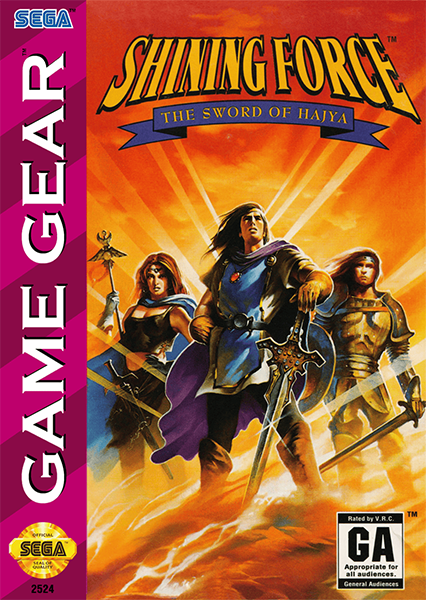
Shining Force: The Sword of Hajya
NAME(S): Shining Force: The Sword of Hajya / Shining Force Gaiden II: Jashin no Mezame / シャイニング・フォース外伝がいでんII ~邪神じゃしんの覚醒めざめ~
PLATFORM(S): Game Gear
DEVELOPER(S): Sonic! Software Planning (AKA: Camelot Software Planning)
PUBLISHER(S): Sega
GENRE(S): Strategy RPG
RELEASED: June 25, 1993 [Japan] | 1994 [North America]
RELATED: Shining Force CD
Shining Force: The Sword of Hajya
Background
If you’ve been following my blog posts, you might recall that I was playing through Shining Force 1 and 2 for the Sega Genesis with my girlfriend. She was new to the franchise, but I’m a veteran of countless playthroughs of Shining Force, and quite a number of the other entries as well. This includes Shining Force CD, so you may be wondering why I’m playing The Sword of Hajya.
If any of you remember Tips & Tricks magazine or the various Codebooks they would occasionally publish, you may have also had the experience of aimlessly browsing their nearly all-text pages, seeing video game titles and descriptions of codes and secrets that would cause you to fantasize about what those games could possibly be. Before the internet was easily accessible, this would be the way I learned of many games’ existence.
You can imagine my surprise when I was scanning the (brief) Game Gear section, only to read the title Shining Force: The Sword of Hajya. Shining Force II wasn’t a well-kept secret, but this was the perfect game to fly under the radar, given the Game Gear’s relative obscurity. Few game titles ever commanded my imagination to this degree. I mean, what the fuck is a “Hajya”, anyway? Isn’t that the sound you make when peanut butter gets stuck in your epiglottis?
As a child, the Shining Force games after the original held a certain mystique to me. The first entry was already somewhat inscrutable, with dozens of esoteric secrets and oddities that captured my imagination. Something always felt further beyond the game’s world. Recruiting Jogurt? The “Forbidden Box” item hidden away in the game’s files? What couldn’t the Shining world be hiding? Not least of all, Shining Force ended with a notorious (to me) cliffhanger that begged for a sequel. The adventure wasn’t over! They said it! Sort of!
Despite my young and relative inexperience with the internet, it didn’t take much searching to learn about Shining Force II and how its story had little to do with the first game’s. Eventually, I would hear that Max’s adventures did continue… on the Game Gear. When I learned of Hajya, my mind ran wild with possibilities. Which characters from Shining Force would return!? What crazy secrets were going to be in this one!? It wasn’t until much later that I discovered I had been juked yet again. Shining Force: The Sword of Hajya wasn’t the destined sequel. Max’s quest would continue in Shining Force: The Final Conflict—one of the franchise’s only Japanese-exclusive stories. My childhood fantasy was never obtainable to begin with.
Alas, growing up in poverty, it was not trivial for me to even acquire a Game Gear and Hajya. And it would be years before I discovered emulation, let alone gathered the nerve to use it. I would eventually lose interest in Hajya as its mystery was gradually unveiled through the wisdom of aging and further internet experience. It wasn’t completely neglected, however, as I made an effort in late 2014 to finally play and finish Shining Force CD, a compiled remake of the first two Shining Force Gaiden titles on the Game Gear, of which Shining Force: The Sword of Hajya was the second, localized title be damned.
It’s therein I share a similarly odd chronology with Hajya: for reasons unknown to me, the first Gaiden title was passed up for an English localization. It remains untranslated to this day, even unofficially. CD does have an official translation of that same story, of course, but it’s a pity for the west to be missing one of the final nuggets of early Shining Force history. I mean, you’d certainly get your share of lunatics who would play it just for a change of pace. Or just to say that they have played it. On that note…
There’s some part of me that envisions an alternate timeline where I successfully sought out a Game Gear and Shining Force: The Sword of Hajya, growing up with the game as I did its progenitor. Wanting to reach out and feel the slightest touch of what that imaginary past would have been like is what compelled me to play this ultimately outdated and redundant version. For what it’s worth, I played the official Nintendo 3DS Virtual Console version. I did not use emulator features such as save states to gain any advantage. This was a by-the-books “legitimate” playthrough. Unfortunately, this did limit my ability to take screenshots, so this review won’t have many. I am sorry for that.
From “Shining Force Gaiden” to “Shining Force: The Sword of Hajya“
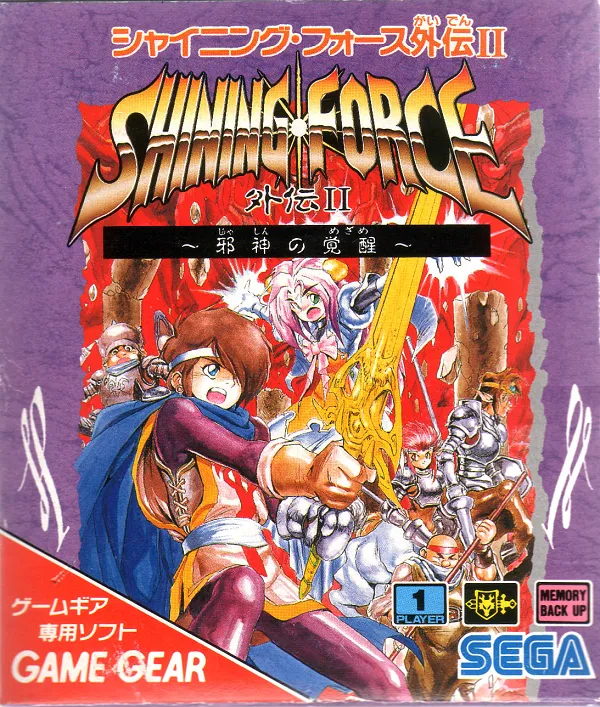
My best guess as to why Gaiden was never localized would certainly involve the late release of the original Shining Force. While released in March of 1992 in Japan, it would take until July of 1993 to hit North America. To give context, Shining Force: The Sword of Hajya, i.e. Gaiden II, was released in Japan in June of 1993. Yes, the second Game Gear title was already out by the time the first Shining Force even reached the entire west!
Shining Force: The Sword of Hajya would similarly adjust its release to Q4 1994, giving the brand some time to establish a fanbase before investing localization resources into a niche game on a niche platform. Because the final Game Gear Shining Force title, Final Conflict, wasn’t released until 1995, it stands to reason that the powers that be adopted the “newer is better” adage and released the latest entry to pad out the library of their latest hardware venture. As far as I’m concerned, that’s an adequate theory.
Now, just because their decision may be justified does not mean that it’s necessarily correct. First of all, the general reason to pass over an early entry would be to enjoy the presumed advancements in game design and interface one expects from a sequel. However, my understanding is that the first two Gaiden games are nearly identical in these respects.
Given this, seemingly the only incentive to localize Gaiden II would be that it’s more recent. It’s not like there would have been fan demand for it, or even awareness of it back in 1994. It’s entirely possible that some overhead bureaucrat made the decision to only localize Gaiden II without any knowledge or understanding of what the games were, and this short-sightedness risked negative reception and its associated fallout.
The potential reason for that being how The Sword of Hajya‘s story is directly connected to Gaiden. It’s not like the tenuous relationship between the mainline entries, Shining Force (SF1) and Shining Force II (SF2), where knowledge of the former provides only a slight smattering of lore which borders on being amusing callbacks. Hajya contains many of the same characters as Gaiden, with its plot even centering around the main character of the first game, Nick.
The adventure begins (continues?)
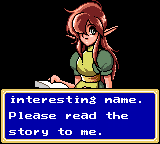
homework.
The story of Shining Force: The Sword of Hajya takes place only two months after Gaiden, which itself is placed 20 years after the events of the original Shining Force. The heroes and villains from the previous game return, with Prince Nick of Cypress marching off to stop King Warderer of Iom’s evil ambitions. Nick is joined by several (un)familiar faces from Gaiden, but there are still doubt about his chances to succeed.
Nick’s right hand has been petrified into stone, thus rendering him unable to use the legendary Sword of Hajya to defeat the legions of Iom. I feel like if I had access to a legendary weapon that I would be strongly motivated to become ambidextrous, but maybe Nick is just lazy. Come to think of it, he’s still going out and fighting. Wouldn’t that imply he’s using his left hand anyway? I guess it’s possible he’s just barking orders.
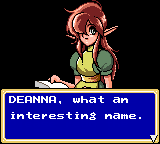
Regardless, as Nick is leaving, a castle mage named Natasha enters the courtyard carrying an unconscious boy. This amnesiac lad, Deanna, is our main character and returns the favor of his rescue by joining the Cypress knights. He and a few other rookie soldiers are tasked with defending Cypress castle until Prince Nick’s return.
Some time passes, and the inexperienced knights face their first challenge when the castle walls are penetrated by Iom’s forces. They quickly reveal that Prince Nick has been captured and is to be sacrificed to the dark god, Iom. Oh, dear! With no other option, these youngsters head out to rescue Nick and recover the now stolen Sword of Hajya.
Those familiar with the Shining franchise, particularly its golden years, are likely to not expect much complexity in the way of plot, themes, and characterization, and that is particularly true of Shining Force: The Sword of Hajya. Scaling down the adventure for a portable system has led to compromise in virtually every facet, and even the text did not escape. The first game didn’t reinvent the wheel when it came to Japanese RPG tropes by any means, but it had a few sparks of life, mainly in its creative setting that featured a wide variety of fantastical species, elements of science fiction, and a lighthearted tone containing a tasteful amount of fourth-wall-acknowledging humor. The plot itself was elevated by the framing of these qualities, and contained the occasional amusing twist, such as those surrounding Max and Kain.
Interestingly, Shining Force: The Sword of Hajya‘s plotting and overall demeanor have much more in common with the standards of Shining Force II. For starters, the sci-fi machinations seen throughout SF1 are almost entirely absent, reducing the setting to more standard sword-and-sorcery fare. As in SF2, the plot’s progression is generally propelled by a series of happenstance encounters and errors. The Sword of Hajya itself is a particularly slippery MacGuffin as it’s passed around like a football from antagonist to antagonist in the early parts of the game. It would be comical if only it wasn’t so frustrating.
When it comes to Hajya‘s story, I struggle to even think of what to talk about. The majority of the game’s script is your tiny cast of characters commenting on whatever inconvenient contrivance is forcing you to fight. Deanna, as expected of a Shining series protagonist, is almost entirely mute. The majority of dialogue is passed off to the army’s advisor and returning character from Gaiden, Mayfair.
Before I speak further on Mayfair, I should note how she exemplifies what is one of the greatest general flaws of the narrative, which is how western players have no attachment to the cast or world of Shining Force: The Sword of Hajya due to them lacking access to Gaiden. In the absence of interesting plot, characterization, or dialogue, much of the amusement one gets from Hajya ought to be the returning characters.
Is it meant to be exciting when characters from Gaiden rejoin our party throughout the game? Maybe. But as far as western audiences are concerned, these are just random guys. The primary motivator to empathize with Hajya‘s plot could be the fact that Nick was the player in a previous game, which provides a sense of indignation that could have helped players become invested in the plot. Without the background of having played Gaiden, Nick isn’t you. He’s just, as far as we know, some spoon-in-mouth royal who got himself captured—and we’re his errand boy.
Mayfair, a playable Priest unit in Gaiden, returns to Shining Force: The Sword of Hajya as an unplayable advisor to the player’s army. Any satisfaction that would have come from seeing her progress into a more important role in the world is denied to those coming into Hajya blind, which would have been almost everyone playing the game at the time of its release. It’s such a shame. Without this established endearment, what remains is a young woman who has tremendous authority over our army for some unclear reason. Is she the princess of Cypress? Nick’s wife or lover? His mom? Who knows! We aren’t told.
And Mayfair really needed some kind of reason for the player to already like her, because she’s probably the worst part of the entire narrative. I can’t emphasize enough how Mayfair just does not shut the hell up. Probably a good 80% or so of dialogue is solely from her narrating and reacting to every single scenario and event in the story as if she’s a sports commentator. Mayfair seemingly exists just to explain what is being conveyed by the tiny, non-descript, bouncing sprites in cutscenes. “Oh no! The enemy’s hands were covered in butter and they dropped the Sword of Hajya into the river. We must fight!” That sort of thing.
On paper, this makes sense: she’s a character who’s always with you from the start of the game. But if you think about it for a second further, you should realize many characters are with you from the start of the game. This isn’t the Fire Emblem franchise, where most characters possess the risk of actual death and removal from the script should the player have them defeated. Other than two very late-game secret units, your party is entirely fixed and mandatory. The writers had every narrative excuse to have members of the entire cast routinely appear and offer colorful personal commentary via the requisite exposition in every scene.
Maybe Jaha, being a simpleton, would misunderstand a situation leading to Dawn to scold and correct him in the form of expository dialogue that doubles as characterization. Instead, only Mayfair is consistently present to dryly deliver sanctimonious reactions before ordering your stooges to slaughter the enemy. Other characters do show up in cutscenes, but their screen time relative to Mayfair does not even come close. Changing the script to make the dialogue more diverse would at minimum only require rewriting existing lines and telling the game to pull a different map sprite and portrait up. If that would be too much, I would accuse the developers of neglecting the narrative to a degree where it may arguably be better off not existing at all. If they simply did not realize one character hogged 80% of the dialogue, then I would instead call the developers… well, let’s just go with “confounding.”
Unfortunately, the script’s quality isn’t only beholden to its variety and style. In what is an all-too-common occurrence for the Shining Force series, Shining Force: The Sword of Hajya received a lackluster localization. Typos and bizarre syntax abound, though not to the degree where much of anything is rendered unparsable—only unprofessional.
One of the more frequent annoyances for me was the game’s lack of exclamation marks. That might sound odd if you’ve never seen a script with this problem. Everyone in Hajya comes across as too bored to even be alive. There’s no shortage of Mayfair saying things like, “Oh no. The enemy is taking Prince Nick.” Maybe the funniest example was when a generic enemy teases the player unit Gyan that his liege, Prince Nick, will soon be killed. Gyan responds with something along the lines of, “You monster. I’ll rip you apart.” Yawn. Sure you will, buddy.
Oh, and the character names are completely butchered. I’m not sure how this happened, but several characters are given the names of completely different, unrelated characters. You have a Jaha in this game, just like in Shining Force II, and to make matters worse, he’s even the same class. However, these two are entirely different people. It’s baffling. But the worst consequence of this might be the effective removal of two of the game’s cooler references.
Two secret characters, Rush and Higins, who are Musashi and Hanzou from Shining Force, respectively. Yes: for the two characters who actually are returning characters, they are rendered unrecognizable through name changes. Brilliant. There’s no real significance to them being the same characters, but it’s a damn cool moment. You get two of the most iconic, strongest units from the first game back on your team, and they kick just as much ass as they did the first time. It sure would be exciting, if only you were given the knowledge. It’s as if the localizers intentionally wanted Shining Force: The Sword of Hajya‘s background to be opaque for whatever reason.
An overworld apart
In what might be their most controversial design choice, the Game Gear Shining Force entries also remove the console entries’ trademark overworld exploration that was more common to non-strategy RPGs. In addition to other issues I’ll address later, this has the narrative effect of removing a tangible sense of progression to the game. For most of our journey, we want to end up in Iom to rescue Nick. But where is that? How far are we? How does what we’re doing help us get there? Without context, what should be an exciting continent-spanning adventure turns into a groaning “are we there yet?” road trip featuring the already mentioned comedy of errors and inconveniences.
Much of Shining Force’s appeal is more than the sum of its parts. Though they certainly have their quaint charms, I don’t think it’s blasphemous to suggest neither the plot nor strategic gameplay is the primary draw of the series. I would insist that the main contributor is the aforementioned town and map exploration that has, for some reason, never been standardized in the world of strategy RPGs. With these, the series has garnered a following thanks its exotic locales and character designs, light-hearted irreverence, and oodles of secrets to make engaging with its environments to the fullest a rewarding experience in a way that almost no other entries in the SRPG genre attempt.
Which makes the Game Gear Shining Force entries’ choice to forego the exploration an… ill-advised decision in hindsight, even if it was done pragmatically. It’s possible that something about the hardware or cartridge space made it difficult, suboptimal, or even impossible to allocate resources to the map exploration—but I have my doubts. There are full-scale RPGs on the Game Gear, after all. I think it’s more likely that the portable nature of the games provided an excuse to scale the games down without players asking too many questions and allowing the developers to save on costs. With portable experiences back in the day, there was a basic expectation from players that they would be receiving an experience lesser than its console counterpart. Having this mentality going in pre-empts subsequent disappointment and backlash, which you want to avoid to maintain trust in your product quality.
I’m sympathetic to having to cut corners in development to save on time or money, but I am willing to criticize what is chosen to be cut. If there was something to excise from the Shining Force experience, I would not wish for it to be the series’ most-defining characteristic. When standout traits, “gimmicks” even, are removed, the core gameplay and narrative experience have to be able to hold up on their own, and I don’t believe Shining Force: The Sword of Hajya is able to provide that.
Other than that… man, I dunno what to say. The story and world of Hajya is about as generic as they come, with little in the way of style and humor due largely in part to its absence of flavor dialogue that would have usually come from the exploration sequences. The most notable plot thread the game attempts is a somewhat shameless retread of the Max and Kain storyline from Shining Force. But even when using that blueprint, it fails to identify what made it effective. Kain wasn’t the deepest character in the world, but he was a character. He directly interacted with and antagonized you constantly, which raised anticipation of his inevitable battle and encouraged interest in his character arc.
Hajya‘s attempt has these revelations come out of nowhere at only the very end of the game. When it does so, it teases interesting backgrounds and motivations of two characters only to never elaborate on them whatsoever. It’s almost worse than if there were no twist at all, because they wouldn’t have created the false expectation of something more compelling. When all’s said and done, you are the typical righteous group defeating the purely evil villains who want to make life worse for everyone.
Tried-and-somewhat-true gameplay
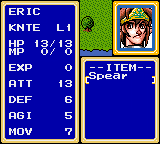
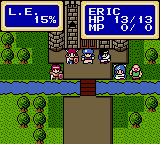
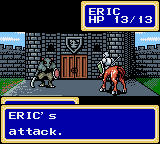
As far as the game’s mechanics go, Hajya is virtually identical to the first Shining Force game, which makes sense when considering its original release chronology. For those unaware, the Shining Force series is as fundamental as it gets when it comes to strategy RPGs. Battles are done map-by-map as you maneuver your army of up to 12 units across an even square grid. Units take semi-randomized turns largely dependent upon their individual Agility stat. While moving across the map, terrain impedes movement and can provide beneficial or detrimental defense and evade bonuses that the player is encouraged to manipulate to their advantage.
Victory is achieved by wiping out all enemy units, but occasionally can be expedited by defeating the current map’s leading enemy or reaching a pre-determined location with your own leader. Likewise, if your leader’s HP reaches zero, you are returned to before the start of the current map with gained experience points and inventory intact, but your Gold reserves cut in half.
Combat has little in the way of flair, generally coming down to a basic numbers game. Your attack minus their defense equals your effective attack, which can be further modified by things such as the percentage of terrain defense a map tile may provide the unit, as well as a unit’s potential resistance to certain types of attacks such as elemental magic. When a unit’s HP hits 0, it is unable to participate in the map any further and requires revival outside of maps for a small Gold fee.
Magic also exists, which can deal 100% accurate, somewhat fixed, defense-piercing damage, or provide healing, stat boosts and reductions, or status effects. This is all at a fixed MP cost dependent on the spell being cast. Randomness in Shining Force’s formula will make battles somewhat unpredictable thanks to a slight variation in final damage, the potential for units to attack twice in one combat round, possible critical hits that deal extra damage, and chance to completely evade an attack. Having contingencies for these unexpected outcomes is the key to avoiding sudden losses during maps.
The Meta
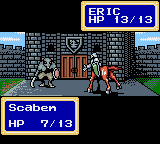
For my playthrough, I wanted to challenge myself. The game’s hard mode had to be unlocked (discussed further down), so I played on the default difficulty and did a fairly typical self-imposed challenge: no using Egress to gain additional EXP, and similarly any death of the main character would have me reloading my previous save so as to not become overleveled through reattempts. I did use Egress to return to base at the start of new maps to restock items, but no actions were taken to gain additional EXP before using Egress. I made an attempt to defeat all enemies on a map before ending it, but occasionally ended them early by mistake due to incorrectly guessing which enemy unit was the leader. In these instances, I didn’t bother resetting.
The closest thing I did to grinding was to have healers use redundant Medical Herb items and Heal spells to gain 10 EXP per use. However, I didn’t stand around spamming them, but rather only used the three to four inventory slots they had available on turns they otherwise had no actions to take. I don’t consider this exploitative, because you’re otherwise expected to buy and use items, and I could have just arbitrarily put more of my units in enemy range throughout the map to receive damage worthy of a legitimate heal, which would result in the same outcome of EXP, if not more due to the potential EXP increase from healing more HP with one action.
There’s basically no way to “properly” use this method, as circumventing it requires you to either ignore an entire game mechanic (items), or to preserve items and magic when you would normally use them, which would result in an artificial demotivator on your end that would still result in a less organic/legitimate/fair experience, or what-have-you. For the record, my healing class units ended up about one to two levels higher than my other higher-level non-healer characters. We aren’t quite up to Shining Force II levels of exploitation here.
From my perspective, people ought to use the gold and items the game provides you and intends for you to use, but shouldn’t stand around doing nothing other than passing more Herbs to your healers from non-healers to get 10x the EXP you normally would from just using their own inventory. This is only if you give a shit about some arbitrary determined “integrity,” of course. If you’re the type to just power level or whatever, more power to you. I don’t think the strategic experience of Shining Force: The Sword of Hajya is so eminent as to deserve an argument for its preservation.
That is to say, the game is very easy. I know we’re talking about fuckin’ Shining Force of all things, but this is a new low. Throughout most of the game, my units were dealing half or more of an enemy’s health per attack, and taking damage within the single digits—rarely over the minimum one point of damage. The fact that I achieved this with my aforementioned self-restrictions is kind of amazing to me.
With regards to the hard mode I mentioned, research (that I’ll describe later) suggests that Hard mode increases enemy damage by 25%. My understanding, then, is that an attack from an enemy that deals 8 damage on normal would deal 10 damage on Hard. If this is true (and to be fair, I haven’t tested it), then I think I would be unlikely to notice a difference in challenge even on Hard mode. I mean, what’s 25% of 1 damage? Does the game even round up?
Freeze 3
The deadliest part of Shining Force: The Sword of Hajya probably isn’t even affected by this damage boost, if higher difficulty modes in other Shining games are any indication. That’s because the most dangerous attacks in the game are magic spells. Or rather, a magic spell. It’s Freeze 3. While it varies depending on the game, Freeze 3 tends to work like any other offensive spell with power and range relative to what level is being cast. In Hajya, a bizarre programming choice has resulted in the complete unbalancing of the magic system.
Freeze 3 costs 10 MP—a somewhat costly but not exceptional amount—that can target any enemies within three spaces and damage anything within two spaces of that target in a 2×3 area.. For those familiar with Shining Force, this is a range and area of effect more typical of high-level Bolt spells. Considering Bolt is balanced by its notoriously high MP costs, these traits alone would make Freeze 3 outclass any other spell.
That is, if those traits were alone.
Freeze 3 also does anywhere from 40-60 damage.
To everything it hits.
The final generic enemies in the game rarely pass 50 HP.
In Shining Force: The Sword of Hajya, Freeze 3 is the equivalent of dropping a damn nuke onto the battlefield. 10 MP to deal 40-60 damage to a single target would be broken. Being able to do it to as many as 12 targets is beyond the pale. I don’t know why Freeze 3 is such a cursed spell in this damn series. The most infamous map of the first Shining Force is perhaps the circus battle in chapter 2, and that’s largely due to its boss casting Freeze 3 on you. And in that game, Freeze 3 is working as intended and simply relatively powerful for that early point of the game.
As you might imagine, this is a double-edged icicle. You eventually gain access to Freeze 3 yourself, most likely through the game’s second mage, May, but enemies aren’t quite as restricted. The bane of your existence late game will be the Demon Master, enemy casters that know only Freeze magic. From my recollection, they never exceed more than two per map, but whenever one appears, you have to respect it like nothing else. For some godforsaken reason, these enemies have an above-average movement of 6, making it difficult (if not impossible) to get the first strike on them when considering Freeze 3 has a range of 3. You would need units with 10 movement, and you’d need enough to kill them before their turn comes around where Freeze 3 will kill everything in sight. And you don’t have those things. You can’t get those things.
So, what the fuck do you do? Great question! The most practical solution is to put a single unit out to pasture as bait to sacrifice to the dark god Boreas, then finish the Demon Master off with everyone kept just outside of range. But hold on! Freeze 3 has a range of 3 and an effective area of 2 spaces, remember? So when your bait is targeted, other allies can’t be within two spaces of them. And since the Demon Master will be targeting from 3 spaces away, your waiting units will have to cover 5 spaces in order to attack from close range.
A Demon Master is surprisingly bulky and can take anywhere from three to five hits to kill. The average movement is 6, and the most common attack range is 1. This means you have to get upwards of five attacks in from a starting distance of 5 spaces when Demon Masters will, at most, have 4 spaces directly next to them to attack from. Reaching the space furthest away from you would require an additional 2 movement, as well. And if the Demon Master survives until its next turn (which is partially random due to how turn order is determined, alongside damage variation and evasion, etc.), anyone who attacked it is going straight to Hell. If your main character is among them, it’s an instant loss, remember. Starting to see the problem here?
This isn’t to say that this is an insurmountable enemy: just one that takes an extraordinary amount of care to not be suddenly obliterated by. Enemies in this game love to square dance and shuffle one space at a time between turns where nothing is in range of them, so a Demon Master can catch you by surprise when you thought you were out of range and ruin your day. It’s frustrating, but careful spacing, a flying unit, high-movement mounted units, and the range of your own Freeze 3 can potentially lead to minimal sacrifices. Potentially.
This all comes to a head in the games third-to-last map, which possesses the game’s only non-generic boss with Freeze 3. The conditions to engage with this boss are almost as bad as they could possibly be. They’re located at the far side of the map against a wall, and the surrounding approach is a completely open 180° radius. The top right of the map contains a treasure chest, and anyone who opens it will be at the mercy of this Winter Warlock. To make matters worse, the boss has 99 MP. Making matters worse, the boss has over 100 HP. Even worse, behind the boss is an enemy healer with Aura, an AoE heal that will make it all but certain you don’t somehow safely one-round this boss.
This is by far the most difficult map in the game. At first, I thought I might have to abandon my self-imposed no Egress/no grinding challenge just for this fight—but I managed to eek out a win. Something I’ve neglected to mention so far are the game’s two secret characters, Higgins and Rush. If the player is fortunate enough to examine the random tiles hiding these fellows on the two requisite maps, they’ll be rewarded handsomely in the face of Freeze 3.
From my observation, Higgins and Rush, presumably because of their unique classes, seem to have some kind of innate magic resistance. Attack magic consistently does to them about half the damage it does to other units. This means that these absolute legends can survive a Freeze 3 (if at full health), and I used them religiously as sacrifices. I essentially baited the boss to the left, got the treasure chest on the right now that I was out of range of Freeze 3, then I used other units to heal the two as they dealt with the healer and, subsequently, the boss.
One saving grace of this fight is that the boss is holding the Shining Sword, which casts Bolt 2 when it’s used as an item. Bolt 2 is far weaker than Freeze 3, so this essentially buys you a turn to unload attacks on him. This is completely RNG-dependent and unreliable, of course. Following the might of Freeze 3, the Bolt 3 and Demon Breath magic possessed by the final bosses can only make one laugh.
So, this begs the question: did they just not notice a possible error? It should only take the testers playing through the game once to inevitably notice something has gone horribly wrong when Freeze 3 is used.
Wikipedia offers an alternative explanation. According to the game’s article, this was a change to the North American version. I have to assume that extends to the EU release as well, in that it has accurate damage numbers. If this alteration was indeed intentional, then I cannot imagine what the reasoning of the localizers was. If they want to make the game harder, that’s one thing. It’s not even that uncommon of a localization practice. But why this and seemingly nothing else? Why was Freeze 3 determined to be the sole conduit for higher difficulty? It doesn’t even make sense. It means it’s superior to magic you get later that’s supposed to do more damage in exchange for higher MP costs. Level 3 magic isn’t even the highest level, as they can go up to 4. That would make level 4 the obvious one to buff, if any.
I genuinely don’t know. It’s nonsensical to the level that I would sooner suspect an error than a rogue, radical theory of balancing. It’s worth noting that Wikipedia doesn’t cite a source for their claim, so it might have been an assumption. If anyone knows more, let me know in the comments. Also, the same blurb mentions this damage hike applies to Blaze 3 as well. Frankly, I don’t remember noticing that. They could be correct. Maybe enemies are just more likely to have Freeze 3. If that’s the case, we’re very lucky to not see more elemental diversity among the enemies’ spell lineup.
After the ice age
When comparing the enjoyment of gameplay to the first Shining Force, one might expect me to consider them roughly equal, but I think Hajya‘s slight increase in polish often makes things a little less interesting. With the exception of the dreaded Freeze 3, enemies are so unthreatening that maps struggle to find an identity for themselves through memorable encounters. I mentioned the circus map in Shining Force earlier, where the Marionette boss would annihilate players with powerful magic. It was a bit unfair, perhaps, but entirely beatable on even a first attempt, and the feeling of overcoming such a precarious and unique challenge is one that sticks with you.
I already can barely recall the unique traits of the mooks I squashed on my way through the game, which is saying a lot, since most are copied wholesale from Shining Force. For instance, the classic Zombie enemy is back in all of his gangrenous glory. In the first game, these foes stood out to due their high attack power for that part of the game and their resilient defense that could make even your more reliable fighters deal 1 point of damage.
Further adding to their memorability is how they were initially covered by Demon Mages ready to cast multi-targeting Blaze spells from afar. It was a genuine threat, and that particular map encouraged you to consider sneaking behind the enemies to reach the next location and end the map early. I had no similar incentives in Hajya. Did the Zombies even do above-average damage? Uh, maybe? The fact I didn’t really notice says it all.
I should also note that the game has the more consistent stat growth formula seen in Shining Force II. I’m not a fan of this, personally. It makes level ups far more predictable and less exciting, and it homogenizes repeat playthroughs. Some people might enjoy the consistency of leveling up and seeing +1 in every stat every time, but I don’t find it as interesting.
Of the few gimmicks the gameplay has, the most notable might be in Chapter 3, where your party is temporarily divided into two set groups. It occurs right around the time where you normally would have too many party members to field all of them at once, so it gives a little extra worth to the cast at large. I liked the chance to use units I might otherwise not have tried out. Otherwise, the progression is generally identical to before and after the split. Your team is simply more limited, is all. I guess it’s worth pointing out that the second party’s leader is Natasha, which is can be frustrating as she’s practically made of glass. As with Deanna, her death during these “split” sequences results in a loss.
Sights and sounds
I will say that it did tickle me to see so many of what I consider classic enemy designs recreated in the Game Gear’s more restrictive resolution and color palette. It was like visiting an old friend, a sensation I had not felt from Shining Force II due to its largely original designs. I’m glad that game shook things up, but the reused designs did give Hajya a sense of being directly connected to the first game, even if the storyline itself did little to establish such. The graphics should be praised for being largely accurate to their inspirations despite the inferior hardware. Nearly all original details are retained and recognizable, and the Game Gear’s rich colors help to ensure that as little of the series’ artistic identity is compromised as possible.
The music fares similarly well, and more than a few of the tunes remain stuck in my head—even if I could have done with more variety in map themes and battle music. Particularly catchy is the basic battle music that plays when you initiate an action, featuring a rising, triumphant melody that tends to trail off just as the animations end. There’s a teasing sense of unfulfillment as the music repeatedly crescendos into a section that refuses to exist, and I mean that in a positive way. I was always looking forward to hearing it again, always waiting for that continuation that would never come. Instead, just another second of this catchy, uplifting melody. It’s a good thing I could listen to it loop for hours, since you hear it a hell of a lot.
Another highlight is the map theme, Huge Fortress, which appropriately inspires images of imposing mountains and other enemy dwellings. It has a dramatic, scaling opening that transitions into a determined and courageous marching rhythm.
The economy
Since this is a Shining Force game, I’m all too familiar with incorrect or outdated information online. Fortunately, likely due to this game’s lesser complexity, I didn’t find much in need of correction. Another contributor is that the game features the most generous failsafe I’ve yet seen for a Shining game when it comes to missed items. Any treasure chest item or enemy drop, no matter how inconsequential, is moved to the shop’s Deals section if the first opportunity to obtain it is missed in any way. Rings, stat boosters, weapons, healing items—it’s all there. You only need to pay the sale price, which provides an incentive to still get these items for free from their proper locations.
Unfortunately, I found money (gold) to be in extreme abundance in this game. Though I should mention again that I never allowed my army to be wiped out, which cuts your gold in half each time. Regardless, with gold being in such abundance, I never felt pressured to make absolutely sure I obtained every rare item in its designated chapter in order to avoid unnecessary costs. Still, that’s a matter of flawed execution rather than a flaw with the generous concept itself.
The Deals section is so thorough that it seemed to contain everything I sold throughout the entire game, which is a bit… overkill, to put it mildly. By the final map, I was scrolling through dozens of outdated weapons to check for new things of actual value, and I suspect this caused me to miss a few when they first became available among the sea of trash. This behavior isn’t necessarily unwarranted, as the player could hypothetically accidentally sell all of their weapons that only unpromoted units can equip and be without recourse for said unpromoted units, but riddle me this: if you’re keeping a complete catalog of every weapon the player has ever owned that they can buy back, then what is the practical difference of just having a shop that always has older weapons purchasable?
There isn’t one. It’s just a matter of which menu you prefer to have cluttered: the one that contains often one-of-a-kind rare items, or the one that updates maybe once or twice per chapter. Additionally, if the shop’s inventory was comprehensive then you wouldn’t need to dedicate more than one slot per item type. If I sell two “Short Sword” then the Deals section will list them separately to represent its limited quantity, something that isn’t needed for the unlimited main shop inventory. Still, any tedium or confusion resulting from scrolling through either cluttered stock could have been mitigated with either multiple pages and/or some sort of icon or text color highlighting which items are new additions. It’s ultimately a minor issue, and cumbersome inventory management may as well be part and parcel to the Shining franchise experience.
Mechanical oddities
Anyway: a slight correction I wanted to make. The Power Ring isn’t obtainable, so far as I can tell. This is contrary to some guides online. I noticed during the final chapter that it was the only basic ring I never found, even within the shop’s Deals section. I found someone confirming that it doesn’t drop in Hajya, as well as others noting that this design choice is repeated in the Shining Force CD remake. It’s odd considering the Power Ring isn’t super broken or anything, and it could have provided a way to help level up struggling units. This game doesn’t have as many of those late-bloomer unit archetypes as the two Genesis titles did, but still. This design is reminiscent of the Shield Ring in Shining Force, which was visible on some enemies but never made legitimately obtainable by the player.
My other correction is of more ambiguous veracity. The game’s official instruction booklet lists the classic Evil Ring as among those within the game, but I never obtained it. Contrary to the Power Ring, the Evil Ring does appear to be in CD, with no shortage of sources claiming to have used it or that it’s dropped by the Demon Master enemy in the game’s third-to-last map. Guides I can find that exclusively cover the Game Gear original bear no mention of the Evil Ring, which is especially strange considering the incongruity with the manual.
A possible explanation is that the Demon Master (and potentially others?) do have the Evil Ring equipped but don’t drop it upon defeat. The Demon Master’s AI might be unlikely to use the Evil Ring’s ability to cast Bolt 2, as it may (correctly) calculate its native Freeze 3 as doing more damage. If that’s the case, nothing would appear amiss and worth mentioning from an encounter with this Demon Master unless one manually looked at its inventory. Because I’m now past that map, I can’t check myself. If anyone knows, please reach out or comment below. Regardless of its potential existence in the game, I am fairly certain it can’t be obtained, much like the Power Ring. It would be a random exception to the Deals section. I know my Natasha would have greatly appreciated having it, with her pathetic offense and slow spell acquisition. Oh, well.
“Excelent” and esoteric
As for bonus features, the game does establish the trend of Shining Force games having higher difficulty modes unlocked upon completing the game. With a cleared save file, inputting down on the D-pad five times during the opening Sega logo will enable “Excelent” mode. No, really. It’s actually spelled like that. The narrator on the file select screen explains the purpose of the mode, which is butchered in the English version to make it sound as if the game’s literal text script is harder to understand.
Community consensus is that this was a mistranslation of a statement about the game now being more difficult. In anecdotes I saw online, however, players seemed to struggle to find differences between the default difficulty and the “Excelent” difficulty. It crossed my mind that people may have been misinterpreting this as a higher difficulty mode, and that the translation was more accurate than some thought. I thought that perhaps this optional mode changed the script from a combination of hiragana and katakana to one with kanji. If this was the case, then a difference between the modes in the English version would indeed be undetectable, and it would just be a mode that uses a more complex Japanese alphabet.
Considering the language barrier, I asked my friend who’s fluent in Japanese, Ryan, to help me look into this. After searching the Japanese side of the internet, he found a source that directly states the “Excelent” mode has enemies deal 25% more damage. Considering that a 25% increase would be almost imperceptible in the game’s starting stat lines and the natural 1-3 or so point range of random damage, it would stand to reason that players briefly testing this mode out wouldn’t see a difference in the numbers. Mystery solved, as far as I’m concerned—at least until I hear otherwise.
What I Learned from Shining Force: The Sword of Hajya
All things considered, would I recommend The Sword of Hajya to a modern fan of Shining Force or strategy games? No, I wouldn’t. There are just too many games that have evolved the gameplay seen here, and without the overworld exploration of the console entries, this Shining Force title doesn’t have enough to offer anyone who’s not a kid back in 1994 willing to accept compromise in pursuit of accessibility. Our mortality is too limited to spend time playing redundant games instead of those which subvert our expectations or move the medium forward. Take it from me, someone who doesn’t follow that advice. I now have even more Shining Force knowledge than the average fan of the series, which makes everything I say about the games beyond reproach. It was all totally worth it.
With that said, was I able to envision myself possibly being one of those kids, spending dozens of hours across multiple playthroughs acclimating to this new cast of characters and maps as I once did for the original Shining Force? Undoubtedly. Here’s to the Noah that never was. It was nice to have known you for a few hours. Also, don’t do that one really embarrassing thing you did in the 5th grade. You know the one. Well, I guess you wouldn’t, actually.
“Knock, knock!”
“Who’s there?”
“Hajya.”
“Hajya who?”
“Hajya imported the other Gaiden games, you wouldn’t have had to ask!”
Leave a Reply