








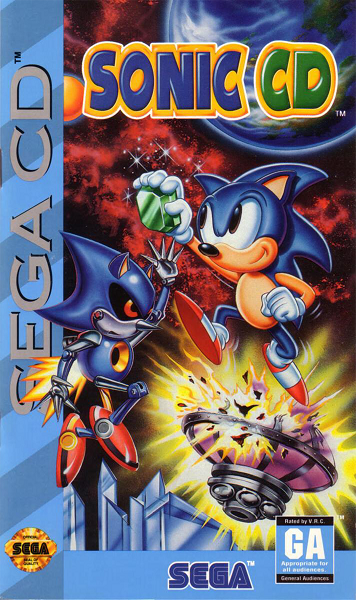
NAME(S): Sonic CD
PLATFORM(S): Sega CD (SCD)
DEVELOPER(S): Sega
PUBLISHER(S): Sega
GENRE(S): 2D Platformer
RELEASED: September 23, 1993 (Japan) / November 23, 1993 (Worldwide)
I got this game as a kid for Windows way back as part of a big Sonic compilation pack. It included Sonic 3 & Knuckles, which was irrelevant to me, as I had them on cart, Sonic R which was terribly glitchy but still an terribly awesomely terrible experience, Sega Smash Pack II which actually worked and included several great non-Sonic games, and Sonic CD which infamously didn’t run on Windows XP because of a missing file. So it was borderline a waste of money, but it was on sale.
One day my mom took me to her work place, and I had the idea to bring the Sonic CD disc with me to see if their computers would run it. They did, and I spent a very magical day playing Sonic CD for the first time. I wasn’t able to beat it, but that was the last time I touched it until emulation. By then it never held my interest enough to finish. I beat it this time, but it still struggled in the same way.
Sonic CD is a very strange game. It’s essentially a parallel universe Sonic the Hedgehog 2 that actually exists and can be played, being made by Sega of Japan after Yuji Naka left for the American branch to make the Genesis Sonic 2. This is the reason it’s the only game to reuse the assets and style of the first game. I like this, because I think the original Sonic possesses a more distinct visual style than 2, even if the sprites are less detailed. There’s a very geometric, origami-esque look to the sprites that stands completely on its own. Sonic CD not only brings that back but features a heavy ’90s aesthetic, using the Sega CD’s increased storage space to include hip dance music of the time and huge levels full of moving parts and flashing lights.
I love the heavily-sampled house music of the game as well as the glitzy lights, but both get exhausting too quickly. The main problem with Sonic CD‘s aesthetic is that it’s so homogeneous that its stages end up lacking identity. In the original trilogy there’s a huge difference between the psychedelic funk of Marble Garden Zone and the soft mystic synth pop of Lava Reef. Sonic CD assaults you with a constant disco rave that almost gave me a headache by the time I finished.
The stages are also visually distinct in that they use different colors and sprites, but the level design is so constantly haphazard and chaotic that playing them all feels identical too, and they just feel like clutters of objects rather than anything resembling a natural environment. I tried really hard to avoid switching to the Past and Future, because they would frequently just drape the levels in browns to emphasize a different time period and it looks very ugly. Going back to stage design, the stages are enormous but don’t bring the subtle benefits that the other games do. Sonic, being a short arcade-style game meant to be played repeatedly, made huge stages with multiple easily-twisting paths to give the feeling that each play through didn’t feel too familiar.
Sonic CD has an equal amount of divergence if not more, but now the different pathways are forced upon the player and break the flow. Levels instead of being a series of split tubes become actual mazes. You can hit dead ends just by going right constantly, and the way forward will often not be clear. Sometimes dropping or going higher and going right isn’t good enough and you actually have to go backwards. This backtracking and finding your way around becomes a bigger pain when coupled with how much the game loves to use springs.
This game is very emblematic of modern Sonic level design where the player is guided too much by the environment and struggling for control. It’s easy to feel like a pinball between all the flashing lights, bouncing springs that shoot you forwards and back, and unclear goals. More than once I went in multiple loops trying to find an exit and my timer went over five minutes. If you’re unintentionally spending that much time on a Sonic stage, something has gone wrong because it means the series’s main mechanic of building smooth momentum doesn’t feel natural. The original spin dash also obviously needs work, having you need to hit a certain tapping threshold before you fire and always firing at the same speed. It’s unintuitive because you can’t control the acceleration.
There were also several cheap shots in the game. My favorite was when I jumped on a spring next to a wall only to have it shoot me up into a left and right moving block that I couldn’t see which squished me. Sonic CD‘s level design feels like a prototype for what the series would become, showing how easy it is to go wrong with the basic building blocks even when they’re disguised as a classic Sonic game.
The bonus stages suck. I got to play them about five times. I won once. The depth perception is very awkward and the UFOs don’t have hitboxes as big as you would expect, and several times I thought I would hit them and ended up going straight through. It’s nigh impossible to see the spike tiles on the ground until you run over them, and being in the water for more than a quarter of a second drains all of your time. Good thing there’s no secret final boss. Speaking of bosses, it’s nice that they got so creative with them. They’re more of twitchy obstacle courses than fights with Robotnik, and you could make the argument they test the player’s basic mechanical skill better than fights. The race against Metal Sonic in particular was a great idea, though not particularly well executed.
I didn’t find Sonic CD very fun to play, but at least it feels like an actual Sonic game. The aesthetic is repetitive but astonishing when taken in small increments, and the audiovisual feedback of Sonic is a large part of the appeal. Most modern Sonic games don’t even get that right. Sadly, though Sonic CD has that going for it it suffers when it comes to the more advanced construction. If this weren’t some obscure treasure from an era people desperately wanted more of, it would probably rightly be ranked as the weakest Sonic platformer of its era.
Leave a Reply