




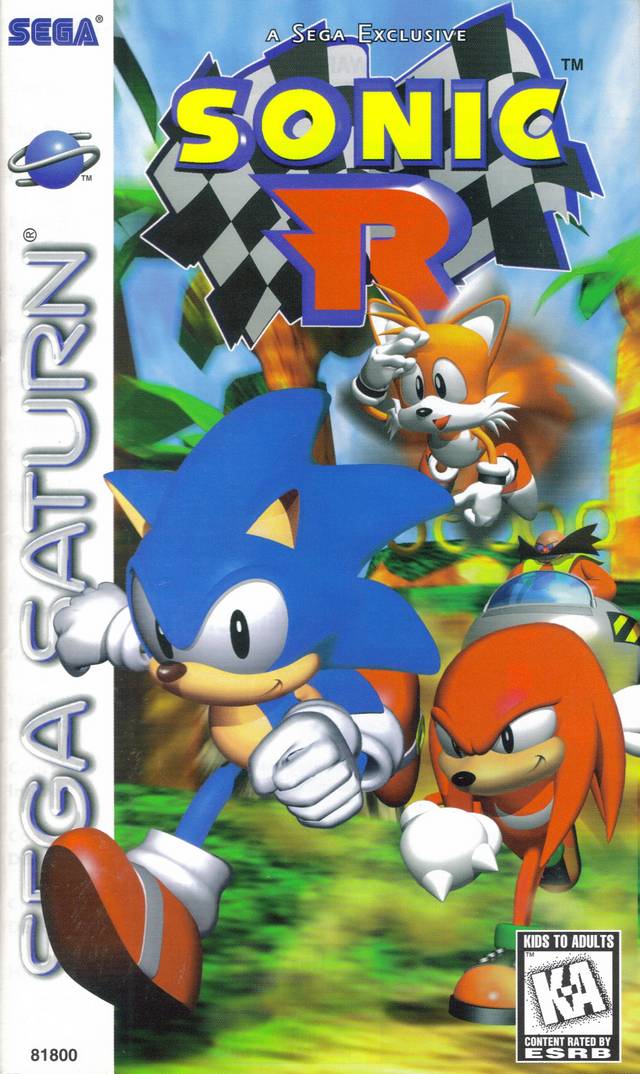
NAME(S): Sonic R / ソニックR / Sonikku Āru
PLATFORM(S): Sega Saturn / PC / GameCube
DEVELOPER(S): Traveller’s Tales / Sonic Team
PUBLISHER(S): Sega
GENRE(S): 3D Platformer Racing
RELEASED: November 18, 1997 (North America) / November 21, 1997 (PAL) / December 4, 1997 (Japan)
I first played this game probably when I was around nine years old. I bought a cheap collection of Sonic the Hedgehog PC ports that also included Sega Smash Pack, Sonic 3 & Knuckles, and Sonic CD. It was a pretty raw deal all-around. Sonic CD notoriously didn’t run on Windows XP, leaving me to convince my mom I was sick one day so she’d take me to her workplace, which was an insurance office where all the computers still used Windows 98. I played that game practically all day but didn’t beat it. For years, it was my first and last chance to play Sonic CD, and by the time I was old enough to play it again, I was experienced enough to know it wasn’t that good in the first place.
I mainly got that PC collection for Sega Smash Pack after getting a ton of mileage out of the sequel (and Shining Force especially), but it also had problems on XP that led to inconsistent crashes and made progressing in the collection’s sole RPG, Phantasy Star II, even more difficult than normal. Sonic 3 & Knuckles was by far the most functional of the lot, but had buggy sound emulation issues and was the easiest to obtain a more legitimate copy of anyway. When I say “legitimate,” I’m counting emulation, as it’d probably run way better.
You’re probably expecting me to say Sonic R deserves credit for being the only one that fully worked, but it didn’t. The main problem I remember was music would randomly not play when starting a track, leaving you to race in eerie silence. There were other problems too, and I think one of them was save files corrupting. That didn’t stop me from getting everything in the game as many times as I could before my mom made me swear to not play it and my other PC games ever again saying they were “viruses.”
I’ve spent more time asking myself “what the fuck is Sonic R?” than anyone on this planet ever should, and I’m disappointed to say that there probably isn’t an interesting answer. No crazy drug-induced developers, no creative disputes, no unique story to explain this notorious mess of a game. The reality is that Traveller’s Tales was taking their first shot at a new 3D engine, Sega wanted an original Saturn Sonic game out the door, and the composer was a fruity westerner whose pop songs sung by TJ Davis (who, surprisingly, was/is Caucasian) were loved by Yuji Naka who demanded more of the same. Sonic R isn’t a product of insanity, it’s simply an alignment of the quirkiest traits of its generation coming together to make one of the most immediately memorable games of the time despite several of those traits being inexperienced 3D game design.
Sonic R is not just a bad game; it’s one of the best bad games ever made. There are many games loaded with various problems that persist as curiosities due to having some unique game mechanics or perhaps a good story, etc., but Sonic R has none of that. It’s an aesthetic marvel with tastes that would only ever be shown during the time of its creation and absolutely nowhere else. It’s something to have a game that looks good for its system (which Sonic R does), but it’s something else entirely to have art design that’s completely left behind as graphical fidelity improves. Sadly no art design has been left behind more than the original 3D era, and Sonic R was one of the last and most elaborate bastions of that vivid design that would be left behind not long after it was made.
But let’s break away from the praise for a moment as we address the actual gameplay of Sonic R. As anyone should know by now, the R stands for Racing, though this would actually be the third Sonic racing game after the two Sonic Drift games on Game Gear. Those games were even worse, but no one ever played them and they aren’t as funny to make a joke out of anyway.
Since Sonic R was created during a time when the Sonic cast was still a reasonable size, you have a modest initial character selection of Sonic, Knuckles, Tails, Amy, and Dr. Robotnik. All characters in the game run on foot as they should with the exception of Amy, who drives a little car, and Robotnik who rides in his Eggwhatever. Grand Prix mode turns out to be anything but as you play single races in any order you want from the game’s generous pool of five tracks, with the Rainbow Road clone locked until you place first in every other course.
Which is easier said than done, because it is the AI, and only the AI, that can properly control the characters in this game. You, a measly player, will have no choice but to continuously drunkenly bump into and ricochet off walls as you futilely attempt to get a handle on your raging bullhog. There is no such thing, nor will there ever be such a thing, as a straight line in Sonic R. You can focus as much as you want, but if the track doesn’t curve then your character will half a second later thus leaving most of the racing to you as you struggle to stay on the track like controlling a really shitty remote rocket. The danger level in Sonic R increases the closer each turn is to a 90-degree angle because any sharp movement on the analog stick at all will infallibly cause you to skid right into the wall you were desperately trying not to hit in a path that’s the closest the game ever comes to a straight line.
It might seem like it’s time to slow down, and even ignoring the fact that removing the maintaining of momentum destroys the innate satisfaction of any racing game, slowing down is the absolute last thing you ever want to do in Sonic R. Why? Because it’s almost not possible. With every character having three seconds of acceleration before reaching their top speed, going back down to that initial speed and deliberately trying to stay there is remarkably difficult.
Attempting to do so is like slamming the brakes on the highway and will send your character in a spinning frenzy as you bump into everything in your immediate circumference and watch the AI pass you as they seamlessly take the turn you were doing everything in your power to make. The best thing you can do is either try to avoid the turn by hoping there’s an easier alternate route or simply keep holding up and rub yourself around the wall, probably smearing it with copious amounts of animal flesh and blood so you can reorient yourself when the rotation is complete and try to get ahead of the AI again.
And that’s all you really need to do. It’s a racing game, so you run and jump your way to the finish line and then do it twice more to complete the course. Along the way you can collect the token Rings which regenerate shortly after being picked up and can be used to fuel boost pads which automatically move you very quickly depending on the amount of Rings you have, and if you’re Amy or Robotnik you can only very partially make up for your ridiculously sluggish speed by spending a small number of Rings to shoot the game’s only weapons at other players. Or even still, you can spend your Rings to open steel doors marked with the appropriate amount. These steel doors not only open some shortcuts, but can lead to secret paths that allow you to obtain Chaos Emeralds or more Sonic Coins.
And here’s where we talk about the most interesting design decision of Sonic R: the courses. To attempt to make up for the small amount of tracks, each track itself is absolutely gigantic for a racing game of the time with a huge amount of running space and a seemingly endless amount of possible shortcuts to take. Many racing games before Sonic R had maybe a track or two with shortcuts that were only ever very obvious or very hidden, but in Sonic R, shortcuts is the whole name of the game. This is only possible by combining platformer-friendly physics such as the jump mechanic with 3D platformer level design masquerading as a race course. Take a Super Mario 64 level, punch a hole through it, and then draw a line somewhere will give you a start on imagining Sonic R‘s courses.
In order to beat the AI’s incredible ability to turn, you need to cut them off using every shortcut imaginable. Whether these shortcuts are the obvious ones like jumping across a pool of water to reach a different part of the course early or obviously unintentional ones like jumping outside of a loop-de-loop for the same reason, discovering and abusing these shortcuts and making the most of them with platforming and not racing skill is the closest thing to fun and originality in gameplay design Sonic R has.
It’s possible to beat the game several times and still discover routes you have no idea how to get to from an earlier path. This makes Tails by far the most optimal racer of choice at the beginning. Not only is he the one you come closest to being able to control, but he can fly which makes abusing shortcuts very easy. As if that wasn’t enough, for whatever reason his flight defaults his speed which allows you to recover from bumps or turns (redundant?) easily. No one else in the game has a mechanic like that. Using any other default character is just punishing yourself.
In addition to the huge course size allowing a lot of room to discover more shortcuts and alternate paths, it also allows many places to hide the aforementioned Chaos Emeralds and Sonic Coins. Each course contains two Chaos Emeralds (the first contains one, the last has none) that are all hidden behind some of the game’s steel doors. This optional challenge requires you to collect rings as you race which also requires the holy gift of precision, and then to find the steel door and run into the Chaos Emerald that spawns on the other side. Though many of these areas are possible to reach without going through a steel door first, unlocking the steel door is what causes the Emerald to spawn, so there’s no cheap tricks here.
One such example is in the Reactive Factory stage where you need to ignore the obvious main road marked by rail guards and an actual road, and instead hop over or squeeze into a tiny space on the left to go through the water area into the far corner of the stage. Here there’s a steel door waiting but the area is completely open so this door doesn’t lead to any path. Oddly enough, you’re just supposed to try to open it anyway which causes an Emerald to shoot up out of a submarine object ahead of you as you first wait for it to slowly fall and settle before attempting several times to grab it because as we’ve been through slowing down is the most difficult task in Sonic R.
You must then make up for lost time as the Chaos Emerald doors actually lead to longer, slower paths (making them totally worthless traps once you get the Emerald) and place in first in order to keep your Emerald for good. Getting all seven automatically unlocks Super Sonic, the game’s best character. Before I neglect to mention, the steel door shortcut paths that don’t lead to Chaos Emeralds but get you ahead of the pack are only ever unlocked by the AI through complete accident, but that doesn’t stop the freeloaders from using the shortcut you paid to unlock on every subsequent lap. Doesn’t that just beat all?
Getting Super Sonic makes the game’s final challenge of the Sonic Coins much easier. In each track besides the final (the final is the worst track by the way) there are five gold coins with Sonic’s face on them hidden, almost all of them in spots totally off the beaten path. Some of these Coins aren’t even on alternate paths, and are instead hidden in nooks and crannies that temporarily stop you from being able to go straight and get ahead. Some are hidden behind steel doors like Chaos Emeralds, and only after getting all five on a single run and placing in the top three can you race one-on-one against one of four secret characters in order to unlock them.
Finding them is actually much more difficult than placing high enough, but this gives a great opportunity to appreciate Sonic R‘s complex maze-like course design, excellent visuals, and surreal atmosphere. Once you know where all the coins are there’s nothing stopping you from restarting and getting them all immediately.
As said, the game has secret characters besides Super Sonic despite him being the best and easiest to get. Thus, the act of beating them in a one-on-one race becomes trivial. Regardless, as you unlock the secret characters they gradually replace each of the completely inferior original five racers and give you more of a challenge while replaying the tracks or getting more Sonic Coins. The secret racers include Metal Sonic in his Sonic CD incarnation, Egg Robo which is Robotnik from a non-locked Sonic & Knuckles cart who is also the only secret character who can use weapons (meaning he is slow to the point of worthlessness), and two original characters.
One original character is Metal Knuckles, who in addition of looking really cool is with Super Sonic in completely trouncing the rest of the cast in ability. There’s a gigantic gap between literally every other character and Super Sonic and Metal Knuckles. Metal Knuckles not only has the second highest speed ranking but can even fly for an indefinite period of time. There used to be debates over whether Super Sonic or Metal Knuckles was better because that seems utterly broken, but there are actually almost no shortcuts in the game that need this over Super Sonic’s (faster) double jump for example, leaving Super Sonic still as the game’s best character due to his ridiculous speed.
The last secret character is the legendary Tails Doll, the strangest thing in a game composed only of strange things. Tails Doll is a lanky stuffed doll that floats and dangles like a dead puppet along any terrain with sparkles following behind his hanging feet, and trades the real Tails’ flight for the ability to float upwards extremely slowly which is actually worse than real flight and can’t make up for Tails Doll’s mediocre speed.
This completely mechanically irrelevant character has become a meme for how bizarre of an inclusion he is, and how simply creepy he looks. Tails Doll is the only thing in the game I can find no explanation for. Why the developers would default to a creepy floating stuffed doll over another Metal character or a different character entirely will never be known, as will it never be known why Tails Doll has a Moogle-like red ball bobber on the top of its head or why it has a zipper on his back. There’s zero logic behind Tails Doll’s character design, physics, and inclusion. Even as weird as Sonic R is he’s completely out of place and will mystify players longer than anything else in the game as a testament to its insanity.
The second best testament is the game’s soundtrack, which is almost entirely pop songs complete with female vocals. Overlooking how it’s weird enough to have videogame music with primarily vocals, all of the music is as ’90s as can possibly be: super upbeat dance songs covered entirely in electronic instrumentation as opposed to the ’80s which used sparser beats. Even better are the lyrics of the songs, which are either laughably optimistic like a mom’s gym cassette tape or simple love songs in a game with zero romance.
Reactive City’s “Work It Out” is the most gym-ready song of all, with lyrics about working hard to make your dreams come true and to make the planet a better place for everyone. Radical City’s “Living in the City” recounts the experience of having to survive in the high energy demanding hustle and bustle of the city. But even still, there’s “so many things to do” and it’s “a city where no one lets you down”. Perhaps the funniest song of all is the Egyptian ruin stage’s, Regal Ruin, which features a song called “Back in Time.” Makes the most sense at first, until you hear:
“So take me back in time
To another world
When you can be mine
We don’t have to worry
When you’re by my side”
Apart from playing the same five courses over and over Sonic R also has multiplayer and time attack modes. Time attack not only measures your course records but also includes minigames such as a game where you race to pop all five balloons on a course, and a tag mode where you race to tag four other AI characters. The AI for this mode is surprisingly really good and will run away from you, turn around when you get too close, and hold their position if they’re too far away and won’t run into dead ends. Completing tag mode with Tails Doll is the ultimate challenge in Sonic R.
In one of the game’s very few good ideas it records records for every mode and course separately for each character, avoiding the usual racing game problem of all the best times belonging to whoever is discovered to be the best character. This should be in literally every game with a time attack mode and multiple characters, but I’ve only ever seen it in Sonic R. Go figure.
One of Sonic R‘s main goals during development was to show off the Saturn’s graphical capabilities, and they succeed at this marvelously. You get full 3D environments to explore that look smoother than any non-top of the line RPG on PlayStation in an action game, and the reflective surface on the water look very beautiful as well in their own archaic, metallic way. From what I can understand, special techniques were used to mask the Saturn’s limited draw distance to make far away sections of the course appear without fully rendering the objects’ data.
This allows for the gigantic scale of Sonic R‘s courses to be felt no matter where you are on the track, and racing through a course you know is much larger than you’ll be able to explore a single run is a curiously immensely satisfying sensation that is lost in normal 3D worlds that can be discovered and put away at leisure. Adding to this subtle beauty is the addition of a weather system. With the exception of snow which freezes water this is purely cosmetic, yet the various weather and times of day you can race in for each course help highlight the fantastic aesthetics through endless playthroughs.
And that’s what Sonic R is all about. It may seem odd to forgive such atrocious racing physics solely in the face of visual and sound design, but you can find any number of superior racing games in terms of mechanics. What Sonic R does well, however, is something that only existed in various parts of its era in individual games, and it all came together in a single game for the first time to create an experience that’s gorgeous, joyous, hilarious, and mysterious. With all of this being achieved through design sense completely of its time all these qualities are only emphasized and multiplied.
Sonic R is nostalgia incarnate, and all traits of its design are so closely related to each other that it’s a unique experience that will likely charm generations outside of its own despite its many, many faults. Sonic R is such a complete relic of its era that it becomes anything but a relic, and it’ll have a legacy that persists endless gameplay enhancements decades after it. Sonic R is the ideal archaic, flawed game—and that’s why it’s perfect.
Leave a Reply