








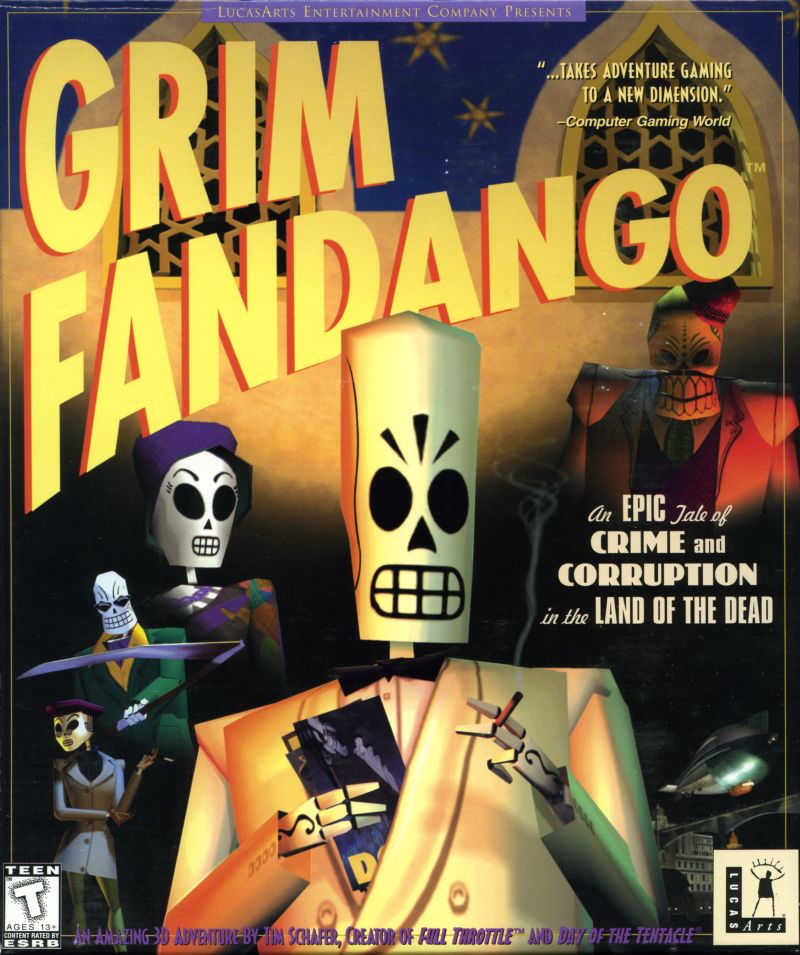
NAME(S): Grim Fandango
PLATFORM(S): PC
DEVELOPER(S): LucasArts
PUBLISHER(S): LucasArts
GENRE(S): 3D Adventure
RELEASED: October 30, 1998 (North America) / November ??, 1998 (Europe)
50 game-breaking bugs and just as many resets and game save downloads later, I’ve finished what I started at least four years ago. In 2011 or so, I began Grim Fandango and greatly enjoyed its writing but didn’t have the patience for its gameplay. From a fresh file, I’ve now experienced the game in its entirety.
To begin with, I have to admit that the game has aged heavily—from a technical standpoint. Seeing this criticism lobbed at even the 2015 remastered version makes me wonder what’s left. First of all, the controls are definitively as bad as early 3D gaming gets. Grim Fandango opted to use tank controls, which was an extremely obvious attempt to fit in with what was popular at the time, with the developers even admitting as much.
Tank controls are an integral part of how some games designed and balanced their action sequences (Resident Evil and Onimusha), but in a purely non-action adventure game context like Grim Fandango, they’re just a worse method of moving around when compared to alternatives. Even when considering fixed camera angles, it would’ve been preferable to just temporarily lock the player’s movement direction until the joystick’s position changed. That way, you’re not constantly rotating around like a barely-sentient coat rack.
Most classic point-and-click adventure games don’t even need to deal with some of these issues, but Grim Fandango‘s insistence on being in 3D introduces a slew of problems. Collision detection is overly sensitive, and the slightest encounter with it or a mild spin of the control stick will cause Manny to sharply change direction. Not only that, but reorienting the control stick when its still in the direction it was before he automatically moved sends him into a drunken frenzy.
The controls only make engaging with the game’s arbitrary puzzles even more frustrating, those of which may be obtuse even by LucasArts standards. It’s the apex of “adventure game logic.” That is, randomly slapping random tools together like Rube Goldberg to do something comparatively simple. Of course, there’s subjectivity with regards to whether or not a puzzle is unintuitive, but it’s hard to imagine that subjectivity would be anything other than a range of “why would I have thought to do that?”
The asinine controls further test one’s patience in backtracking, making simple interactions of the adventure genre such as moving and examining the environment into an ordeal. To aid with exploration, Manny automatically moves his head to look towards points of interest, but you can never be exactly sure what he’s looking at which brings the infamous “pixel hunting” to three dimensions.
When a huge sum of the writing in adventure games is flavor dialogue from examining background objects and you make moving and examining a glitchy, poorly programmed mess (sometimes fatally so), you have a huge conflict of interest between succeeding at the game and enjoying it.
How much I use a guide in obtuse adventure games is often down to how easy it is to move around, explore, and experiment to figure things out myself, but in Grim Fandango, I used a guide for nearly the entire game. It’s not worth messing with already nonsensical puzzles when mistakes and wrong turns can add up to hours of wasted time, which prohibited me from fully experiencing the narrative.
I can only pray they fixed the plethora of glitches in the Remastered version, and I already know they switched to a point-and-click interface. The resolution should be much improved too, so hopefully I’m the last person who will ever deal with the worst of Grim Fandango‘s technical issues.
The real question is whether putting up with all of that was worth Grim Fandango‘s storyline. Simply put: it was. People often compare Grim Fandango to Pixar without elaborating. It’s not as simple as it being CGI and well-written. It’s their elaborate, logical worlds and societies they construct. Tales like Toy Story and Grim Fandango can capture even an audience’s imagination because their fantasies are always cemented in reality.
On the surface, both have impossible fictional settings and designs, and yet they’re each contextualized in our own world. Neither the world of Toy Story or the Land of the Dead in Grim Fandango revel in absurdity. The denizens of each universe have culture, economic systems, societal roles, and personal goals. Manny is not an archetypal grim reaper arbitrarily taking souls. He’s a travel agent who’s doing community service so his soul can pass on.
When the question arises of how there can be risks and stakes in a land where everyone’s already dead, that question is answered with the Sprouter guns, which cause flowers to bloom from bones, thus permanently incapacitating the dead. It’s this brilliance and creativity that connects the whimsical dreams of children to the bureaucratic world adults understand, and it’s why these stories have survived through generations of cultural change.
Sealing the deal of Grim Fandango‘s setting is how seamlessly its influences blend together. The Land of the Dead combines Aztec mythology with ’50s deco and fashion sensibilities, and on this framework hangs other artistic movements suited to the modern times Grim Fandango alludes to, such as film noir and spy thrillers. Manny is an underdog who has to rescue his love from the mob by becoming tougher than the underworld bosses themselves.
Femme fatales? Hidden bases? Climactic boat battles? It’s all there, and the Aztec aesthetic provides an original spin that helps to claim these tropes as its own, which prevents the story from ever coming across as trite parody. There is a consistent sense of humor, but it’s derived naturally from consistently defined character personalities and never demeans the world itself. Unlike many humor-focused LucasArts narratives, the drama is as easy to believe in as the jokes, which just makes both hit harder. Manny may crack wise a lot but his ambitions and intelligence are a constant focal point of himself and the rest of the cast.
Though Grim Fandango‘s story seems small in scale today if you remove the time spent on puzzles and such, the writers at LucasArts crammed as much brilliance as they possibly could given their limited resources at the time. Since Grim Fandango‘s idiosyncrasies still so clearly persist on its sleeve, there will always be an entry for new generations to appreciate the sheer effort and imagination that went into the game. Grim Fandango has aged, but it’s aged as much as it ever will. A good, clever story can never be made archaic. That’s what makes this one a classic.
Leave a Reply