








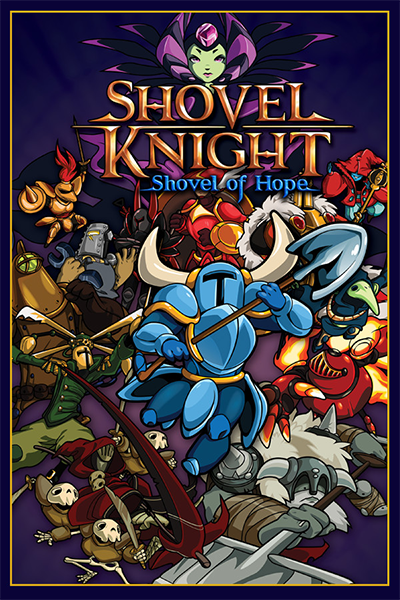
NAME(S): Shovel Knight
PLATFORM(S): PC
DEVELOPER(S): Yacht Club Games
PUBLISHER(S): Yacht Club Games
GENRE(S): 2D Action-Platformer
RELEASED: June 26, 2014 [PC] (Worldwide)
When I first became aware of Shovel Knight it was back when only the demo was released. It was featured on an episode of Game Grumps, back when they still seemed to be putting effort into making the audience laugh. Anyway, I was watching it out of habit and not any particular interest in the game, especially after seeing it was a retro indie platformer which I bear a heavy dislike for (and still hesitate whenever one is recommended). But something was different about Shovel Knight: I had an actual urge to play it. It looked fun. It looked like it didn’t use the “retro” bit as an excuse to go without ambition on a nostalgia wave. That’s a big assumption from just one preview, but when the game came out I made a point to grab it.
My expectations were spot-on. Shovel Knight got it right. For all its undeniable pandering to nostalgia with its slew of references, borrowed gameplay mechanics, and graphics and music also serving to point towards other good games, it gets away with all of this because it actually has an understanding, and thus respect towards, everything it claims is important in gaming. Shovel Knight has the potential to become a very important and influential game despite the fact that the retro platformer fad has been underway for a long time now. But Shovel Knight‘s success makes something apparent that’s completely different from its brethren. Shovel Knight marks the critical and mainstream success of a retro game that’s clearly designed by video game fans for video game fans, something I’ve never seen so obviously before.
Shovel Knight didn’t look at its influences through simple rose-tinted glasses, saying “This was excellent! That means it works!” and proceeding to copy them on a skin-deep level. Shovel Knight‘s developers looked at the games they loved, asked themselves why they worked when they did, what was going wrong when they didn’t, and copied those philosophical design elements while piling on the nostalgic window dressing only after what truly mattered about why those games was acknowledged.
To be perfectly honest, I was taken aback by how incredibly conscious Shovel Knight‘s level design was. Video games are a young medium that’s only recently entering its confused post-graduation stage of life, and gamers now growing up and continuing to play games, as opposed to most of the older Atari generation, has brought rise to many people who are now thinking deeper about exactly why the games they like and didn’t like affected them so much. Serious gaming criticisms and analysis are on the rise, and with independent developing it seems everyone wants to show off their design philosophy and how they think games should be.
Shovel Knight is so self-aware of these recent debates and critiques that its level design is constantly on the beat. It works like complete clockwork. Whenever a new obstacle is introduced it’s always done in a “safe zone” where the player can find out what it does before they enter a challenge with it that can kill them. When a new enemy is added it’s much of the same with an appropriate amount of distance placed between it and the player.
I couldn’t help but notice this is done literally every single time and there’s something disturbing about how its so consistent that it becomes planned and mechanical. I almost want to call it “smug,” but that makes it sound like I think Shovel Knight should allow mistakes and be a worse game just to make it seem more “human,” which is probably ridiculous. It’s not a criticism of the game, just a very weird feeling and makes me wish I wasn’t so conscious of this stuff when I play. Like Shovel Knight‘s developers are.
I think back to all the points Arin Hanson made in his Mega Man X Sequelitis episode, and given its popularity I can’t help but think that some people in Shovel Knight‘s team saw this, thought there were good points, and actively made sure they were in the game. You almost never see criticism have such a direct impact on the development of games. Most mainstream developers and directors feel anonymous as if they’re in some ivory tower, completely out of reach and touch with the people who actually play their games. But Shovel Knight‘s developers are definitely the players, and they never forget what it’s like to be one.
Anyway, let’s take a step back for a bit. Shovel Knight of course stars the titular hero who’s on a simple quest to save his beloved Shield Knight. A shield is hardly a complement to a shovel, but I guess “Hoe Knight” would’ve been pretty questionable. Shovel Knight, brandishing only his Super Mystery Power and also actually a dozen other Magic Powers must defeat his former knight companions and the evil sorceress who commands them.
Shovel Knight‘s world is pretty ordinary for the most part. The try-hard quirkiness of giving the hero of the game a shovel for a weapon is forgiven by the fact it actually makes a case for itself in the gameplay, and the intentionally overly dramatic, stuffy, regal old English dialogue and other lampooning of the setting have been done to death to the point of becoming archetypal dork humor ever since Monty Python and the Holy Grail was released in 1975, but again its too modest to really groan at how played-out it is and the knights are at least a little cute.
Not heavy on story, Shovel Knight still features an abundance of flavor text for the player to read at their discretion when taking a break from the platforming. There are plenty of NPCs to chat with, and there’s dialogue before every boss fight to give a little personality to the characters besides their appearance, but the player can still skip these if they want to with no consequence.
Perhaps the only aspect of the story truly worth mentioning are the aspects in which it’s combined with the gameplay. There are many cutscenes in the game where Shovel Knight dreams he’s rescuing Shield Knight but is always unable to no matter how hard he tries, and by “he” I mean the player, in order to demonstrate his struggle, but these cutscenes in particular make me think Shovel Knight is operating under some kind of strict “Critic’s Guidebook,” trying to impress and gain brownie points by simply showing how thoughtful it is. Shovel Knight isn’t remotely a narrative-centric game and by the third time of seeing this cutscene I was simply waiting for it to be over so I could continue with the actual game.
It’s fleshing the story out, but it’s still akin to polishing a stone that’s not too impressive to begin with. I see a lot of people commend the game for this and I think it’s focusing on the wrong strength of the game and congratulating something thrown in for the sake of impressing rather than significantly adding to the experience, meaning Shovel Knight‘s critics fell right on the bait. Honestly, this isn’t worth dwelling on and it affects my opinion of the game neither negatively nor positively, but it is an example of how critically-conscious the design of Shovel Knight is, this time in a slightly off-putting way in my own perspective.
With that out of the way, we can move on to the tight platforming gameplay that Shovel Knight does best. At the beginning all you can do is swing your shovel to attack, dig, or break blocks, or point it downwards to attack and also bounce off enemies and objects. Though very simple, Shovel Knight has plenty of challenge variety due to the platforming stage gimmicks that combine old traps with Shovel Knight‘s conventions such as the bouncing.
As the game progresses you can get Relics that mirror the sub-weapons of the Castlevania series that cost magic points. Some of these Relics give you new ways to traverse and find hidden treasure but none of them are necessary to complete the game. I love how the game has an overworld map with the freedom to choose where to go, though I don’t think this is utilized much more than an aesthetic. Shovel Knight‘s too short to give you many choices of where to go that each player’s path through the game will differ much, but it still looks nice and is far preferable over a list or a bunch of icons. Finding and fighting optional bosses that are a nice change of pace from the knights is very cool as well.
Shovel Knight‘s sense of feedback is great. The sound when hitting an enemy is loud and feels strong, and the copious amount of gems you can find scattered all over the stage favor quantity over value giving the player plenty to collect with a barrage of more satisfying sound effects to make the player feel more accomplished than simply grabbing one gem would do. Bouncing on things is easy and usually allows you to maintain momentum when going through a stage, and it’s fun to see how long you can keep it up for.
Levels frequently have short split paths to find more treasure, and treasure can be used to buy upgrades in town that give the player both a personal satisfaction as they choose what to upgrade first and a sense of progress that makes exploring all of a level for gems worth it. The constant rewards that are used to bait and string the player through the game have also been used many times in other games such as Castlevania, but it’s worth mentioning that Shovel Knight understands most players will go for these rewards and thus doesn’t have them add up too quickly. I got every gem I saw and only had every item bought by the final stage, something I’m sure was planned for. Shovel Knight encourages the player to see the entire game without making any of it feel like a chore.
And now it’s time to segue into what I think is Shovel Knight‘s only major hole in what it is: the level of challenge. I suppose it’s refreshing to see a retro platformer that doesn’t try too hard to be difficult, but the challenge is almost non-existent. To start with, your basic weapon is already far too useful. Every time you hit an enemy you’re pushed back a bit to safety where you can then jump or attack again with essentially no lag between, and bouncing can be done indefinitely, pushing you far away from any danger while giving you a huge space to decide whether you want to dodge or go back in for another attack.
Enemies are barely equipped for your unstoppable bouncing power and will often either do nothing or try attacking the space next to them where they’ll never hit you. Some enemies are immune to bouncing and can even block frontward attacks such as the generic knight enemy, but this works out because you can still bounce to get away from them and simply ignore fighting them all together. Eventually you’ll go to the next screen or go across a hole they can’t chase you over, and although you might take a hit or two your health almost doesn’t matter in Shovel Knight because healing items are frequently found and there’s no limit to the amount of times you can die, each time restoring your health and magic points completely.
This is also a good place to mention the punishment for death, where Shovel Knight merely sends you back to a checkpoint with the loss of some of your gold you can risk recovering at your death point, but dying again means permanently losing what wasn’t gotten back in addition to even more gold. This is a very thoughtful thing and it would’ve been easy to instinctually copy the lives system of older games that was often a holdover of quarter-robbing arcade machines, but it humbly chooses not to hog too much of the player’s time and patience by instead making a death annoying and inconvenient, something to always be avoided, but not unreasonable to the point a player would eventually give up on overcoming their challenge in the first place. It’s another very nice sweet spot
Shovel Knight finds in considering how the player might feel about the game as they’re playing it. However, while this does lower unnecessary frustration it doesn’t have the added benefit of being able to increase the challenge without needing to ward off the player. Since death doesn’t matter too much it would’ve been the perfect opportunity for Shovel Knight to have much more dynamic, riskier, exciting challenges because whenever you lost it wouldn’t take long to get back to where you were and practice again, as opposed to certain other games that are difficult and would send you all the way back to the beginning where many players would eventually ask themselves if it’s even worth it to continue playing. It’s disappointing that Shovel Knight realizes lives aren’t always necessary and are often a distraction but doesn’t come to the conclusion of what should supplement the increased sense of confidence.
And the bosses. If the challenge is the weakest part of Shovel Knight, then these are the weakest part of the challenge. I can understand overlooking the challenge of the platforming and standard enemies, but the bosses just confound me. These are unavoidable fights that demand your entire attention but the game designers didn’t realize how pathetic all of them were. In general, boss attacks usually deal the same half point of damage every attack, but you and your unstoppable shovel can wail on them endlessly and drain entire points in a matter of mere seconds because enemies and bosses have almost no window where they can’t be hurt, which would normally force you to prioritize your health over theirs.
And, of course, the bouncing is more effective than ever, because it’s a safe, closed arena where the boss will be at predictable spots for you to land back down on as they attack in front of themselves while you’re ten feet above their head. You, naturally, do have invincibility frames so a head-to-head encounter with a boss will never drain your health faster than you can drain theirs. The bosses in this game are so totally helpless against even the default set-up. These fights being disappointing hurts a lot because the bosses actually have a large amount of very cool attack patterns, and the dialogue before each one makes the fight even a tiny bit personal, but they never do either any justice in the ten seconds they last.
If your shovel isn’t powerful enough already, you can still use the many optional and hidden Relics. I won’t talk about every one, but it’s worth mentioning that while I love sub-weapons in games, Shovel Knight‘s weren’t appropriately matched for the occasion. Perhaps the most baffling sub-weapon is one you can get very early on, a pendant that turns you invincible for three seconds at the cost of some magic. On paper that sounds reasonable as it’s such a short time, but realize that that three seconds is enough to get past any enemy that has an actual risk of killing you by knocking you into a hole, or can be used to get rid of the only very rare times a boss actually hits you making the fight even more unfair.
The magic cost is a little hefty on this Relic, but enemies drop more magic like candy and you never need to come close to exhausting your whole stash to reap its full usefulness. The other Relics aren’t nearly as overpowered but they still struggle to find any appropriate use due to your shovel being so fast and mobile already. I think it would’ve been better if Shovel Knight designed its levels more around the freedom to choose these sub-weapons to create more unique platforming challenges. The short, optional areas where you can find treasure with the sub-weapon are the only times they’re necessary. Making them necessary to get through a level means some would no longer be optional, but I’m willing to pay that price to expand the simple mechanics of the game.
The music and graphics naturally try to replicate 8-bit games. I realize I’m in the minority here but I’m not particularly into the soundtrack as a whole. It’s catchy and I enjoy the music when it’s playing, but the 8-bit conventions of it make the songs really blend together to me and I can rarely remember them after the stage is over, with a few choice exceptions. And like a lot of 8-bit games the graphics are clearly far too good to be pulled off on an NES so this homage comes across as a bizarre pixel fetish that I think I’m the only one not into these days.
I’m split on Shovel Knight‘s aesthetics because I think it has a fantastic, charming sense of color design that doesn’t neglect any part of the wheel, and the foregrounds and backgrounds are very detailed and never reused in other stages. The pixelated nature gimps the quality of the sprites for no reason other than nostalgia though, and I wish the game had more ambition and took the risk to have some smooth, truly impressive sprites rather than ones that you look at and just be mildly pleased. There’s also a high number of recolored enemies, and many of them are simply boring like the family of mice and don’t particularly feel like they belong in the setting, looking at odds with the character designs that are important such as the knights. The human NPCs in towns are particularly jarring.
I’m definitely not one to say a game needs to be challenging to be good (in fact, I hate this philosophy), but while Shovel Knight is still enjoyable, its lack of challenge is significant because it has a direct impact on all of its best qualities, which are all of those relating to the platforming itself. There were many parts of Shovel Knight‘s level design where I thought “oh, that’s very clever” on observation but rarely did I feel like I got the full extent of their application. The low difficulty didn’t demand much of my attention so I often got into phases where I went into “auto-pilot” and just ran through the game rarely ever having to think or feel tension in real life.
It lead to a sensation where I was being entertained while in a level but after it was over didn’t feel satisfied or accomplished, and I had nothing to think back on about the experience. It’s like… going through the motions. And that’s why I’m not able to say I truly love Shovel Knight. Because it’s ultimately a very complacent game. For everything it does right, I feel like I’ve seen it somewhere before in a game that ended up leaving a much stronger impression on me by having a more engaging challenge or some other unique twist.
It’s exemplary in that it understands what makes a game attractive to play but it’s satisfied with that understanding alone and doesn’t build past the base, or even reach the base’s full potential with its simple and often unbalanced challenge. It’s a game that lacks some kind of pizzazz and doesn’t reach its influences as an example of the genre.
But unlike so many games it got the first couple of steps right which is what’s so upsetting. I said Shovel Knight will probably end up being an important game, but I hope future developers who draw influence from it do so in the right places instead of yet again coming to the conclusion that it was the aesthetic of old games that made them good. It’s a lot more complex than that, tough to replicate, and even tougher to refine, the third step Shovel Knight didn’t reach.
It admirably tried though, and it succeeded at being a charming, breezy platforming game that’s easy to recommend any fan of the genre, and just as easy to forget about after it’s over. With such a conscious developing team I anxiously await to see what improvements will be in the inevitable Shovel Knight 2 that I’m sure will attempt to upstage this original. I’ll be one of the first people in that line to play it.
Leave a Reply