




NAME(S): La Pucelle Tactics / La Pucelle: The Legend of the Maiden of Light / ラ・ピュセル 光の聖女伝説 / La Pyuseru Hikari no Seijo Densetsu / La Pucelle Ragnarok / NIS Classics Volume 3
PLATFORM(S): PlayStation 2 (PS2)
DEVELOPER(S): Nippon Ichi Software
PUBLISHER(S): Nippon Ichi Software (Japan) / Mastiff (North America) / Koei (PAL)
GENRE(S): Strategy Role-Playing Game (SRPG)
RELEASED: January 31, 2002 (Japan) / May 4, 2004 (North America) / April 1, 2005 (Europe) / April 15, 2005 (Australia)
Quick note (November 24, 2025): I added a small, off-the-cuff review of this game’s enhanced port, La Pucelle Ragnarok. Please check it out! My review of the game’s original version is very old, and I’ve yet to update it.
La Pucelle Tactics Review
Publication Date(s): December 15, 2015 5:16 am EST
Right out of the gate, Nippon Ichi Systems (NIS) were developing cult classics like the SNES versus jigsaw puzzle game, Pieces. However, the original PlayStation was where they began to define their idiosyncrasies. The NIS brand truly started with the Marl Kingdom series. For decades, its first title, Rhapsody: A Musical Adventure, was the only entry to be localized in English.
NIS cleverly made heavily-stylized games that disguised their mild development budgets. Favoring the relatively simplistic strategy RPG (SRPG) genre permitted a frugal use of resources. The genre’s less-demanding narrative standards compared favorably to the large-scale environments of traditional, turn-based RPGs.
Uncharacteristic of the era, NIS using 2D sprites and minimal 3D models likely made their games easier to program and cost-effective. The console generation’s low screen resolutions helped to hide the rougher details in NIS’s sprite work. This, along with their distinct visual style, allowed their games to compete with higher-budget 2D contemporaries like Legend of Mana.
Keeping Up With the Times
When the PlayStation 2 (PS2) released, console standards increased while NIS’s funding did not. Their first PS2 game, La Pucelle Tactics, would have to contend with these issues. While not strictly a Marl Kingdom game, it takes place in the same world and shares many of its stylistic sensibilities. Though NIS are synonymous with over-the-top, eccentric comedy, their early RPGs are quite different in tone.
United by technical aspects including 2D graphics, distinctive character designs and worlds, and being strategy RPGs, these earlier games possess a lighthearted, measured grace. Titles like Rhapsody, La Pucelle Tactics, and Phantom Brave resemble classical fairy tales. In an approach similar to the works of Studio Ghibli, they likewise feature coming-of-age themes and frequently star female main characters. While all NIS games are high-fantasy settings, this description hardly overlaps with Disgaea or Makai Kingdom‘s crude, comic absurdity.
Premise of La Pucelle Tactics
La Pucelle Tactics stars devout servants of church La Pucelle, who combat demons threatening mankind. Lead character Prier aims to be a demon hunter alongside her younger brother, Culotte. Supervising the orphan siblings is Alouette, a La Pucelle veteran and apprentice priestess. Prier’s brash attitude clashes with the pious Alouette, straining their relationship as they uncover a demonic threat to the entire world.
In a trait shared with Phantom Brave, the overarching story of La Pucelle Tactics isn’t a constant focus. Both are less concerned with their ultimate goals than with their general adventure and its incidental occurrences. Neither title suffers for this, however.
Unlike Disgaea, which you could argue has a similar structure, the individual chapter plots are generally interesting. They reliably develop the world and cast, marrying individual character arcs to the overarching narrative so the party is united in shared stakes. In Disgaea, party members often feel tacked-on, lacking a significant, personal relationship with the party.
What Makes La Pucelle Tactics‘s Story Memorable
La Pucelle Tactics competes with Makai Kingdom for having the most charming cast of an NIS game. Each character has a satisfying conclusion to their arc. Everyone, at some point, is temporarily permitted to be the most important person in the narrative. This avoids the common NIS problem of a passive, uninvolved supporting cast.
La Pucelle‘s world is full of magic, but it’s never shoved in your face. At one point, you encounter a pirate captaining a flying ship of talking cats, aided by a butterfly girl with an unrequited crush on him. Disgaea would point out and embellish the absurdity of this, but La Pucelle organically plays it off. It’s a world where its denizens expect this sort of thing to happen. To the unfamiliar player, the world gradually increases in scale and meaningfulness, never plateauing in its relatability from doubling-down on humor.
Audiovisuals
For the weaker parts of La Pucelle Tactics, we have… mostly everything else. The game looks worse than Rhapsody despite the generational leap. This is presumably from the technical difficulties of learning new hardware. If you’ve played the original Disgaea, you may remember the sprites looking dark and blurred, or “muddy.” La Pucelle Tactics isn’t as off-putting, thanks to the art style’s bright tone wiping away some of the drab sprite colors.
Still, it’s disappointing that the game’s style couldn’t be fully capitalized on. La Pucelle Tactics relies on stylization to make up for lower visual fidelity. While its graphics are relatively simple and low-tech, the visuals are still an integral part of the experience.
The audio quality similarly takes a hit, with an English dub track that’s barely audible. It’s a shame, because there are some talented vocal performances. The only egregious casting is Prier’s brother Culotte. The 12 year-old periodically switches from an appropriate voice to that of a sarcastic, stoned surfer. Like the vocals, the volume of the background music volume is mixed incredibly low compared to the voice clips during battles. I have no idea why the sound mixing in La Pucelle Tactics is such a mess. You’d think it’d be a simple matter of adjusting audio levels.
Artwork
La Pucelle Tactics has, in my opinion, the weakest official and in-game portrait artwork of any NIS title—by far. Character silhouettes in official and in-game art are amorphous blobs. That and the simplistic coloring technique are out of step with the rest of the game’s elegant aesthetics.
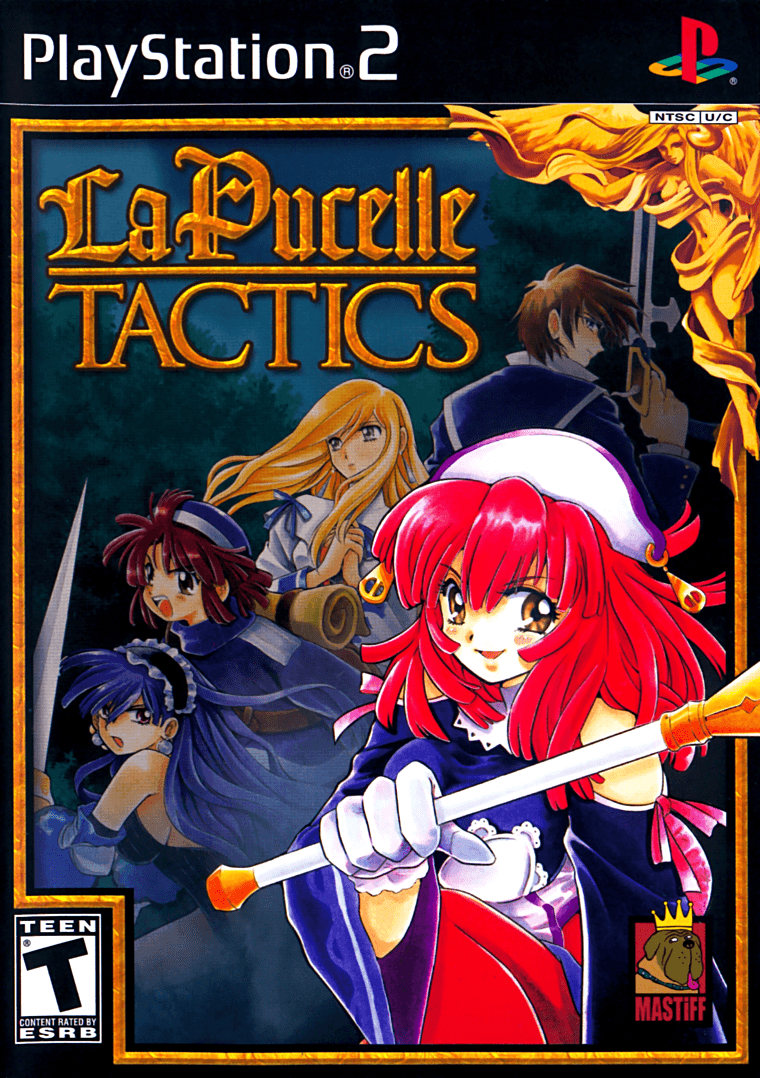
The in-game artwork particularly bothers me, as the cover artwork is excellent. Just look at Prier’s hair; Prier and Culotte’s designs resemble Raggedy Ann and Andy. I feel that’s appropriate for a story with the cadence of a fairy tale and a child-friendly look. It’s unfortunate that the cover artist seemingly wasn’t the main one.
Gameplay
NIS would experiment with their strategy RPG systems with each game following Disgaea. This makes La Pucelle is a rarity in having an unrelated game that’s basically a linear upgrade. That game is Disgaea, and although it feels rather archaic now in light of its sequels and the increasingly player-friendly design of strategy RPGs, it still towers over La Pucelle in accessibility. Playing La Pucelle can feel like trudging through molasses. Any sense of victory derived from completing its maps feels as shallow as its combat mechanics.
While NIS games can lack strategic depth, they typically make up for it with an elaborate metagame, and imaginatively-contextualized mechanics. However, never has it been more difficult to overcome the basic gameplay demands than in La Pucelle. Units move slowly, there are cutaway animations for even basic attacks, and enemies can be damage sponges despite their low threat level.
Add to this fact that this means you’re encouraged to use adjacent combo attacks (which add more to animations) and need to purify enemy portals that will spawn an infinite number of new enemies if you take too long to reach them and this slow speed only gets worse when coupled with the inherent lack of tension from simplistic stratagems.
Character Building
There’s no weapon types or class-locked equipment in La Pucelle Tactics. Instead, every character and class has their own, unique skills learned from leveling up. The exception is Magic, which can be taught to anyone.
Equipment randomly has an elemental charge, depicted by a number and colored icon. A character equipping the requisite total number of the same element (color) allows them to cast its Magic. The available Magic’s power is relative to the equipment’s elemental number. Casting a Magic spell until it reaches level one gives that character permanent access to that Magic, regardless of equipment.
Combos
Placing units adjacently and choosing to attack has a chance for non-participants to join in for a combo attack, marginally increasing damage. Combo attacks don’t cost MP like Skills and Magic do, so they’re not as powerful. Determining the most cost-effective Skills, as in damage per MP cost, is the most useful thing you can do. Personally, I found Alouette’s Holy Bells Skill to be very effective throughout the entire game.
Passives
Units have stat traits they increase alongside their personal level and Skills. Traits come in multiple categories named after stats, and typically level up by doing actions relevant to that stat. Attacking often raises your ATK trait, etc. Having a specific level and combination of traits will bestow a unit passive abilities. For instance, a unit with a high enough ATK level might learn a passive that randomly buffs their attack power during a round of combat. Paying close attention to which trait combinations unlock passives and piling them onto your units is a critical part of La Pucelle Tactics.
Purification
The portals mentioned above are linked to a largely superfluous gameplay mechanic. Characters who are part of the church (i.e., only certain story characters) can use the Purify command to seal evil portals during maps. Most portals are benign, but portals with black smoke rising from them will spawn enemies after a certain number of turns. All portals extend in a straight line, and their direction will change to match the facing of a unit standing on its spawn point.
When portals are purified, they disappear in a linear fashion, damaging every enemy in its path. If you’ve played Disgaea, this behavior is virtually identical to destroying Geo Symbols. Purification damage increases depending on the number of tiles Purified. The player can manipulate portal panel directions so that they intersect, causing a chain reaction upon Purification.
There’s no Throw command in La Pucelle Tactics like there is in Disgaea, so positioning units is typically far too cumbersome to make Purification combos worth the time spent setting them up. Seeking Purification may also move units away from enemy positions, further drawing out map length.
You’ll usually find your hands full just trying to defeat enemies in a timely manner. Most time dealing with Purification will be when beelining for dark portals, taking pot shots from enemies all the while. Other than dark portals, which are a significant annoyance that pad out maps, the Purify mechanic may as well not exist. On top of every other issue, it forces the player to favor using certain story characters in their party.
Recruiting Monsters
In La Pucelle, monsters can be recruited with the same Purify command. Your chance of recruiting a monster upon killing it increases the more it’s Purified. Since only a small number of characters can Purify, doing so usually entails standing adjacent to your target and getting your ass kicked until the odds feel good enough.
Frankly, recruiting monsters is another of La Pucelle‘s mechanical quirks that isn’t worth bothering with. Unlike Disgaea, monsters cannot be reincarnated or anything of the sort to keep them relevant. Their primary use is having a story character learn magic from them.
If you do use monsters, they’ll inevitably be power crept, unlike unique characters, who consistently improve. Why even give monsters any EXP? There are no generic units other than monsters. Fortunately, La Pucelle‘s story characters are so likable that you’ll probably prefer using them, anyway.
Novel, Split-Path Story Structure
A more promising gimmick in La Pucelle is that each chapter—often being a standalone story—is able to have multiple endings. Chapter endings are based on doing any number of things to uncover more cutscenes where the party learns more about the chapter’s dilemma. Depending on the chapter, you may need to go back to earlier maps, do optional maps during the chapter, or speak to certain NPCs at the right time.
I honestly can’t remember the specifics of these endings. I do remember the game routinely guilt-tripping me for not getting the best ending when there was no hint on how to do it. There’s a particular chapter that made me feel pretty bad. While this didn’t happen to me, a certain chapter’s bad ending can permanently prevent you from recruiting an extremely good party member.
Ultimately, I think this is a cool feature. Most endings—even bad ones—don’t inhibit you in any way. There’s only one ending for the game’s main storyline, and it’s independent of other chapter endings. The good endings can make you feel proud of going the extra mile when the game isn’t forcing you to be a good Samaritan.
This may have been implemented too obtusely, but it takes advantage of the game’s episodic structure. I think a simple flow chart that persists across a New Game+ mechanic would singlehandedly “fix” this part of the game. There’d be far less pressure in getting every good ending, and bad endings wouldn’t feel wasted, as you’d still progress your flow chart. Depending on how much extra work a developer wants to put in, there could even be post-game Tactics Ogre-esque checkpoints for the player to travel between.
La Pucelle Tactics Verdict
Overall, La Pucelle is a charmingly quirky game where it counts most. Likewise, it’s nowhere near interesting enough in areas that still count for a lot. As with many unbalanced games, it’s only of particular interest to those who value its specialties. If you can tolerate a low-depth strategy RPG in exchange for a whimsical, unique tone and world, it may be worth your time.
Though the game mechanics are among NIS’s weakest from their peak period, La Pucelle Tactics is one of their hardest games to forget. My memories are worth more to me than my time spent playing it. An unusual thing to say, but perhaps that makes it all the more worthwhile.
La Pucelle: Ragnarok
Publication Date(s): November 24, 2025
Background
Since originally writing the above review, La Pucelle: Ragnarok has been released in English. Ragnarok was one of many NIS PS2 games to be ported to the PSP, each receiving new features and bonus content. Its initial 2009 release, along with a port of Makai Kingdom, was not localized, likely due to a perceived lack of consumer interest.
A functional, English fan-translation eventually emerged that inserted Mastiff’s North American release script. It wasn’t ideal, and the patch had some technical issues, but for a while, it was a fine way for English audiences to experience Ragnarok. Back then, I had tried the patched Ragnarok, but never stuck with it for one reason or another.
I’m happy to report that the compromised fan-translation is no longer necessary. In 2022, NIS rereleased the Ragnarok version of La Pucelle alongside the aforementioned Makai Kingdom port in their NIS Classics Volume 3 collection. I believe some platforms, such as Steam, allow customers to buy the titles separately. However, I think others, like the Switch, only sell the collection. It’s inconvenient, but I suspect most demographics, if they like either game, would enjoy both.
I bought the collection and played through both titles. Unsurprisingly, they are the best versions of each game, and anyone playing them for the first time should seek those out. Obviously, they’re the versions easiest to find, so that shouldn’t be difficult. The enhancements from Ragnarok are much more substantial than those added to Makai Kingdom, so the former is particularly recommended over its original.
Changes: UI
This section currently isn’t intended to be an extended review, so I’m writing mostly off of memory. I’ll just go over some highlights. It’s been a while since I played Ragnarok, but I think I experienced basically everything shy of the post-game Demon World content. Said content was in the original game, where I also have yet to do it. It’s a tedious grind. Point is, I have significant experience with Ragnarok.
The best parts of Ragnarok are its interface enhancements. Of these, the added ability to skip animations is a critical improvement. This solves the original game’s biggest issue and dramatically speeds up its pace. I think there are some other speed adjustments, such as being able to skip walking animations and accelerate Purification effects. All of that is great.
On the other hand, some parts of the UI are curiously untouched. This is observable in control shortcuts, or the lack thereof. Future NIS games allowed using the shoulder buttons to snap between units who had yet to take an action, and would also move to the Base Panel if there was still room to deploy units. Ragnarok doesn’t add this functionality, so players have to manually scroll to take any action. It’s an odd and frustrating oversight, as I struggle to think of an SRPG lacking this feature prior to Ragnarok‘s release date.
Changes: Story Presentation
From what I can tell, the English version of Ragnarok reuses Mastiff’s script, just like the PSP fan-translation. This also allowed NIS to reuse its accompanying English dub. While that may only represent reduced costs for the company, returning players with an attachment to that dub probably appreciate this choice. Mastiff’s localization edited some graphics to avoid religious controversy, such as removing crucifixes. I believe this censorship was reverted for the rerelease, which is nice.
Of course, there’s an impasse when it comes to Ragnarok‘s new content. Its Japanese script had to be translated and dubbed into English for the first time. I don’t recall feeling like the script was too stylistically distinct from Mastiff’s job. Where things do clash, however, is the new dub cast.
I don’t want to litigate NIS’s decision to hire new actors while choosing to reuse the old dub. It’s possible they were justified in doing so, and it’s likewise possible they could’ve put the extra effort and money into rerecording old lines or seeking out the original actors. I’m not taking a position on that, today. Just know it happened.
Whatever the case, the new actors’ attempts to imitate the old performances are naturally imperfect. Some lines and characters are more convincing than others, but the uncanniness is always somewhat distracting. Players who prefer the Japanese voice track will sidestep this incongruity, of course. I’m sure the actors did what they were told, and did their best. No shade on them.
Changes: The New Storyline Scenario
As with every PSP port, Ragnarok added a new campaign scenario. I’ll be frank: I think the new scenarios—for every port—aren’t good. They’re alternate story paths from beginning to end, and that lacking intersection isolates them from much of the main path’s content. Since the new campaigns are shorter and smaller-scope, certain locations, features, and playable characters aren’t present.
This typically results in feeling like you’re playing a truncated, worse version of the original game. It’s all in exchange for a new storyline and maps. This compromise, however, highlights how the original games were very much more than the sum of their parts. La Pucelle‘s gameplay does not have enough mechanical complexity to afford losing the appeal of its world and characters. I couldn’t tell you anything about Ragnarok‘s new maps from memory, which should speak to something.
As for the original story, I’ll give Ragnarok credit for having the most interesting premise of these new campaigns by far. It’s inspired by an alternate ending from the original game, which initially came off as a simple gag. That ending was a “what-if” scenario that prompted the player to start another cycle. It’s exorbitantly unlikely a player would ever come across that ending unintentionally, as it requires extensive grinding in a specific manner.
Unfortunately, I think Ragnarok still explored this concept in an unsatisfying way. It would have been extremely cool to see a straight-up continuation of that alternate ending. Without getting into spoilers, it would present major character conflicts, and I expect it could follow a tone similar to the alternate path in Soul Nomad.
I feel like NIS wanted to do this themselves but compromised. It’s possible they wanted to avoid making the game too dark or mean-spirited relative to its usual tone. I understand that, truly, but… I dunno. Shouldn’t art be willing to take risks and be evocative? This would still be for a bonus, short, non-canon story. It’s not like it would paint over the original with a black brush. If anything, NIS have already done that due to their preferred depiction of Priere whenever she makes a cameo in their other games.
The new scenario touches on that alternate ending’s concepts, but sympathetically pumps the brakes too hard. Its conclusion gives the sense of upholding a mostly-identical status quo. As such, it cements itself overall in the same place as the other ports’ new scenarios. It’s too much of a retread and victory lap. Unexciting. Tedious. The same but worse.
Changes: New Units
I will say, however, that the reward you get for completing the scenario is pretty dope. Trying to avoid spoilers, it’s a new unit who’s quite powerful. This is despite them lacking the typical amount of four unique Skills. This reward can be used in the main game, so there’s no conflicts there.
Ragnarok adds a few other units, too. The original Disgaea trio of Laharl, Etna, and Flonne appear to play their tired shtick out for the millionth time. Oh, and there’s a Prinny. More exciting are Rozalin and Cornet from Disgaea 2 and Rhapsody, respectively. It’s odd that Cornet is the only Marl Kingdom character to appear, given that La Pucelle exists in the same world.
The last of these new units is the strangest. Eri, the bouncy shop assistant NPC from the main town, can now join you. I have no idea what compelled NIS to do this. She has no story relevance. It was strange that she always had a unique portrait and design to begin with. But to do something with that now?
Well, Eri is super cute, so I don’t mind. Her inclusion otherwise exhibits disinterest, however. Eri’s map sprite is her town sprite scaled down, but it doesn’t look good. Overworld sprites have a different size ratio because of the change in perspective when on maps. Overworld scenes are framed at an almost 180 degree angle, while maps are depicted isometrically. Instead of drawing an entirely new sprite for Eri, they stuck her in a hydraulic press and forced her to fit. Poor lass.
That’s got nothing on her battle application, though. Eri sucks. She’s the only unique character to have no Skills. You can teach her Magic, like any unit, but her INT stat is terribly low. Her ATK isn’t, but basic attacks offer a small damage multiplier when compared to physical Skills. Eri literally has no niche, and struggles to contribute anything to battles. Your best bet is to teach her support Magic like Braveheart and Espoir, as their effectiveness is static. Still, as a physical-oriented character, her SP pool is poor. She’s just bad, man. Did NIS even realize this?
The new units tend to have less unique Skills than existing story characters, but you only really need one good Skill to contribute relevant damage. Eri didn’t even get that much.
What Didn’t Change
Being blunt, if NIS can get away with not altering something from the original, expect that they did. All other issues regarding game balance, production, and QoL persist. Generic units still tend to suck. The audio mixing for reused scenes is still a catastrophe. And alternate chapter ending requirements remain obtuse.
My Verdict on Ragnarok and Recommended Experience
We may not have an idealized version of La Pucelle, but Ragnarok is the closest to it. The original game was flawed, yet worth trudging through its weaker areas to experience its idiosyncratic world. Those principles hold true for Ragnarok, but new players will come in with higher expectations than those of the early 2000s.
Ragnarok‘s scant updates need to make up that difference, and I wonder if they’ll be enough. I think it’s a shame fans of quirky fantasy might miss out on La Pucelle. But can I really blame them for its archaic elements putting them off? I would’ve struggled to blame them back then. Myself, I initially hated the game when I first played it. I didn’t complete it until years later.
I’d recommend newly-emerging NIS fans to reverse-engineer their tolerance for the company’s older games. Start with Disgaea, check out Phantom Brave and Soul Nomad, then Makai Kingdom, and finally La Pucelle. If you find one of those titles to be too sluggish, you’re almost certain to think that of the next in line.
Of course, this isn’t a perfect guide for every player. Some stories may resonate with a player enough to cover for their weaknesses. Feel free to go outside of that order and taste-test the games. It’s not like starting one means you have to finish it right then and there. All of these titles are the sort to grow on you over time as you adjust to their quirks, so patience is recommended. But, you’ll just resent anything you’re forcing your way through. At least make sure that base sense of curiosity is still within you before dedicating yourself.
There’s no shortage of Let’s Plays these days, if you’re into that. I’m hardline of the stance that it’s never the same experience as playing a game. However, if you’re seriously choosing between never experiencing the game or some of it… Well, a Let’s Play doesn’t sound like the worst thing in the world to me. Personally, I’m going to continue playing La Pucelle. I don’t trust anyone else to possess my exquisite taste in power-leveling Papillon.

Leave a Reply