






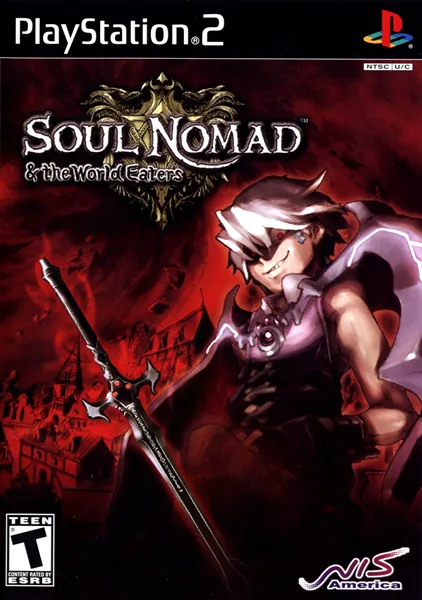
NAME(S): Soul Nomad & the World Eaters
PLATFORM(S): PlayStation 2 / PC / Switch
DEVELOPER(S): Nippon Ichi Software
PUBLISHER(S): Nippon Ichi Software [JP] / NIS America [NA] / Koei [EU]
GENRE(S): Strategy RPG
RELEASED: February 15, 2007 [JP] / September 25, 2007 [NA] / June 26, 2008 [AU] / June 27, 2008 [EU]
Soul Nomad Review
Intro
Soul Nomad & the World Eaters is Nippon Ichi Systems’ final strategy RPG for the PlayStation 2 (PS2), the company known for creating the popular series Disgaea, and for their strong sense of humor and dedication to using hand-drawn 2D art and sprites in their games.
In Soul Nomad, your male or female protagonist has spent their entire life in an underground city, hidden safely from the dangers of the outside world. Upon coming of age, you receive a sword imbued with the soul of the god of destruction, Gig, whom led the world to ruin many years ago. You’re to use his sealed power to defeat the three World Eaters that threaten to destroy what little of the world remains. These gigantic monsters were created by Gig to assist him when he still had his body. Be careful though, because the more of Gig’s power that you use, the more control he gets over your body, and if he gains his freedom he’ll pick up where he left off and wreak havoc on the world.
Gameplay
Soul Nomad is a turn-based strategy RPG. The basics of it are that you control several groups of characters (each represented by one unit on the battle map) and move them one by one to defeat all the enemies. Instead of simply switching between player and enemy turns, each character’s turn order is determined by their speed.
As previously mentioned, this is unlike other NIS games in that each of your units on the map are actually a group of up to nine characters. When outside of battle you can manage these “Rooms” of characters, switching around their position in the 3×3 field or replacing them with different characters.
Depending on which row a character is placed in, they will perform a different kind of attack. Furthermore, each Room has a special effect attached to it that affects all characters in the Room. For example, one Room increases your next attack’s power by 5% for each space traveled, while another raises your evade to 90% but makes one hit kill you. To get new Rooms, you can either buy them (but only for the main character’s Room) or randomly generate them (which you will have to do for everyone else).
Over the course of the game, you gain the ability to have up to nine Rooms, and up to six Room Locks. Locks prevent the locked rooms from being changed when you use the random Room generator. There are plenty of unique story characters that join you, as well as generic characters you can buy and create in the Room editor to put in your squads.
Supplemental to battle, you can also use Gig Edicts (basically items) which have varying effects, and attach Decor items to your Rooms to give them additional traits. There are even more Decor effects than Room effects, and they’re generally more significant.
A standard Decor item can increase a certain stat by 20%, and if you equip three of these Decors then you’ll indeed get a massive 60% boost. To balance the power of the Decors, you can only use them for one map. Once the map is over, they’re used up and gone. You can buy Gig Edicts and Decors from the shops using GP (your money).
While on maps, you can also use Tactics abilities. Each character has a different set of three Tactics, and the character is determined by who you set as the leader of that squad. These Tactics abilities usually grant stat boosts similar to Decor, but they wear off over the course of the map. On the plus side, they regenerate once it’s over.
Some rarer Tactics can heal HP and/or STP, and some can damage the enemy without getting into combat with them, or lower their stats temporarily or place traps on the battlefield. STP is another stat that decreases with every square moved and action taken. As STP lowers, so do the stats of your squad. You can replenish STP by doing nothing for a turn or using a Gig Edict or Tactics.
Also important, you bring additional squads into battle by summoning them with your main character and paying GP based on how strong the squad is. Like most strategy RPGs you can land on special terrain that grants bonuses like increasing your defense or healing your HP. When you make a squad attack an enemy squad, the characters randomly decide which other characters to attack.
When the leader of a squad is killed, the squad is removed from the map no matter how many other characters are left. If you’re lucky, all your characters will immediately target the enemy leader and net you a quick win. If you’re unlucky, a certain squad may take forever to take down or will randomly decide to target your leader first. Certain attacks can target a specific row or column, and special attacks tell you directly what areas of the squad it’s going to hit.
Once your STP is low enough you can choose whether or not to use a special attack before attacking an enemy. Special attacks always come last but are very powerful and let you aim for specific characters. However, you can use a particular special attack a limited amount of times on a map and if the targeted enemy is destroyed before the special attack’s turn comes up then nothing happens and you still lose the special attack as if you had used it.
While outside of battle and in the Room editor, you can choose to embark on a Room Inspection. An Inspection lets you go “inside” a Room and fight a series of randomly generated battles that increase the power of the Room if the boss of each floor is beaten. For example, if you defeat the boss of the floor of a Room that increases your attack by 20%, then that room will then power up to increase your attack by 21%. Every room can have its special ability strengthened, but there’s a specific cap on how much stronger you can make each room.
After clearing a room, you get the option to head out where you can be safe and save. If you choose to clear several rooms in a row then you can get a big GP combo bonus reward. After clearing 20 floors, a new space in that Room opens up for you to place another character if possible. Inspections are a great way for earning GP and leveling up in addition to making stronger rooms, and certain rooms can only be unlocked by clearing certain objectives in Inspections.
Outside of combat, you travel the world map by clicking from point to point, looking for places that advance the plot or lead to the next battle map (these places are always marked for you). Every once in a while you can visit a town, which is represented only by menus and a still background image. You click on people to talk to them and read their dialogue, and the ones you need to talk to are marked, as always.
Interestingly, you can use Gig Edicts on townspeople to fight them, recruit them into your army, or steal from them. It’s fun to play around with at first but not very useful, and every townsperson you recruit into your team you lose on the subsequent playthroughs. You’re best off just stealing money if you need it (like to summon squads). There’s no part of Soul Nomad where you control a character moving freely around an area. The progression of the game is clicking to places on the world map that advance the plot, beating the battle map, then repeating this process until the game is over.
The Good
Soul Nomad contains Nippon Ichi Systems’ best storyline by far. The dystopian world is a cool setting, and likewise Soul Nomad is the darkest of NIS’s plots. The game still contains much of the company’s strong sense of humor, but it’s always placed appropriately. There will be times when the party can relax and just joke around a bit, and there’s never a time when a joke is forced into a serious moment, disrupting the story’s tone. The humor is handled perfectly. The base goal of having to battle these three giant monsters each with their own appearance and power is fun and exciting, and you’ll always look forward to interacting with any World Eater.
The game does a great job at setting up suspense by showing you the first World Eater early, and it’s massive power makes you wonder how you’ll end up defeating it. There are many mysteries surrounding the current state of the world and how it got there, and any player will particularly be interested in Gig’s past and where the god of destruction suddenly came from and why. Soul Nomad also does a great job at keeping its cast of characters consistently plot relevant. No one goes to waste, and everyone has some kind of story no matter how big or small. Soul Nomad does a great job of using old tropes in new ways and situations.
After reaching at least one ending of the game and doing a new game+, you can embark on a new split storyline path, a “what-if” story of what would happen if you let Gig possess you and joined him in destroying the world. It’s pretty fucking awesome actually, but sadly only ten maps long.
This is also NIS’s best looking game for the PS2 (that they developed, not published), which is fitting considering it’s the last one they made for the console. The sprites and backgrounds look crisper than ever before, and people who plan to play this on a widescreen TV will be pleased to know that it looks particularly great on one, as far as PS2 games go. The game hardly pushes the console to its limits, but it looks about as nice as it could for the 2D-centered game it is and such clarity couldn’t be possible on the original PlayStation, unlike earlier NIS titles which often looked very “muddy” (La Pucelle Tactics, Disgaea, Makai Kingdom).
This is a strong contender for Tenpei Sato’s best soundtrack. There’s a ton of variety like always, and it’s especially cool how each World Eater has their own awesome theme song.
Like other NIS games, the English localization is top-notch, and the dub in general is pretty good. Gig’s voice actor deserves particular commendations.
There are multiple endings; one for each character. They don’t change much, but you can get one by putting that character in your main character’s squad and taking them to an Inspection at least once, and using your combo special attack with them at least nine times.
The Bad
As interesting as Soul Nomad‘s plot is, it really doesn’t get enough time to stretch itself out. With the entire game being you going from plot point to plot point, the speed at which the plot develops is too fast. Slow pacing is a bad thing, but fast pacing can be a bad thing too. With no explorable towns or other areas, there’s no time for a player to “stop and smell the roses” if they ever feel like it, and townspeople have some of the least interesting things to say out of almost any JRPG I’ve played. Almost never do they give you any more insight into the characters or world of Soul Nomad.
Ideally, an RPG would have its plot unfold constantly at the pace Soul Nomad does, but also allow the player to slow down if they like by pursuing optional quests or talking to townspeople and exploring for additional details on the world and characters. This way, no player feels the plot is moving too slow because they can always advance it if they want, and those who want to slow down and look for obscured plot details can do so at their leisure.
Coming from this, Soul Nomad feels like NIS’s smallest game. There’s an abundance of storyline maps, but unlike other NIS games, you can’t replay any maps you’ve beaten. You can either do the next map or clear some more Inspections to gain levels and money. NIS is also known for their length post-game content, but Soul Nomad has a whopping three extra maps that can be played after the game is beaten. Each one grants a secret character once beaten, but since there’s nothing after those three maps there’s no reason to use them. There’s no additional super boss like Baal waiting for you here. Once it’s over, there’s nothing else to work towards.
This doesn’t really matter, but Soul Nomad has the most pointless “silent” protagonist of all time. You can choose a male or female character, but the story either way is written as if you’re a male, and your unit’s data still calls you a male if you’re a female, which is relevant because a few Decor items deal with gender. The main character has no spoken lines but every once in a while in a cutscene a dialogue prompt will come up where you have to select it and press X to continue.
But these dialogue prompts only have one possible line to say, which makes me wonder why they place and use them as if you were choosing what to say. If the main character already has a predefined personality and dialogue, then why aren’t they voiced and used like every other character? It’s pointless as all hell. Yes, I know there are some points in the game where you have a dialogue choice, but these points probably amount to three total through the course of the entire game so it’s a moot point really.
An obnoxious and stupid supporting lead character. Danette’s character archetype seems forced to make old fans more comfortable with Soul Nomad by having a dunce character that fits NIS’s usual dumb humor.
The random Room generating system is one of the most nonsensical game mechanics I have ever seen. I already touched on this in the above writeup on how the game is played, but basically each squad sits in their own Room and there are multiple rooms that grant different powers. In addition to this, each Room has a different layout of squares you can place characters. Some may be shaped like an H or a T and you can only put characters in those rows/columns.
To get new rooms, you have to randomly generate them. The main character can buy their own room, but it’s only five spaces in an X patten and that isn’t good enough to last for even half of the game, so you’ll either have to spend hours in Inspections to increase Room space or just randomly generate them a room like everyone else.
So how does Room generating work? You just click a button and all your Rooms are replaced with totally different Rooms with new layouts. Don’t like them? Press it again. As you progress you can get Room Locks which prevent a Room from changing when you generate new Rooms, but you can only get six of these ever, and the maximum amount of Rooms you have is nine. This means that for those last three Rooms you’ll have to keep resetting so that each one is not only the Room you’re looking for but also has a good layout.
By the end of the game, the odds of getting all of the right Rooms with all the right layouts when there’s so many different possible Rooms that increase over the course of the game is nearly impossible. And naturally, over the course of the game you’ll have to keep changing your Rooms when bigger and better ones become available, so you’ll be dealing with this increasing frustration for the entire game.
If you could just lock every Room this would be tolerable, but you can’t. The easiest solution would have been to just let players buy their Rooms with the cost changing depending on the Room and the layout requested, but alas. Fuck this system. Not being able to coordinate and plan out your team in a game that’s supposed to be based around strategy is just…. Well, it speaks for itself hopefully.
Charging the player money to summon squads is pointless. Summoning cost increases over the course of the game equally proportional to the increased money you get from winning battles. If money is never an issue for summoning, why charge for it? Summoning cost shouldn’t exist and the amount of money you win from battles should be decreased to make up for it.
The best thing about summoning cost is that it punishes the player for over-leveling in Inspections, but Inspections are kind of a superfluous feature to begin with—especially when you consider the most useful non-post-game thing about them is getting money you might need to summon squads. Money you might need because the random room generating has given you a layout that makes your old characters pointless, and you had to buy new ones and pay more money to increase their level enough to stand a chance on the newest story maps.
Maps are very boring. The same objective of just killing all the enemy units gets old quick, and there’s nothing like Disgaea‘s Geo Symbols or Makai Kingdom‘s randomly generated stages to mix things up. Since the characters in squads randomly choose their own battle patterns, all you’re really doing is selecting your units and moving them next to the enemy and pressing X. Outside of micromanagement in-between battles, you feel your role is very minimal. Most maps are wide open fields with terrain that grants no specific effects, so you rarely can use it to your advantage.
As you’ve probably sussed out by now, Soul Nomad‘s combat is very weak. But here’s the clincher: it’s super easy. All you need to do to break the game is only use one squad. That’s it. Summoning? Don’t worry about it. Just make one squad with a healer sitting in the back so they’ll heal you every battle round and you’re golden. Your enemies will never be able to pierce your wall and you’ll slowly gain a higher level than any of them by being the only squad getting EXP.
That’s right: the game is actually easier if you use less squads. Since you won’t be paying money to summon, you’ll also build up a huge profit that you can use to buy Decor to make you even more invincible every map or Gig Edicts to use in the rare event something goes wrong. You’re unstoppable. This is also very convenient because you only have to worry about randomly generating one Room, which is much more tolerable.
If that’s not good enough, go level in an Inspection. Each floor boss has a very high level despite being weak, and you can easily kill them and gain one or two levels each time (and there are many rooms where each floor’s power only increases by one level each time). After that, exit out and save and go back in. In a half hour, at the beginning of the game, you can make yourself strong enough for the final boss.
Leave a Reply