




Intro
Originally Published: November 17, 2025 3:55 pm EST
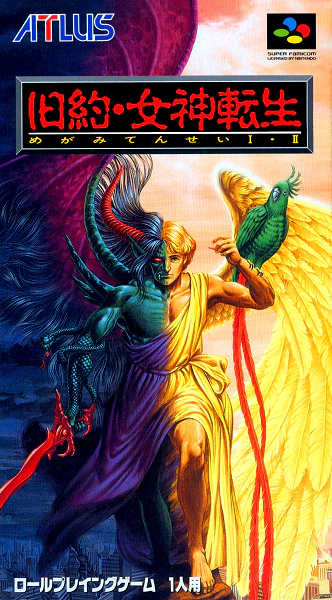
Megami Tensei: The Old Testament, or Kyuuyaku Megami Tensei, is an SNES (Super Famicom) remake of the NES (Famicom) games, Megami Tensei (MT1) and Megami Tensei II (MT2). These two RPGs marked the beginning of the long-running Megami Tensei (MegaTen) franchise. Atlus possibly wanted to bring the titles to parity with their successors, such as the recently-released Shin Megami Tensei: if…, and commissioned Opera House to develop this remake.
Opera House’s alterations to the original experience were primarily related to presentation, as game mechanics went relatively untouched. Modern conveniences like save points and Terminals respectively let players resume games without password entry and warp between dungeon checkpoints. Dungeons from Megami Tensei were heavily truncated, yet remain sizable labyrinths that test anyone’s attrition and resource management.
Aiding other expediencies is a redone user interface that results in the swiftest Megami Tensei title yet. Animated transitions as the player rotates their perspective in dungeons play out on a dime, and moving as well as menu navigation are also now lightning-smooth. By reducing the slight lag time that piled up in previous entries, Opera House makes returning to these older adventures as smooth of an experience one can have while retaining their original, unique flavor.
As one might expect from a remake, the audio and visuals are updated to SNES standards. The higher resolution and resulting fidelity brings the macabre, demonic worlds further to life than before, and enemy sprites even display slight animation. While the music is suitable for a 16-bit era production, it’s a relatively contentious topic for The Old Testament.
The original Megami Tensei II‘s cartridge utilized a special, internal sound chip that allowed its compositions more extensive layering and sonic details. Opera House’s attempt at replicating this style for the SNES is an unfortunately shrill, dense, and somewhat cacophonous soundtrack. However, the severity of these reimaginings varies from track to track, and many of Megami Tensei II‘s songs are little worse for wear.
When booting The Old Testament, the player is free to choose which of its two games they want to play. Each title is distinct in its tone, style, and structure. Their content is different enough to where I believe they should be covered separately. I’ll review each game in the order I played them, which matches their original chronology.
NOTE: The following review(s) was/were recently edited to improve grammar and syntax. Rhetoric was largely unaltered, and certain information may be unintentionally mistaken due to some of these writings being nearly a decade old. Please understand that the following text may not be up to my modern standards.
Megami Tensei
Originally Published: October 24, 2014 11:28 am EST
I knew there wasn’t going to be much to this game because it was the first Megami Tensei game, but I want to one day have beaten every game in the franchise, so this was inevitable. I had a sudden urge to beat the ones I haven’t yet and thought this remake of the first two games was a natural choice. Naturally, I assumed that it would be really short due to adapting 8-bit games. Surprisingly, I got a game that lasted me at least 12 hours—and I had the turbo button on for every fight. I played this game practically nonstop since starting it, and at times, it felt endless.
Another surprise is that there is little about the game that feels too archaic. Maybe it’s because it’s a remake, but there’s little more to ask for from the interface, and it doesn’t waste too much time thanks to the novel automapping feature. By pressing the L button, you can bring up the map whenever you want. You’ll be doing that a lot, as your perspective constantly changing can be confusing—not to mention the gigantic dungeon mazes. The map marks several important areas such as the fusion church, the healer, and stairs, but it misses a lot of other things such as shops, save points (!?!?), and various unique places of interest that you’ll want to go back to.
The map not plotting these is probably the game’s biggest flaw. You can have the entire map filled out but still need to look at a guide to find the specific floor for certain locations. And I would encourage using a guide in that case, as I did, because the alternative is walking through the entire dungeon at least twice. There’s also no easy way to compare equipment stats, but you buy equipment so little that this inconvenience rarely comes up.
Other than those UI foibles, using magic, summoning demons, fusing, and just about anything else you can think of is simple and fast to do. Nothing is too cumbersome, which is the downfall of most vintage RPGs. MTTOT was the second-to-last MegaTen game released on the SNES, and the level of polish makes that evident. The game’s menus and movement are noticeably faster and more responsive than Shin Megami Tensei II‘s, and even those of the first game.
For its time, the combat is pretty decent. What stands out most to me is that there were plenty of times where choosing defend at certain points was actually the best choice. It’s a step away from just spamming your strongest attacks and occasionally healing, and I appreciate that. The rest is pretty standard old-school RPG gameplay: targeting is random, turn order is (mostly) random, and you can attack or cast magic. Admittedly, I found magic to be quite ineffective in this game, largely because demons have extremely limited MP. Your two human party members can use items, and the main character can summon or return demons in lieu of being able to use magic.
There’s also an auto-battle function that has every party member launch physical attacks until the battle concludes. Physical attacks are normally what you’ll be using anyway, especially when fighting outclasses enemies. You can cancel auto-battle for subsequent turns by pressing B. The auto-battle combined with my emulator’s turbo feature made this game’s pacing much more tolerable.
However, there are some parts of the battle system that don’t work as smoothly. A big obstacle is the random targeting. Running into mobs of five or more enemies is actually extremely common, and because you can’t take enemies down one-by-one, there is drastic scaling in difficulty when it comes to mobs. You’re already taking more enemy attacks per turn to begin with, but the random targeting makes even the smallest damage add up to a major concern. There’s no greater fear in this game than running into a dungeon’s “worst” enemy mob—every dungeon has at least one. This makes surviving in dungeons come down to luck more than I would’ve liked.
Despite dying being a thing that will happen a lot, MTTOT does a good job at making defeats tolerable and sometimes even refreshing. You lose half of your money when you die, which is important since it buys equipment, items, and demons’ summoning costs, but dungeons are so big that you should earn enough to survive if you just keep healing to last for as long as you can.
Later on, you get a spell to go back to the last save point, which is usually close to a healer, allowing you to better protect your money. Since the dungeons are big and there are endless split paths, going back to the start doesn’t necessarily feel like a waste of time, because there’s usually a route close by that you didn’t explore and wanted to go back to anyway.
Due to the game’s formula of “find a hidden item that removes the dungeon boss’s advantage -> find and kill the boss -> find the path to the next dungeon,” you’re encouraged to fill out every floor’s map. If you’re fighting as much as you can, you should gain enough levels to not require grinding, which surprised me. If I was ever fighting extraneously, it was for money and not EXP.
Lastly, the encounter rate is actually reasonable. In fact, I’d say this has one of the best encounter ratios I’ve seen in an RPG. I get them consistently after 20-30 steps, and I don’t feel like my progress is being impeded with endless encounters. This also makes some of the backtracking you have to do fairly painless. Don’t forget the auto-battle!
Unlike your typical SMTs, where your protagonists are basically fragile “king pieces” you have to protect, I found the human characters to be by far the most useful. The demons around your level will generally have similar stat spreads, but humans have equipment in addition to their stats. Humans can also choose how to distribute their stats upon level up, and if you’re doing the right thing and focusing on offense (which you should, if just to get one kill per attack against mobs), you’re going to be far more powerful than your demons.
I found demons to be best for providing support spells, and acting as shields for the humans. Fusion options are extremely limited in this game, and most my fusions resulted in useless default demons. I still tried to fuse as much as I could, because it does sometimes pay off by giving you stronger demons than you’d normally recruit. Many demons are only available through fusion, as you will never encounter them in a battle.
I’m generally not a fan of demon negotiation in SMT. I think it straddles a weird line between being too random and being too predictable, and since this is the first attempt at the mechanic, you can expect it’s both of those. There’s about four personality types, and their dialogue plays out the same way every time. You try to do things they like to raise your odds of recruitment, then give them a gift and pray they join. Out of the eight or so demon types that are in each dungeon, only about two will be recruitable, and the rest are hard-coded to never talk to you
This limits fusion options even further, and it makes demons feel more like “better than nothing” fodder to fill out your team. I remember keeping a demon on my team for a really long time just because it had an obscene amount of HP, and the ability to cast Diarama four times. A really annoying thing is that certain demons will always attack upon trying to talk to them (the ones that will never join), but you don’t know this until you try, so they always get at least one free attack on you.
There’s barely any story in Megami Tensei. The most text in one cutscene is the opening narration, which provides you with your background and goal. You’re thrown right in. Compared to Shin Megami Tensei, the first SNES entry, this is a narratively tame game despite its occult influences. For reasons not explained, there are a lot of human NPCs you can find that will give you tips with little to no characterization in their delivery.
The game’s narrative simply lacks flavor. It’s what you would expect from an old RPG: its extremely straightforward and all business. It superficially resembles a standard Megami Tensei game without behaving like one. There are a tiny amount of funny moments in the game that do match the franchise’s off-kilter style of humor, at least.
Regardless, I really like the feel of this game. The music is repetitive as all hell, but remarkably catchy considering its era, and it’s suitably uptempo to counteract the slog through dungeons. I also like the fact that the entire game takes place in one giant area. There’s no outside world, and every dungeon is connected. The feeling of peeling back the layers of the world is always a strong motivator. Since you can see a map of all the game’s dungeons from the beginning, you always know how much closer you’re getting to the ending.
That’s probably what kept me playing. It’s pretty addicting to fill out the maps and know you won’t have to do it again. I think the fact the game is still overall fairly linear hurts the labyrinthine feeling a little, but it may have been for the best. For example, finding a dungeon’s secret item will likely have you fill out at least 80% of the dungeon map, and the dungeons are connected horizontally. There’s only one place in the game where you could accidentally go out of order (Bien or Valhalla).
There’s a few miscellaneous aspects of the experience I’d like to mention before dipping out. First of which is the second-to-last dungeon introducing an absolutely evil enemy that has an attack which can permanently level down whomever it hits. No, really. They actually did this. It’s just a common, normal enemy type for this area, and it can appear in mobs. You can theoretically run into eight of these demons and have your main character (or anyone else) lose eight or more levels by the time the battle ends. These do not come back. You have to gain EXP and level up all over again, and you are always capable of losing those, too. There is no restriction or limitation on this. You simply hope the enemy does not use this attack. Pick a god and pray.
On one hand, it is absolutely hilarious how mindlessly cruel this is. You’re exploring demonic hellscapes in SMT games, and I always prefer when the difficulty reflects that. You should be the underdog, because an ordinary human in any of these games would be torn apart by the equivalent of that world’s bunny rabbit. But, like… it’s one thing for bad luck to result in having to redo a section of the game. It’s another matter entirely for that bad luck to result in receiving a permanently more difficult experience than you would have had otherwise. It’s possible, albeit unlikely, to level down so much that you can’t even handle the latest enemy encounters to level back up. Still, it’s wild that can even hypothetically happen.
I don’t think I’d remove this attack from the game, because it’s such an iconic and memorable moment. The first time you realize what’s happening in all of these auto-battles is enough to make your jaw drop in disbelief. You have to laugh at how absurd of an idea it is, and that reaction contributed more to the game than if I were to have just gone through another ordinary dungeon only to have forgotten about it later. Maybe it could have had some restrictions on it, though. Perhaps each one of that enemy in an encounter can only use that attack once? Still pretty evil, but it reduces the odds of things snowballing to an unreasonable degree.
I dunno. Boy, is it funny, though. I think there were a few times I reloaded recent saves because I had bad luck with these encounters. I’d lose way more time leveling back to where I was, so why not? Oh, and you can attempt to run from these enemies, but it’s not guaranteed, so you open yourself to a round of free attacks. It’s usually better to strike first and hope you take a few of them out before their turns come around, thereby lowering the odds of seeing that attack.
An interesting element of this mechanic is that you can essentially use it to re-spec your human party members, whether intentional or not. The stat point you lose when leveling down is randomized, and it’s not like the game tracks where your stats used to be, so you’ll be flying blind when building yourself back up. It’s even possible to gain a net benefit from this, as your stats can go below their base values.
For instance, the hero has a few points in INT, which is borderline useless for him due to lacking magic spells. You can get that down to 0 if you’re lucky or patient. If that ends up being the only stat lowered, then you essentially have your next level ups come faster due to the lower EXP requirement for lower levels, and your hero is virtually just as strong as they were before. It’s convoluted (and certainly unnecessary), but it’s amusing how additional aspects of a game’s meta can open up from just one strange design choice.
In fact, I actually did have the opportunity to take advantage of this. Not deliberately, mind, but the game gave me lemons and I made lemonade. Around the final 30% of the game or so (if memory serves), you can find a weapon called the Dancing Sword that’s exclusive to the heroine. Though it has an unremarkable 23 attack power, it has the ability to strike anywhere from one to eight times. Normally, that doesn’t make up for its attack power, especially considering your heroine will likely be built to be a mage—but when the game started forcing me redistribute my levels, I changed that. I began bumping her STR and LUK, the latter of which raises critical hit chance.
Eventually, she became the powerhouse of my party. I could get her critical hits to kill enemies in one or two hits, allowing her to single-handedly cut down entire mobs. Other multi-hit weapons rarely reach even half the amount of attacks, and any damage exceeding what’s needed to kill an enemy is effectively wasted, so their higher base power isn’t necessarily worth the trade-off. It took the hero getting the ultimate weapon to even compete with the damage my heroine was putting out, and she was doing it for quite some time before then. I don’t know if this was the optimal strategy or anything, but it made me feel very clever.
I also want to shoutout Girimehkala, who even in his first appearance is a fucking asshole. He’s a rare encounter in a relatively early dungeon (I’m not sure if he can even spawn there when you first arrive), and he’s difficult to beat for the usual reasons: tanky, a ton of resists, hits hard. The punchline comes when you finally defeat him, as he’s worth almost no EXP or money. He just shows up to ruin your day, and you get nothing for it. To add insult to injury, he’s a very slow demon, which makes running away from him practically guaranteed. For daring to not be a coward, you get nothing to show for it. What a legend.
To end this review, MT1 a pretty addicting albeit simple game that admittedly relies on what little of the Megami Tensei franchise’s personality exists. I’d recommend it to a hardcore fan of the series’ art direction. I feel like people into SMT for the dungeon crawling can find dungeon crawlers with more depth, and fans of the more ambitious PS2 games won’t find the game interesting (unless they’re hardcore into the occult aesthetic like I am.)
I enjoyed the game and don’t regret it, and that’s because a part of me wants to say it’s yet another example of an SMT game being exemplary in the context of its time. However, I’m saying that in regards to it as an NES game, and I don’t know how much I would enjoy that original version. As an SNES game, it’s still a quality game, but SMT1 remains the standard with its more advanced storyline, visuals—everything, really. The only thing I can think of that SMT1 is missing is the mini-map hotkey—and people have patched that in!
Oh, and here’s some songs I liked from the game.
Megami Tensei II
Published: October 24, 2014 (11:28:21 AM)
First of all, I would recommend reading my above review for Megami Tensei, as the gameplay of both games is very similar, and I won’t repeat myself in my review for Megami Tensei II.
I was shocked to see how much Megami Tensei II evolved from the first game, which was a modest albeit well-balanced classic dungeon crawler, to a full-fledged JRPG. While identifiably Japanese in its idiosyncrasies, the first game played exactly like any western dungeon-crawler RPG. If you know about the franchise’s Wizardry inspirations, then you can understand how that was all by design.
For the sequel, Atlus focused on a much more defined narrative: an established world and lore, a plot with twists, and characters that interact and change over time. These were all traits more common of Japanese RPGs of the time, and this marriage of both cultures would result in the formula that defined Megami Tensei up until around the early 2000s. The progression of MT1 to MT2 actually reminds me a lot of Phantasy Star to Phantasy Star II, but I digress.
Megami Tensei has long been a maverick franchise that’s defined itself through constant innovation while staying true to its core principles. In being the first application of many of those principles, MT2 struggles to have its own distinct identity. It’s ironic, because I might argue MT1 holds up better than 2, because it being such a simple, vintage dungeon crawler makes it stand out. MT2‘s set up as a traditional JRPG has it come across exactly like the basic MegaTen game you would have expected MT1 to be.
It’s like MT2 was a prototype for Shin Megami Tensei, and MT1 was a prototype of a prototype. It may seem like I’m just talking about a series’ tendency to refine itself in sequels, but it’s not the same. From Megami Tensei until (arguably) Shin Megami Tensei II, each game felt like it was a “reboot” of the game before it. Take the same premises and concepts then do them all over again with greater scope. The near total lack of continuity contributes to this somewhat, but I think it’s the static mechanics and aesthetics that really cements this feeling.
The third Shin Megami Tensei game, Nocturne, was unmistakably a MegaTen game, but no part of it feels like it could be sincerely called a retread of what came before it. Combat was overhauled with the addition of press turns and added depth to the fusion system, and the game has an iconic, unique visual style and tone to this day. It takes the best ideas from its predecessors and executes them in such a fully-realized fashion that they’re made to feel completely fresh. It’s an ideal sequel. I don’t believe Nocturne‘s existence makes the earlier games irrelevant, but I think it demonstrates a changing philosophy in the franchise’s progression when compared to its early years.
In a sense, Megami Tensei II is the first proper MegaTen experience. Story conventions, demon designs and roles, the dark dystopian/post-apocalyptic tone—everything fundamental to an SMT is here—you’ve just probably seen almost all of them done better since. When taken solely in the context of its time, MT2 is a highly ambitious and unusual game that I would say is superior to its predecessor and a contender for the best NES RPG (assuming that the remake didn’t change too much). But when compared to the rest of the series, I think I had more fun with MT1‘s simplified feedback loop. It’s distinctly nondistinctive, if that makes sense.
That being said, my most memorable moments from The Old Testament are almost entirely from Megami Tensei II. I know I implied most of the game was redone and improved in sequels, but there are absolutely exceptions. Those exceptions make the experience. So let me talk now about what actually makes MT2 special.
The premise is fantastic. In a world decimated by nuclear war, you begin in a fallout shelter. In a wildly meta move, your protagonist is playing a video game made by MT1‘s protagonist based on their adventures in that game. The game’s introduction has you actually play that game, which is a recreation of the start of Megami Tensei. While you can choose to blitz to the end of this sequence, your performance determines certain perks you can receive when the game truly starts. There’s no returning to this “game,” so I would recommend getting the most out of it, especially since you’re given rewards depending on your thoroughness.
Of course, the inciting incident inevitably happens and demons are unleashed upon the world. You meet Pazuzu, who gives you a summoning computer and tells you to go save the world. I mean, who else would you trust other than a gamer? Your best friend comes along with you as you enter the outside world and begin your adventure.
In what I already know is due to the remake, the outside world is given a cool aesthetic that suits the post-apocalyptic environment. Dystopias and post-apocalyptic settings are common to the MegaTen franchise, but MT2 takes a bit of a different direction. Perhaps because of the era it came out in, MT2‘s post-apocalypse is more nuclear-themed than their usual fare, notably featuring water that glows in a neon green.
It’s interesting to see a common fictional signifier of nuclear apocalypse when the nuclear aspect is largely irrelevant in other SMT games. SMT1 also features a post-nuclear war environment, but the only part that mattered was the extent of the destructive force. The environment in SMT1 was otherwise a standard post-apocalypse: swathes of desert, unfertile land, and abandoned buildings.
Given Japan’s personal trauma of having nukes used on them at the end of World War II, I can’t help but wonder if MT2‘s depiction of a more nuclear-influenced apocalypse gives a glimpse into what could have been an alternate inspiration for MegaTen‘s future settings. I just find it interesting that the first game to feature a post-apocalyptic world framed it so differently than virtually all of its successors. As culture developed, perhaps those old tropes of green glowing water and mutants were seen as too hard to take seriously in future games.
Beyond that, other environmental signifiers are more what you would expect. The land is barren. While in towns, you can often see backgrounds that are covered in graffiti, hinting at the lawless world. You can also talk to many NPCs that are dressed really oddly. All of this lends to the “cyberpunk” aesthetic that characterized the earliest SMT games and just kind of vanished as the games began to take place in entirely modern settings. It’s a treat to get any more of that vibe.
While I was initially excited by the much greater emphasis on story and environmental design than the first game, it didn’t deliver enough for me to really get excited. This is (or was) still an NES game, so there isn’t that much text, and you’ll often go through an entire dungeon only for a few lines of dialogue (not counting any NPCs). There are some cool twists, but they’re mostly good for shock value, because there’s little to no text build-up. In fact, MT2 is kind of defined by twists. Your objective changes so many times throughout the game that you start to feel like a passive observer. You go through dungeons because, well, what the hell else are you going to do?
SPOILER commentary. Click to show.
I really liked the best friend’s betrayal and redesign, although it feels like a waste that you never got to fight him. I liked getting your arm chopped off by the stone statue and needing to get a cybernetic arm while you slowly lost HP from bleeding out and were unable to use your COMP. I also liked the part where you’re swallowed by a fish and have to explore his innards like a dungeon.
On the other hand, I dislike all SMT games that make Lucifer look like too much of a nice guy, and this was the strangest thing about this game. Your friend revives Lucifer in a way I don’t think is ever stated, and you can have Lucifer join you because he simply wants to free humans from God, who’s been an asshole. In many games, Lucifer can be seen as manipulative, but he’s so straightforward and friendly in this one, and it’s difficult to argue with his logic. If you do side with God, everyone except you and the heroine dies. That’s not a positive ending compared to defeating God, fixing the world, and receiving an inspirational postscript.
But most importantly: this is a direct sequel to MT1. This is the same exact Lucifer that was in the first game, was evil, and tried to destroy humanity. What the fuck happened? His personality and goals changed completely.
Though there are now towns and an overworld, the gameplay has barely changed from MT1. There’s very little to do out in either location type, so they’re just extremely brief diversions from the next dungeon. Though you’re often given several paths, the game still follows a linear structure, which is a huge problem. The dungeons are gigantic, and once you get to the midgame so many new locations open up that it’s difficult to have any idea of where to go first. If you spend hours in a dungeon walking in circles only to give up and finally look at a guide, only to find out you missed something or you’re not supposed to be there yet, you’re gonna be pretty frustrated.
Despite the game being easier than the first due to smaller enemy mobs and the addition of stat-increasing items (among other things), the dungeon design is twice as frustrating. I said in MT1‘s review that your mini-map doesn’t mark things that it should, and that hasn’t changed. There’s one really terrible offender in MT2, where half the dungeon is covered with trap doors that are completely impossible to tell apart from the regular tiles. The only way to find out which tiles are traps is to fall through them, climb back up, take another step, and hope that one won’t send you falling down too. Trap doors you’ve stepped on aren’t marked, so you better remember which 10 of 50 or so floor tiles are legit.
Another big pain in the ass was an entire island of the game had a gimmick where your computer would randomly glitch up and prevent you from seeing the map or summoning demons. This is just way too much. The dungeons are already big and challenging enough already, and taking away your ability to know where the fuck you are is purely tedious bullshit.
This “glitching” effect remains until you exit a room, and the first-person perspective sometimes made me so dizzy that I would just give up and use an escape spell so that I could go back in and look at the map again before it went away. There’s too much shit in MT2 that’s purely a waste of time. While MT1 had similar or identical traps, I thought they were spaced out much more. In any case, I don’t have as terrible of memories as I do MT2‘s.
As for the music, compositions are much more complex and don’t loop as quickly as MT1‘s tracks. However, I don’t know if I’d say MT2 had as many standout, catchy songs. The OST is still generally good, but it’s one of the weaker SMT OSTs I’ve heard. One incredible track is “Explorer,” one of the game’s main dungeon themes. It features a grinding electric guitar riff that builds into an explosive techno synth melody that propels you through your dungeon delving. It’s just a fucking badass song, which is a trait the 8 and 16-bit SMT games had in spades.
Conversely, the world map theme is incredibly grating because of its first few notes and sounds tonally out of place. It’s more like standard heroic adventure music, but you’re walking around deserts and nuclear-green water. The song shifts into a more serious mood eventually, but you rarely reach it before it’s interrupted. The sound of the “organ” or whatever they were going for here is unbelievably bad.
Verdict
I’ve run out of things to say, so I’ll conclude by affirming that Megami Tensei: The Old Testament was really fun, and I was surprised by how well the games held up. They’re certainly among the weakest MegaTen games I’ve played, but I wasn’t expecting otherwise. I chose to play them thinking they’d be short because they were old, but it took me about 10 days to finish both games, and I was rarely not playing—and I used turbo mode! Though I did avoid using a guide as much as possible, even if it meant wandering around aimlessly for hours.
It’s kind of weird to talk about this compilation as a whole, because the two games are surprisingly different, but I would recommend this game as a solid SNES RPG. It’s quite a shame it’s been left to languish not only in Japanese, but on the SNES. The game hasn’t received a rerelease other than the Japanese Wii Virtual Console in 2012. I think a newbie starting on these just because they’re the originals would be a huge mistake, but for a hardcore fan desperate for more from this era, they’re definitely worth the time.
BONUS: I have a note reminding me to mention that you should “Talk” to every boss encounter. They have unique dialogue, and it doesn’t take your turn to do it.
Leave a Reply