




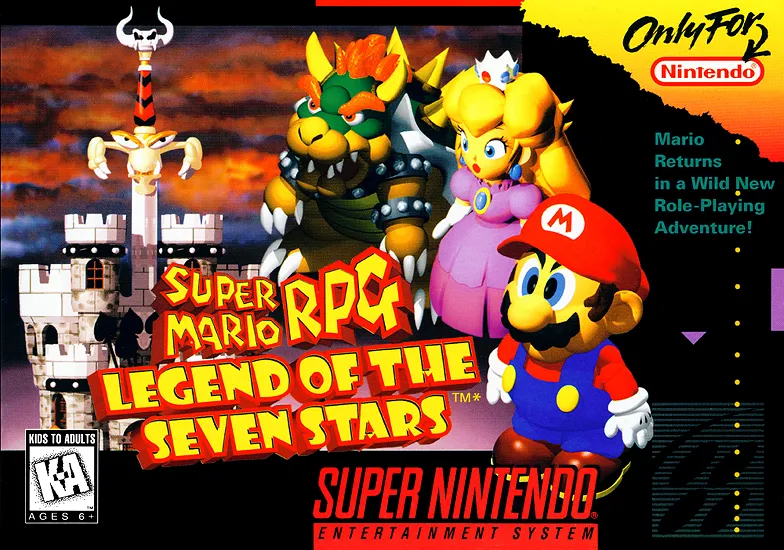
NAME(S): Super Mario RPG: Legend of the Seven Stars / スーパーマリオRPG
PLATFORM(S): SNES
DEVELOPER(S): Square
PUBLISHER(S): Nintendo
GENRE(S): Turn-Based RPG
RELEASED: March 9, 1996 (Japan) /May 13, 1996 (North America)
Super Mario RPG: Legend of the Seven Stars may have the distinction of being the first RPG I ever played. I rented it even though it looked weird cuz hey, new Mario game (I did the same thing with Mario Is Missing… twice). The first area stumped me because I had no idea what the fuck to do and I could barely read at that age. I thought I imagined the game until I got the internet and found out it was a beloved classics.
I read about all I missed and it sounded amazing. On top of that, I’d played Paper Mario by now which had become one of my favorite games, so I had faith in it. I placed so so many bids on this game and every single time they were sniped, same for Kirby Superstar. Fuck anyone who outbid me. It wasn’t until I tried emulation that I got to play it for real. I got bored after two hours. I recently decided to finish it; I got bored after two hours.
It’s difficult to know where to begin with SMRPG because I have indifferent to negative feelings on every major aspect of it. One of the ones I don’t is my favorite thing about the game: the graphical style. Namely, the 3D renders. I love them a lot, for the same reason I like Kirby Superstar‘s.
Though at the time, they may have simply been a cool thing to show off modern graphics, comparing them to 3D models after they have a rough, dark, muddy/smooth texture to them that makes them look like clay. It’s a childlike aesthetic that suits both franchises very well, as both games are obviously aimed at a young audience. It’s natural alongside the simple combat and innocent tone of dialogue.
I’d also really like to give credit to square’s character designs. They’re all unique and yet look not at all out of place with established Mario characters. perhaps this is because they have both been integrated equally into that same clay 3D render aesthetic, but the point is square made more original characters here than Nintendo would make in the next couple fucking decades. were it not for copyright issues I would love to see several of these characters come back in other Mario games, such as the platformers. Would be far more interesting than fighting the same old Koopas or a “new” Piranha Plant character wearing a silly garment.
Let’s move onto what’s SMRPG’s true claim to originality. As far as I know, this is the first turn-based RPG to have skill-based commands. I almost want to say action commands should be in every RPG. Not only do they increase satisfaction from victory because it’s based on more intuition than effort or (typically) simple thinking, but proper action commands allow a brief connection between the player and the combat they’re normally distanced from and only control indirectly. It’s feedback, an intrinsically important part of any video game and something RPGs struggle with anywhere outside of rewards, which are arguably a separate concept and purpose.
SMRPG had a fantastic idea to get players more involved in battles, and it also probably allowed gamers accustomed to action games to enter the genre more easily. However, this first attempt is predictably imperfect and misses some marks that undermine the value of the action commands in the first place. Every game I’ve seen after SMRPG with a similar system has done better than it, and those successors still have their own flaws.
SMRPG’s biggest problem in comparison to these later games is how much worse that aforementioned sense of feedback is. when you land a successful hit, the sound effect played is absolutely pathetic and weak, like raindrops gently falling on metal. That can’t be synchronous with Mario’s fist forcefully hitting the enemy, let alone Bowser hurling a giant mace at something. the satisfaction gained from connecting the player to the battles is completely minimal and a poor reward, as if to say your contribution was equally weak and not very helpful.
The visual cues are also off and further hinder some of the feedback. depending on the weapon or kind of attack, Mario for example might not even be seen hitting the enemy but is instead just swinging in front of him. This means you aren’t timing to, again, the feedback of the fist hitting the enemy but instead arbitrarily before that happens or not at all. The timing of SMRPG’s action commands are often unintuitive, and while this would be a problem, they’re simultaneously so easy to pull off with a generous window of error that it doesn’t matter. The feedback and connection to the battle being yet again hindered along with the ease of pulling the commands off both go to make SMRPG’s only enjoyable part of combat pretty dull.
Blocking suffers the same issue where anything that’s not a direct attack is a crapshoot of when you should press the button. the typical special attacks are in here and I’m pretty fine with them. They’re unique by character which is fun, and some of them offer their own kind of action commands although they’re usually just button mashers. They should’ve come up with more unique action commands for special moves, but the Paper Mario games for example also should’ve done this. Although I really dislike the game, Mario & Luigi: Partners in Time came the closest to doing this with its Bros. Items.
I complained about weak sound effects earlier, but really all audio-related things in SMRPG are weak. I think this game’s soundtrack is really well-received, but it baffles me. Yeah, the forest song is great, I’ll gladly hand you that one, but the rest? Forgettable. I like the choice of instruments emulated like a heavy use of xylophones, woodwinds, and other non-abrasive instruments that set up a suitable easy going atmosphere. It fits Mario’s style well, and I have the feeling Yoko Shimomura has to respect Koji Kondo a lot to achieve that. I respect Shimomura as well. She’s made several of my favorite game OSTs, so believe me when I say SMRPG is among the weakest work she’s done and I never would’ve guessed she made it.
She’s an incredible composer most specifically when it comes to creating a sound palette that suits the world she’s composing for, almost to a mind-blowing range that solidifies her as one of the most talented women in her career, but what’s really impressive is she’s managed to maintain a great sense of melody no matter the style she attempts. I find almost no songs in SMRPG memorable or attention-grabbing in any way, so their easy going nature kind of implodes on itself and puts me to sleep in a deadly combination between it and the slow, easy, distant combat.
Another one of SMRPG’s attempts to make people new to RPGs more comfortable is the addition of slight platforming outside of battle. It’s an awesome idea that works very well. Just being able to press a button and jump whenever you want somehow makes the tedious treks through towns and dungeons a lot more bearable. The issue I have with this isn’t about the concept, but SMRPG’s isometric perspective. I’m not sure whether SMRPG is simply heavier on platforming than other Mario RPGs or not. Whatever it is, it was more frustrating and hindered my enjoyment of the game.
Trying to emulate old Mario platforming while using stricter physics and a different perspective naturally doesn’t work. Gauging the proper distance in some areas is awkward. Although your jumps aren’t noticeably any more or less stiff than the 2D games, the fact you’re now jumping in open space, and almost always diagonally, is even more uncomfortable. I’m by no means a stranger to platforming. If there’s a genre I’m most experienced with, it’s platformers. I remember having to climb up the beanstalk area of SMRPG several times due to missing a jump that doesn’t even require proper timing, only distance. The action trials in Bowser’s Castle are just… better left undiscussed.
The plotting of Super Mario RPG is obviously simple, but there aren’t enough moments when it becomes more than that. The best area of the game is easily Booster’s Palace, as it has the writing sense that Paper Mario regularly had. Booster, the original character and villain, is established immediately and develops a relationship to the player over the course of the dungeon.
The value of this versus dumping the new character on us as a boss right before we fight them is obvious. It also allows for more cutscenes during the dungeons to spruce them up a bit. There’s now a personal reason to play the game: to see more of Booster’s antics. He’s amusing because he was actually given the opportunity to be. You see the second boss of Paper Mario, the Koopa Bros., several times before you actually fight them, and they’re funny or relevant to the player’s goal every time.
Though I said Square’s original character designs are great, they’re often wasted in this manner. I’m also not fond of either Mallow or Geno. The plot is too light for them to ever do anything for most of the game so the player can connect to them.
The light script could still be kept if they were substituted for existing Mario characters like Luigi or Toad. These characters have established personalities and an existing relationship to the player, making them better choices for party members. I used Mario, Peach, and Bowser, because after all, isn’t this Super Mario RPG? All that aside, I generally find the settings and NPC dialogue of the game to be plain. Towns were near impossible to tell apart, and I had little interest in talking to any NPCs because their text was usually plain and unrewarding.
There’s usually charm to a Mario RPG script, but Super Mario RPG‘s charm seems derived from its minimalism. Naturally, it’s just not enough. At least it’s not full of run-on gags like Mario & Luigi. Unlike Chrono Trigger, this years-long wait didn’t pay off. Now I’m wondering whether I like Super Mario RPG or Mario & Luigi less. But, I also don’t really care. SMRPG is a game lacking in heft, and I’m lacking an inspired conclusion.
Leave a Reply