








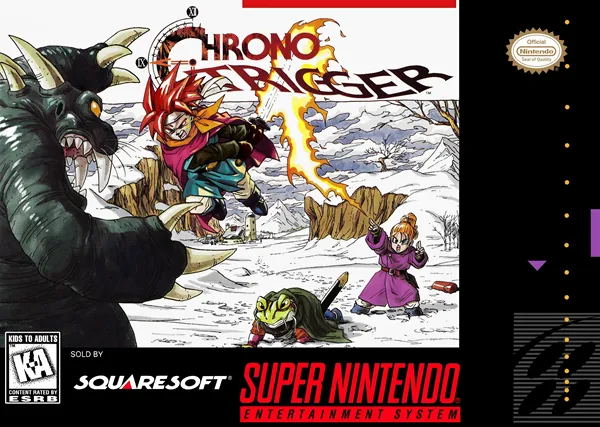
NAME(S): Chrono Trigger / クロノ・トリガー / Kurono Torigā
PLATFORM(S): SNES
DEVELOPER(S): Square
PUBLISHER(S): Square
GENRE(S): RPG
RELEASED: March 11, 1995 (Japan) / August 11, 1995 (North America)
RELATED: Chrono Cross
I think finishing this and Final Fantasy VII are two things I’d been putting off for far too long. As a kid, I didn’t know about Chrono Trigger (CT). I had an SNES and Genesis along with their respective hand-me-down libraries from my grandpa and older sister. I didn’t even find out about the Nintendo 64 until it was cheap enough for my parents to buy me one for Christmas, but the point is that the only games I knew about were the ones I saw in “used” sections of video game retailers.
For those who don’t remember, pretty much every SNES RPG was very rare, sought after, and expensive—even back then. I rented both EarthBound and Super Mario RPG as a kid but hadn’t gotten used to reading in games so they were both kind of a wasted weekend. It really wasn’t until the Game Boy that I’d begin getting into RPGs with the likes of Pokémon Red Version, and the Dragon Warrior I & II compilation.
In hindsight, I now know the first time I saw Chrono Trigger was when I was reading an old gaming magazine in a library with my older cousin. He was the “fibber kid” archetype we all knew: the kind who would make up fake stories and claims about video games. Their uncle worked at Nintendo, so on and so forth. Naïve child that I was, I looked up to him for his age and the fact his family was wealthier than mine so he had cooler toys.
That magazine had an article on Chrono Trigger, and the first thing we noticed was that the character designs looked just like those of Dragon Ball Z (DBZ). My cousin’s adlibbing skills were experienced by now, and he immediately came up with explanations for the similarities. These were Dragon Ball Z characters! Chrono himself? No, you fool, that’s Super Saiyan 5 Gohan. Marle? That Bulma lookalike? Naturally, that’s Bulma holding the “Saiyan Sword,” a sword that could make anyone go Super Saiyan! Honestly, I think the reason these were all believable was less because every humanoid designed by Akira Toriyama looks the same, but more so because you could make up anything for DBZ, and it wouldn’t be anything wackier than what was actually in the story. Why do you think every fan did (does?) exactly that?
Anyway, due to intense fear of the law, I started emulating at a fairly late age. When that was blown open, I finally got to “demo” anything I wanted—for 24 hours, of course—and one of those games was the mythical Chrono Trigger. I played it for a few hours and thought it was all right, and I got distracted by other games that sucked me in sooner. After all, I had thousands competing for my attention now. What also kept me from going back to it was my belief (at the time) that most SNES RPGs, including the ones people say are classics, hadn’t aged well, and it bore a superficial resemblance to the Dragon Quest series, which I didn’t care much for at all. Recently, I decided to give it another chance and finish a legendary game at the same time.
The best time to be wrong is when it’s in regards to being negative. Chrono Trigger really is that good. It’s an intelligent, funny, and beautiful game that’s far above the standards of its contemporaries and possesses a unique narrative that has safeguarded it from aging. I would say two of my other favorite SNES RPGs share the same qualities, Live-A-Live and EarthBound. So yeah, if you want to be validated by a stickler nerd who has no nostalgia or bone to pick with Chrono Trigger, let it be known that he loved Chrono Trigger.
I’ll avoid going over the basic plot because everyone knows it by now, and it’s really not the most important thing here. In the earliest parts of Chrono Trigger, the time travel mechanic can seem little more than an aesthetic, giving a little style to what’s ultimately a linear storyline as you just jump from one time period to the next, solve a problem, and leave. Instead, CT constantly builds on itself and ends up realizing the narrative potential of its time traveling theme.
Lavos, the antagonist and core of the story, is at its simplest essence an evil self-serving monster to be slain in the name of peace. On its face it’s a dull, typical and dated villain for its time. But like everything else in CT’s story, it’s expanded and slowly given character passively by all the different perspectives towards it across time periods. In 65,000,000 BC it’s summoned as a savior of the reptilian race and is cleverly turned into the meteor that began the ice age. When a future society discovers it, it’s seen as a blessing and worshipped for improving their way of life with its harnessed power.
In this context, it’s seen as a creature to be controlled and used. In the far future, we see it’s become a free oppressor that silently rules over the world. Though Lavos’ personality, or even complete lack of one, never changes, it remains a fascinating plot device as it’s defined and characterized by the people and social circumstances surrounding it. There’s a strong theme here about man’s tendency to characterize nature and other higher powers relative to society’s material conditions.
It’s this attention to its lore, consistency, and an understanding of what’s intriguing about history that makes it apparent how intelligently designed all of Chrono Trigger‘s events are. References to other time periods become non-stop and reinforce their relevancy, and CT delivers answer after answer to questions you never knew you were interested in until you realized you were a part of them. Chrono Trigger‘s cast and world map aren’t actually that large, but this allowed the developers to make all of it go to use throughout its various time periods.
Despite seeing everything from cave huts to electricity-powered domes, this constant self-referencing makes Chrono Trigger‘s world feel continuous and cohesive. It’s a source of constant amusement seeing the themes of time travel, manipulation of history, and cultural inheritance freely played with. Chrono Trigger‘s sense of humor and humbleness provides it a sense of modesty and serves as a counterweight that allows it to reach its lofty dramatic ambitions.
It’s an insane game both conceptually and tonally, but it never forgets its idiosyncratic personality, which means the player is never caught off-guard by the frequently whimsical writing. I could cite all of my favorite details from the story, but it would take too long. Besides, I can’t imagine anyone playing this game and not understanding the impressions I’m describing.
I also have to give accolades to the stylistic details of each time period. The architecture is obvious, but the difference in dialect between time periods is only fully appreciated once a time period is kept alive in any other by a representative character. It’s another thing that makes all time periods always feel connected. I think Yasunori Mitsuda is a bit overrated as a composer overall, but he’s undeniably clever in several aspects of CT’s audio production. For starters, fantasy RPGs have featured compositions inspired by classical music since the 8-bit era, and while this can still be felt in those older games, the reach of the composer in what they wanted to express and replicate was always restricted by system hardware limitations.
Mitsuda, however, gets the most accurate orchestral sound out of the SNES sound chip I’ve yet heard. It’s on full display in the theme music (the best song on the OST by the way), and while he follows many tropes or motifs of the setting’s music (woodwind nature themes, choral chapel music, you know), it’s given more organic life than anyone’s achieved before. Credit also has to be given for Mitsuda composing music that fits each time period.
Although, while Mitsuda achieved more than what could be considered successful in making perfectly-fitting music for this project, like usual not many of his melodies really stuck in my head. They come off as mostly just kind of pleasant, and I can’t help but be reminded of how Yoko Shimomura accomplished an identical achievement with the multiple time periods of Live-A-Live, which came out a year before Chrono Trigger. Live-A-Live‘s OST sounds much more electronic and inorganic compared to Mitsuda’s sound, but she writes far catchier, more memorable tunes—at least to me.
This is a beautiful game graphically too. Gone are the chunky, blocky character sprites of previous Square RPGs, and instead we get much more properly proportioned humans and monsters. Chrono Trigger‘s ambitious story would be far less impressionable were it not for an equally matching sense of cinematics, but it’s achieved and makes this one of the best looking games of the 16-bit era. It’s such a colorful game too, and they yet again go the extra mile to color tone the mood of each time period.
Even the turn-based combat feels more alive than ever before. Characters fight on the same screen where a battle begins, removing some of the narrative disconnect between gameplay and story that plagues the RPG genre. Battles are full of dynamic energy and animations. Characters in battle actually have an idle stance which is something we may take for granted in modern games. Combatants walk to an attack target instead of teleporting, and the active turn-based system finally aids in its goal of making battles look and feel more natural.
Chrono Trigger‘s highly-animated battles should’ve been the future of every turn-based RPG after, and yet I’ve almost never seen similar things attempted. Skies of Arcadia and Growlanser IV are the closest in style, and both are also fantastic examples of their genre. Why? It’s self-evident: all of their developers gave a damn about their worlds. Party members and enemies standing perfectly across from each other like virgins at their first party has been a consistent metaphor for JRPG design since 1995.
Nothing’s perfect, and all good praise must come to an end. If there’s a place Chrono Trigger falters in the same way as its contemporaries, it’s in the quality of the combat itself. There’s some great original concepts here, such as having area-of-effect (AoE) attacks and spells. These should add an element of strategy in battles when it comes to positioning your characters, but it amounts to practically nothing as you have little to no way of influencing your characters’ positions on the battlefield.
Additionally, since encounters happen in fixed locations instead of being random, they often take place in tight dungeons. The lack of room to maneuver increases the likelihood of encounters feeling identical due to repetitive positioning where you won’t be under pressure to come up with new ways to use your AoE attacks. You’re basically just hoping for good luck when a battle starts and that you’re placed in an optimal position to kill the enemies immediately with AoE moves.
Even if luck isn’t on your side, it’s no big deal since Chrono Trigger isn’t difficult enough to reap much satisfaction out of taking advantage of or subverting luck. It’s a shame, because I thought some of the boss patterns in this game were rather well-balanced and capable of keeping me on my feet for brief moments. The best boss fights in Chrono Trigger have gimmicks where you’re pressured to constantly keep the boss’s attack power in check somehow while also balancing your own attack pacing and HP. Those are some of the basics of a fun and involving boss fight, but the low difficulty often provides too much leeway for mistakes and suboptimal strategy.
That about covers my opinion on all of the game’s major aspects, so I’ll wrap up. Chrono Trigger has landed itself as possibly my second-favorite SNES RPG, which means it’s usurped EarthBound but finds itself under Live-A-Live. While EarthBound‘s themes and style are one-of-a-kind, it’s become somewhat cumbersome to experience them due to the slow pacing of the game’s field and menu navigation, as well as its battles. Chrono Trigger‘s high level of polish makes me think that when I look back on the game that I’ll just remember a consistently smooth, pleasant experience—because that’s what it was. One of the most ambitious narratives of its generation was pulled off so naturally that it’s almost unassuming.
Leave a Reply