





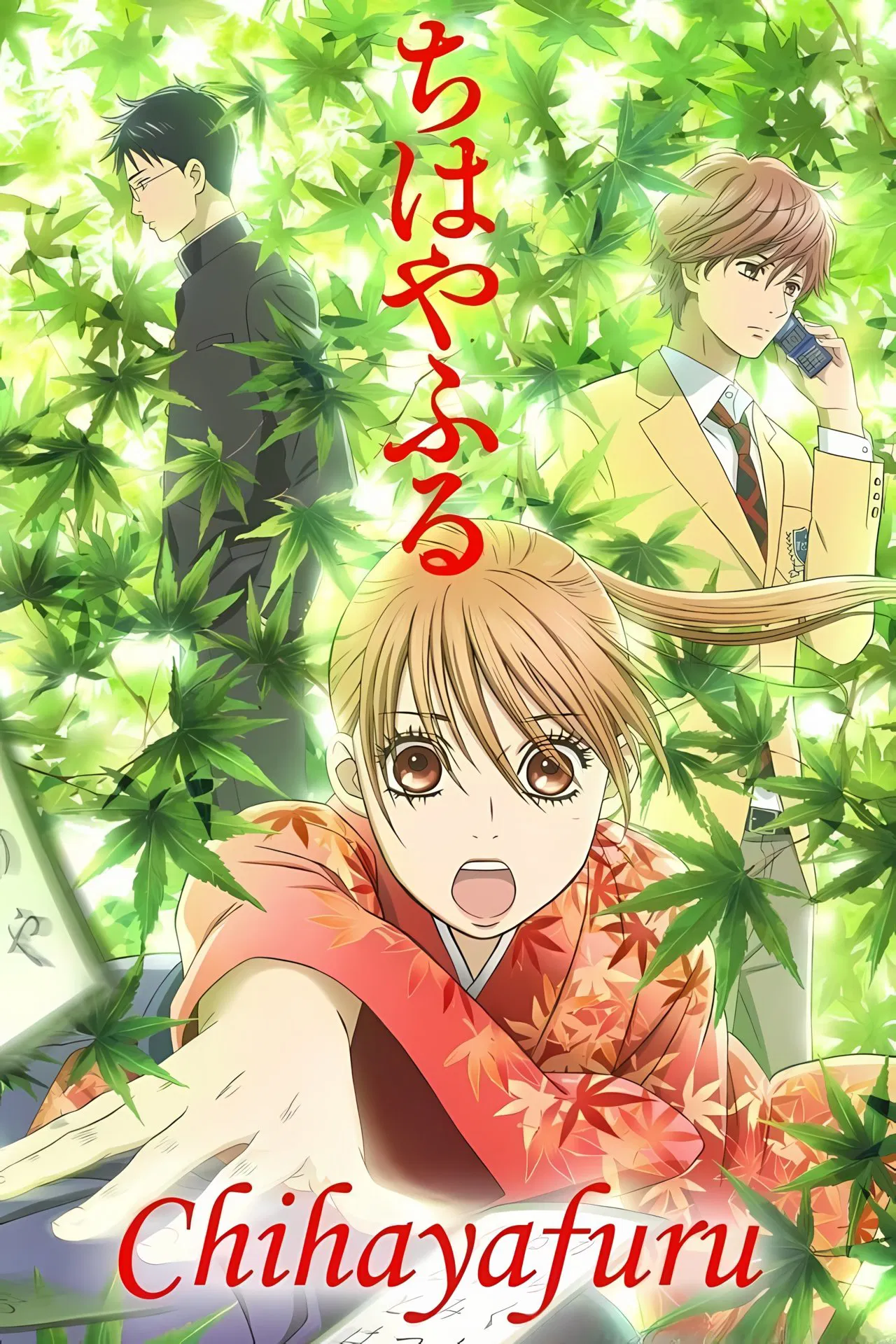
Name(s): Chihayafull / Chihayafuru / ちはやふる
Format: TV series (25 22-minute episodes)
Studio(s): Madhouse
Review
Chihaya Ayase is a high school girl focusing on only one thing: becoming champion of the traditional card game, karuta. But in truth, Chihaya hopes to reconnect with a distant childhood friend. A local ace karuta player, Arata Wataya, taught and played karuta with her before moving away.
However, another estranged childhood friend, Taichi Mashima, moves back to town. Taichi secretly harbors romantic feelings for Chihaya, recruiting her to his new, competitive karuta high school club. Together, Chihaya improves her karuta skills alongside new and old friends, hoping to become the “Queen” of karuta. This, she believes, will be an accomplishment Arata can’t ignore, and a step towards rekindling their friendship.
Unique Tone
Chihayafull is technically a sports anime but with a very unusual cadence. Unlike more common, aggressive sports that anime covers such as basketball, baseball, and boxing, karuta has a calm, neutral serenity. This is reflected in the unique way the series carries itself. Chihayafull aims to capture a josei (older teenager/young adult) demographic with a softer intensity than most sports anime.
The series is gentle without restraining the passion behind the card game. The friendship between the karuta club feels genuine, and speaking roles are divided fairly evenly between all of them. It was refreshing to see many character designs that weren’t traditionally attractive people.
Characters
While I enjoyed Chihaya’s characterization in her childhood flashbacks, I found her present-day self overly quirky in increasingly grating ways. Her obsession with karuta is typical of sports anime protagonists, being predictably used for jokes. However, it gets irritating at times when it’s seemingly the only thing she’s capable of discussing.
Chihaya’s limited dialect is also accompanied with constant silly face overreactions to every single little thing. She’s overbearing in the same way you don’t want to be around a real-life fangirl of anything. She’s also the focus of Chihayafull to a fault. At the beginning, characters get a fine balance of attention, but she gradually usurps them.
Tsutomo Komano is the club’s weakest member, and a losing streak has him considering quitting karuta. When winning his first match, this should-be triumphant, emotional moment happens completely off-screen. All to focus on another one of Chihaya’s comedic, neurotic breakdowns during a match.
Out of the whole cast, I like Arata the most. His emotional connection to the game feels believable, yet not at odds with his rationality. Unfortunately, for plot reasons, he’s barely around. Despite Chihaya’s annoyances, the supporting cast is generally likable. The team possesses great chemistry with distinctive personalities that are only brought together through karuta.
Audiovisuals
This is one of the best recent Madhouse productions I’ve seen. Matches have great visual emphasis on motion. Player movements are represented by nature’s elements, such as wind and water. It’s spiritually attuned with the folkloric culture depicted in each card’s poetry.
Kousuke Yamashita’s score blends light folk instrumentation with a modern, synthetic sound, further bridging the gap between Japan’s cultural eras. It swirls together, giving Chihayafull a distinctive, peaceful, relaxing essence without being lethargic.
Outside of the matches, the progression of Chihayafull is very typical for a sports anime. They talk about karuta, they train in karuta, and they play karuta. The formula works well, so I won’t complain about a familiar structure. Instead, what really matters is how a series uniquely flavors that structure. As stated, Chihayafull’s tone has an elegant poise that’s suitable for a card game centered around a respected, traditional art form.
My favorite thing about Chihayafull is when the cards’ poetry symbolically matches a game’s progression. This lends the storyline’s drama some additional texture and emotional depth. Unsurprisingly, it’s usually the cause of Chihayafull‘s most poignant moments.
Story Structure
On another note, I found it irritating how Chihayafull jumps from tournament to tournament. This results in skipping several months’ worth of events at a time. The series begins with Chihaya already being in one of karuta’s highest ranks. Yet, the plot requires progression to justify a long, syndicated story.
This requires Chihaya spend most of her time in ranking limbo, perpetually shy of being able to challenge the Queen. The author could’ve spent this time covering her rise from a lower rank to a higher one. This would give Chihaya’s personal growth tangible benchmarks for the audience, instead of vaguely gesturing at abstract improvements.
There’s also a romance element to Chihayafull that’s only briefly touched upon, for better or worse. Personally, I would’ve liked to have seen more romantic conflict, as it’s less predictable than the games. Although Chihayafull doesn’t have a particularly great or fresh story or characters, it’s still ultimately about karuta. It’s very much a sports anime, and the featured game is a major focus. Thus, it’s karuta that bears the rest of Chihayafull‘s weight.
Karuta Is Dull
Unfortunately, I think karuta is a boring game to watch. Karuta isn’t a game centered around clever strategizing (the main reason for spectating a game). Even still, Chihayafull attempts to rhetorically romanticize it as much as possible, giving the illusion of something more complex.
Karuta games have a very small variance of how they can progress, and even at only 25 episodes, Chihayafull repeats itself. The game itself doesn’t have enough complexity to routinely keep matches dynamic, so a psychological element is added, allowing the writer to pace games without working with its mechanics.
But since the game is still very simple, even its psychology is limited. In at least half of Chihayafull‘s matches, an unfocused or intimidated character will struggle to grab cards in time. Invariably, they’ll have an emotional epiphany, resolve their inhibitions, and just grab cards faster. There’s no other direction for the game to progress.
One might think this criticism could apply to any skill-based sport, but that’s not true. When Kuroko’s Basketball characters utilize psychological bullying, it’s in service of getting more points, but there’s dozens of ways it can impact players. Their dribbling can be affected, or their throwing, or their stealing, or their running, etc. In karuta, a player uses their eyes to locate cards, and their arm to grab them. There’s less variables.
Skill Expression
The most freeform part of the game is organizing cards on the field. This aspect is barely acknowledged, so I assume the author realizes there’s little variety to work with there, too. Karuta is a game of mostly linear improvement and progression, which makes it unexciting. Even Chihayafull itself goes back on its words, saying things like “only speed matters” in pivotal moments.
Any character’s revelation on how to improve is not so much refining a unique strategy or talent but improving universal fundamentals. Chihayafull insists that individual strategies exist, but they’re just different starting places for each player. When it comes down to it, the ideal skills for karuta would be identical between any strategy.
At one point, Chihaya is taken aback when she realizes grabbing cards too early results in grabbing the wrong cards. Come on, girl. Imagine a tic-tac-toe anime where, halfway through the series, a character realizes it’s most beneficial to start in the center square. Likewise, a karuta player winning by only touching the edges of the cards, thus moving them quicker, isn’t a playstyle choice. That’s not a technique that makes gameplay diverse—it’s an optimized fundamental that everyone should aim for.
Chihaya learning to visualize cards as the imagery from their poetry is a cute, good concept. On the other hand, it’s silly when considering its practicality. In order to mentally visualize a card’s poetry, you naturally need to see and comprehend a card’s words first. By then, you would have the information you’d need to identify the card. Visualization is an additional mental step that would slow you down. Karuta is the kind of game you’d see make up a small arc in an anime like Kaiji. I don’t think it can carry its own series.
Verdict
Considering its repetition and simplicity, I find it impossible to share the cast’s passion for the game. Karuta’s depiction feels so grossly exaggerated that it’s nearly dishonest. The cast’s boundless enthusiasm for the game becomes exhausting rather than inspiring, because it’s difficult to empathize with them. Emotional payoff in Chihayafull is weakened by its filtering through karuta.
As I continued to fall out of sync with the characters, I likewise found the series less engaging. I see no point in keeping up with karuta as a game, which extends to a karuta-centric anime. I can’t imagine either Chihayafull or karuta evolving enough to retain my interest. I’m also not invested enough in its story or characters to compensate. I probably won’t watch any additional seasons.
Leave a Reply