








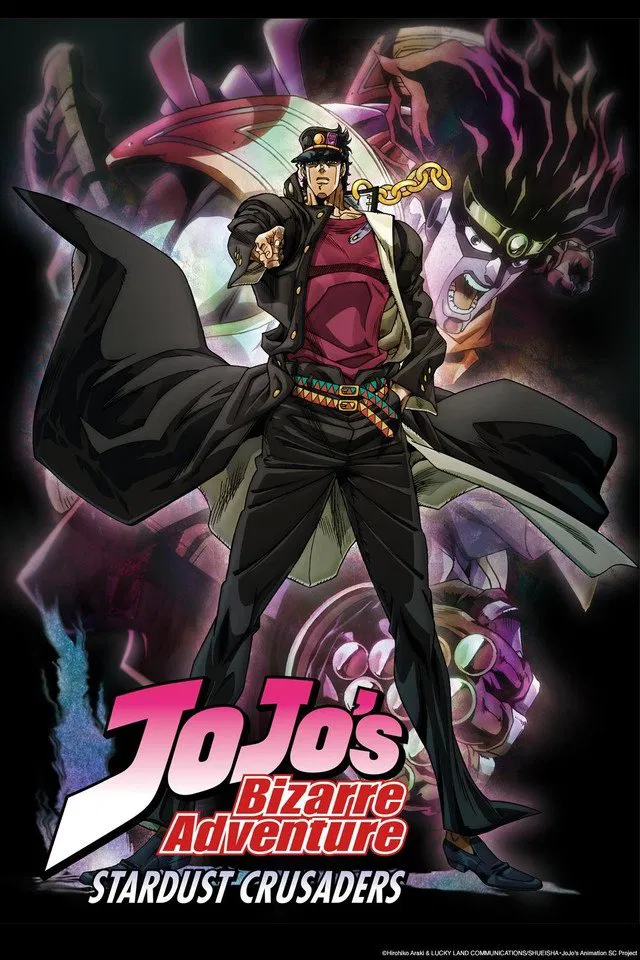
Season 1 (2014)
Name(s): JoJo’s Bizarre Adventure Part 3: Stardust Crusaders / Dai San Bu Kuujou Joutarou: Mirai e no Isan / JoJo’s Bizarre Adventure Part 3 / ジョジョの奇妙な冒険 スターダストクルセイダース
Format: TV series (24 24-minute episodes)
Studio(s): David Production
Related: JoJo’s Bizarre Adventure (2012)
Original Publication: November 12, 2014 (03:55:52 AM)
It’s fairly well known that Stardust Crusaders is by far the most popular arc of JoJo’s Bizarre Adventure in Japan, to the point that when Shonen Jump (SJ) saw the opportunity to bring the franchise over to western audiences, they simply skipped the first two arcs and debuted Stardust Crusaders‘s first manga volume as the beginning of the franchise. For people such as myself. who had long been interested in JoJo’s Bizarre Adventure but had no way to access it, this was a real donkey kick to the ‘nads.
Around the same time, Shonen Jump tried to pull the same stupid garbage with Bobobo-bo Bo-bobo‘s manga, which made even less sense, as that series isn’t separated into arcs with new characters. SJ just started it in the middle of an ongoing story. The logic (if you can call it that) behind such a move is obvious: Viz was idiotically banking on a sudden smash success simply because Stardust Crusaders was popular in Japan, despite Japan having an entirely different culture from the West, and Viz not giving the series any advertising over there. And with Bobobo, they thought Americans would be too impatient for the story to start picking up. Actually, that decision is so nonsensical—they started it around the 75% mark, and no one cares about Bobobo‘s plot—I’m not even satisfied by the justification I came up with, but what the hell else could it be?
I’ve been trying to wrap my head around Stardust Crusaders‘s extreme popularity for a while now, and after 10 minutes I think I’ve figured out. Think of storytelling elements commonly employed in shonen’s history. Why are these common? The main reason is self-evident: it’s because they work. Stardust Crusaders has two of these things. One, it follows a “villain of the week” format that has long been an accepted standard of storytelling in anime and manga, so people over there must like that shit. Two, it’s centered around proxy battles, with obvious giants Pokémon and Digimon displaying their girth all around Japanese pop culture.
But let’s not demean Stardust Crusaders for the latter. The original manga began in 1989, and Pokémon didn’t come around until 1996. With the exception of mecha series, I can’t think of anything before Stardust Crusaders that had proxy battles. Stardust Crusaders is at least partly novel for its new aesthetic, and I appreciate it trying to mix fights up a bit. Yeah, I miss the Ripple, but after the first two arcs it’s hard to imagine what more could be done with it… though I’m sure author Hirohiko Araki could’ve kept it fresh for an eternity.
Let’s get back to the present. For probably no good reason, the extremely popular JoJo’s Bizarre Adventure had to wait decades for a decent anime adaptation, and in a beautiful, honorable thing, they not only adapted the manga perfectly, but even started it from the beginning. We even got some talented subtitle work by the fans, even though the manga has had troublesome fan translations for a long time now. I was anxious to finally delve into the most popular arc of JoJo’s Bizarre Adventure to see what the hype was and close the book on what should’ve been settled a long-ass time ago. Fucking Shonen Jump.
Unless you missed the entry above this one, it’s no secret that I was a big fan of the first two arcs of JoJo’s Bizarre Adventure. It was excellent traditional shonen stylized through tongue-in-cheek parody that made it seem as if it invented itself all by itself. Though the series stresses testosterone-fueled tropes to the max it endlessly mocks them, yet always sides with them at the conclusion. It’s a series that celebrates the inherent stupidity of fantasy as often as it points it out. I won’t go into more detail because that’s what my review for the first two arcs should be for, but I’m explaining the appeal the series has for me and what my expectations were going into Stardust Crusaders.
Naturally, I expected more of the same cleverness. And after the first couple of episodes I began to worry. This segment of JoJo’s Bizarre Adventure seemed to be lacking something vital, and that something was humility. It felt like JoJo being taken seriously, rather than playing seriously. Stardust Crusaders felt like it was racing towards the violent fights and chances for characters to waste time talking about their Stand powers (which weren’t as ridiculously specific as situations in the first two arcs), and Jotaro’s strong silent type personality was much more typical than Jonathon’s gentleman or Joseph’s… well, everything, even though Jotaro certainly still leaves a much stronger impression than Jonathon. With the villain of the week format also being obvious, I began to worry that such an inventive shonen series had given itself to be one of the hundreds of generic titles in the genre, but since I was still satisfied enough I kept watching hoping things would get better.
To my surprise, things suddenly did. After the introduction of the main characters we started to get more of Araki’s highly creative situations that made me much less mind the villain of the week format. While the main characters require Stands that are generally useful and thus boring, the villains can have those crazy highly specific powers that can only be used in one way because they’re not meant to stick around. Once these odd enemy Stands become the norm, JoJo gets its MoJo back and becomes as unpredictable as before.
Even more surprising is how often I found myself laughing out loud at Stardust Crusaders. As if to make up for the seriousness of the first few episodes, the humiliating situations the characters often wind up in are a riot when combined with how intentionally melodramatic every line is. Joseph Joestar and Jean-Pierre Polnareff in particular deserve a lot of credit for keeping JoJo’s Bizarre Adventure‘s integrity intact when put alongside their much more serious companions. You could even consider them to be the glue of the series.
One such serious companion is the main character himself, Jotaro Kujo. For how much the characters in the series play him up as a wild hooligan, he sure as hell is anything but. Almost always totally silent (with a total line count lower than the other main characters, even), Jotaro if the aforementioned “silent badass” archetype with little to distinguish him otherwise except for how well he does it.
He’s entertaining in the same way Joseph is, in that you always know they’re plotting something but never what it is. Jotaro rarely talks big, and since he tends to speak with his victories he naturally demands respect when he shows he’s both strong and intelligent. It’s hard to dislike a character the viewer can admire and trust so much, but he lacks the flaws that make someone like Joseph Joestar so lovable.
There are maybe five times in the series where he actually does play the delinquent role and shows himself to be very rude, but these are quickly forgotten about after they happen and stand at odds with his usual personality where he’s restrained and honorable. Had they played up the rowdy delinquent attitude, Jotaro could have been greatly improved as a character and more fun to watch.
On the other hand, his intense appearance and full-bodied figure make him naturally hilarious when you remind yourself of the fact that he’s only 17 years old and going through a “phase,” like a normal teenager imitating cool characters they see in movies. With how much parody is in JoJo’s Bizarre Adventure, I prefer to see Jotaro as a mock-up of the “juvenile delinquent” archetype popular in anime and manga in the ’70s and ’80s. Otherwise, he pales too much in comparison to Joseph as a protagonist.
I also have to acknowledge how well Joseph Joestar was handled as a returning character. While it would have been very easy for Joseph to steal the spotlight from Jotaro, Joseph is now a fairly different man than he was in the Battle Tendency arc. I legitimately wasn’t expecting his portrayal in Stardust Crusaders, and while I was disappointed at first by his more mature and gentle nature considering how entertaining he was before, I eventually came to the conclusion that they made the right choice by toning him down so that he wouldn’t become the natural center of attention in every scene. In one coin Joseph is given proper character development just from the time skip, and also adds some of his better traits to the series albeit lesser than they were in his youth.
Hey, people get old. At the same time his greater moments remind us of the Joseph we loved from Battle Tendency yet doesn’t make us yearn for it (and thus a different series). I still haven’t gotten over how shafted Joseph was with his shitty Stand though, even if it fits into his more passive role this time around. And despite an intrinsic theme of JoJo’s Bizarre Adventure being inheritance, Araki drops the ball on Joseph and Jotaro’s familial relationship as an opportunity for character development, and although Joseph does come across as the team leader, he doesn’t feel like an experienced mentor to Jotaro and others.
Conversely, Dio Brando feels written in as an obligation to tie up a dangling plot thread, since Araki doesn’t seem to be that excited about his return. He’s almost never seen, and on the rare occasion he is we see little of his strong personality. He still has a very regal presence, but he’s not shown to be as much of a bastard cunt and he’s not nearly as entertaining because of it. Yet, at least. This has yet to be truly confirmed as the series is only halfway over, but Dio still should have had a little more scenes in this first half. To be promised the return of such a great villain and not have “half” of him delivered can only be a letdown after initial excitement.
While discussing characters I suppose I should mention that I question the idea of Stands to begin with. For starters they make the Ripple technique completely irrelevant, which was JoJo’s Bizarre Adventure‘s signature martial art style that was previously defined very well. I don’t see why the Ripple couldn’t have stayed in addition to these new powers which can essentially be seen as their own martial art styles.
Needing Stands as an explanation for these new powers strikes me as a little unnecessary too. In a universe where all sorts of crazy supernatural powers have already been proven to exist, it wouldn’t have required any suspension of disbelief for there to be others with their own unique abilities (especially since this is still what Stands are: new and supernatural).
Normally I’d say the same thing you’re thinking right now which is “who cares,” but it impacts the fights a slight amount when the damage being inflicted isn’t as direct. It lessens the feedback and intensity of some of the fight scenes. I also don’t like the idea of Stands simply being a power that’s given to the user without any work for it. In the first two arcs, Jonathan and Joseph defeated their enemies as they continued to understand the Ripple further, yet in Stardust Crusaders, battles progress until the enemy Stand’s weakness is discovered, and then Jotaro or someone else simply punches it to death the same way he will the next time. I thought the Stands would unlock new abilities as the series progressed, but they didn’t, and this was one of the most disappointing aspects of Stardust Crusaders.
Stands, or more specifically, new fighting styles, needed to be introduced by this point for some variety, but I’m not a fan of essentially writing the Ripple out of existence or the basic aesthetic of Stands. Yet, the fact the Stands are proxies to begin with is one of the things that made the series stand-out when it debuted and probably added to its popularity by adding a “gotta see ’em all” appeal to the show. Watching it now I can’t particularly care about Stands since they’re, again, only an aesthetic, and am only interested in their unique abilities which could have been delivered in a more traditional way to probably more benefit.
I generally hate the “villain of the week” format too, but it doesn’t necessarily ruin a series for me. Most shows that employ this narrative feature the villain being defeated in repetitive ways, but JoJo’s fights are so, well, bizarre that we always are getting something new. The main way this format hinders the show is by making it solely fight-centric with no episodes to slow things down and expand (such as a “training” episode), and by making it feel as if no progress is being made.
The latter is mitigated somewhat by the fact a goal is stated at the beginning of the series and with each episode we’re closer to it, but when you realize they’re going to get there in the middle of what’s a much longer series than this first part any progress can feel like an illusion. The one benefit to this format is actually one of Stardust Crusaders‘s cooler traits, and that’s the adventurous feel where the characters are constantly in new exotic surroundings they spend entire episodes in.
Araki is aware of this “road trip” sensation and provides us trivia about the locations, and the characters comment on them as well. It’s a small but highly enjoyable aspect of the show and an example of JoJo’s Bizarre Adventure‘s referencing personality that sets it apart from all other shonen series.
Stardust Crusaders‘s animation quality is far above the average of a typical anime series, and definitely beats out the anime’s first season which could often feel like an animated comic book, for better and worse. This apparently better budget also allowed for more of the sudden psychedelic color changes, which are great. The action generally isn’t fast-paced enough to really reap the animation quality, but it does make Jotaro’s moments when he uses Star Platinum’s furious fists appropriate highlights.
The score is overall slightly better, primarily due to the triumphant Stardust Crusaders theme that plays frequently. On the other hand, the opening song is far worse than the previous two, to the point where it might actually be the biggest letdown of Stardust Crusaders. The animation accompanying it is as stellar as always and stands out when compared to the actual episodes, but the song itself feels generic even if it’s good by itself. It’s just not up to the standard set by the other two at all. “Roundabout” is replaced by “Walk Like an Egyptian,” and even though it’s also weaker by virtue of “Roundabout” being a better song in and out of context, it’s still a perfect fit for the show both narratively and in personality, and is thus a very worthy follow-up choice.
So, apparently this marks the halfway point of Stardust Crusaders. People say that it gets much better after this point, but people say that about literally absolutely everything, so I’ll just pay it no mind and find out for myself when part two concludes. I certainly don’t expect the quality to drop, as Araki was consistently writing the entire series, and if it stayed the same quality as it is now, I would still be satisfied by the puzzle each villain of the week presents and the amount of laughs the characters can provide.
Stardust Crusaders left me a bit sour at first, and I was certain I’d write a lukewarm review, but once it got that quirkiness back, I rediscovered the main things I enjoyed about the franchise to begin with. It definitely lacks the peaks of Phantom Blood and Battle Tendency, but is overall more consistent than the former, and occasionally approaches the latter in parts of episodes.
Season 2 (2015)
AKA: JoJo’s Bizarre Adventure: Stardust Crusaders – Egypt Arc / ジョジョの奇妙な冒険 スターダストクルセイダース エジプト編
Format: TV series (24 23-minute episodes)
Studio(s): David Production
Related: JoJo’s Bizarre Adventure (2012)
Original Publication: June 21, 2015 (01:54:46 PM)
I’m cursed to write a second review for JoJo’s Bizarre Adventure: Stardust Crusaders because the staff in charge of MAL do stupid shit like make seasons into separate entries so they can pad out their “Completed” stat.
My review for part one of the series is much more robust and most of it applies to the second season as well. I highly recommend reading that first because this review will function more as an addendum and I’ll use this opportunity to talk about some specific plot points. Which means SPOILERS for the whole series will follow and if you haven’t finished both parts you should. I’m also using this “addendum” as an excuse to ignore structure and I’ll just list the things I’d like to talk about.
1. In general part 2 is an improvement over the first. Hirohiko Araki uses bizarre idiosyncratic Stand powers much more often which leads to diverse and endlessly fresh scenarios and battles. He’s used the initial vagueness of Stands being magical otherworldly beings to avoid having many pre-established rules of fighting abilities many battle shonen have and is able to have individual Stands rewrite the rule book whenever he pleases. When other battle shonen attempt to introduce new distinct powers it can come across as arbitrary and forced, but because the Stands never set a standard to begin with Araki can get away with doing whatever he wants with every chapter. It’s almost like cheating. The first part was far from without these strange Stands which makes the quality of part 2 over part 1 an exaggeration but it is an improvement nonetheless.
2. The only thing I think part 2 loses to part 1 over is how underused Abdul and Kakyoin are. It’s a surprising lack of awareness with balancing the team. Abdul has no chance to individually shine and is killed in an instant where he’s completely helpless as if he’s just disposed of. Kakyoin was one of my favorite characters before but fell out of favor when he kind of just stopped doing anything. He’s blinded after not even putting up a fight and is then totally unheard of until near the very end, where he faces the next Stand user as he should after just coming back, but then he loses halfway through. He’s very important in helping defeat Dio but I would’ve liked to see him as more than just a sacrifice this season and his reputation as the smartest of the group is barely demonstrated.
3. I initially hated Iggy and thought he added little to the series, but after finishing it, I now no longer hate him and just think he added little to the series. Not only is he hideous (he has a man face on one of the ugliest dog breeds) but he spends almost every episode bitching and running away. He’s only given one and a half episodes devoted to a battle by himself, and while this is actually a pretty good battle and gives some character insight and development, it happens right before the final few fights. Iggy being used more could’ve balanced out Kakyoin being gone but he’s used extremely sparingly. The human characters are all funner.
4. The pacing is a mixed bag. I said before that the series practically misleads the audience into thinking they’re making more progress than they are, and when the new set of Stand users are introduced we finally believe Araki will drag this out as long as he finds suitable. The group finally reaching Cairo means absolutely nothing when it comes to building tension, even as the opening and ending reference the final battle and conclusion respectively in an attempt to convince us. The tone of these themes is very awkward, especially when you hear the calm “Last Train Home” ending whether you’ve just finished the first episode or are in the middle of the intense final battle. The JoJo openings and endings have been getting worse with each part/season which is a shame, but these ones could’ve been salvaged if they were shown starting with the mansion battles. Hell, “Last Train Home” doesn’t even play in the final episode!
But like I said, it’s a mixed bag. When the group finally reaches the mansion all that meandering finally and suddenly feels like it mattered. The retrospective on the long journey to reach this point is extremely effective and there’s relief and stalwartness felt by the audience who has practically been a companion since the very beginning. The long episodic nature of the series finally adds up to something and is properly rewarded.
5. However D’Arby’s brother, the first enemy in the mansion, is a total pace killer. It’s a huge letdown to see a Stand user who specializes in video games only for Araki to take the easy way out and make both games sports games, so there’s very little creativity. Compared to the quality of the following two fights, this is nothing.
6. The semifinal battle against Vanilla Ice is excellent and I do want to give props for making the final obstacle before Dio the most entertaining fight yet so it doesn’t feel like padding keeping us away from what we really want. Abdul being killed so easily was a disappointment but the rest of this fight is thrilling and focuses on one of my favorite characters Polnareff, so I have no complaints there. But how the fuck did Iggy have any idea what Dio looked like?
7. The finale with Dio is pretty much everything it’s been hyped up to be. I was initially worried because the few times where Dio was shown his personality was more dignified and less insane than how he was in Phantom Blood, but once he was really introduced he revealed himself to be the same Dio as always. My complaints here are very few and minor compared to how amazing this final fight was, but they do exist. I really wish the Dio fight were longer not just because of how good it was, but because everyone other than Jotaro could’ve contributed a lot more. It didn’t feel like much of a team effort like it should’ve, and although they inadvertently helped in the end by relaying Dio’s power to Jotaro, it’s definitely as much of a “Jotaro battle” as any of his before this fight.
What a finale though, seriously. Before this I was upset that I’d never get to see a fight between young Joseph and Dio since they’re my favorite characters, but Jotaro fought that battle no differently from how Joseph would’ve. Jotaro’s personality also makes the fight more intense, as it’s a battle between two characters who have never once shown weakness. Wondering who’s going to break first is some killer tension, and it’s great how Dio knows what to expect from a Joestar but Jotaro has to learn why he should take Dio seriously.
Dio having the power to stop time is fucking awesome. Like any time-based power in fiction there’s some inconsistencies, mostly with how before anyone knows what Dio’s power is it looks more like he’s capable of rewinding time than stopping it. But although i knew what Dio’s power was before going in, the “oh shit” in the air when the party realizes their enemy can control time is palpable. It’s such a seriously stupidly powerful ability that’s so ridiculous many shonens would overlook giving it to someone, but Araki finds ways to have fun with it as Dio first demonstrates how useful his ability is and uses it as a way to increase the stakes of the fight exponentially. How the hell can the heroes beat someone who stops time? That’s only a few steps away from being able to just alter reality. It’s an insane ability given to the already most intimidating villain and I absolutely love the audacity of it.
Oh yeah, the heart stopping, the knives, the steamroller, the gasoline, all of it is amazing. The fight keeps on giving. I’m going to end this with my only other two problems. One, changing Dio’s appearance after he drinks Joseph’s blood was a bad move. Not only is Dio’s new look simply stupid and less intimidating, but it’s just ill-advised to change the iconic image of a character we’ve been waiting to see beaten in his entirety since the beginning the whole series. It’s still Dio who’s being fought, but it’s not exactly OUR Dio which weakens the impact just a little bit.
Second, the final blow sucked. It came suddenly and not in the middle of a new situation. Dio just goes to attack and Jotaro’s punch blows him up instantly this time for some reason. Was Araki in a hurry to move on after dragging out the journey to the Dio fight so much? Not the best time to do it. DIo not even breaking down and realizing his defeat was also a little lame. Finally, I was hoping they’d replay the final “This is the legacy of your bloodline, JoJo” line from the first part’s opener like they did for the final attack of Battle Tendency. Especially since that line has much more relevance here and it would be a great tradition if they kept adapting the other parts. I realize they probably would have to relicense the song for this different season, but it’s only about seven seconds and it’s clear this series has had a good budget thrown into it. I’m actually still kind of in shock of how weakly such an incredible fight ended.
8. The animation is somehow even better than the first part.
9. The humor is still very strong and the most underappreciated aspect of Stardust Crusaders. It’s why a lot of these ridiculous Stands are acceptable to the audience.
10. Where the fuck is the trailer for part 4.
11. Where is the trailer for part 4.
12. Seriously where the fuck is it.
13. The trailer for part 4.
14. What a great series this is though, for real. Hopefully, you already finished it like the first paragraph asked and agree.
15. Where is part 4. Where the fuck is it?
Leave a Reply