








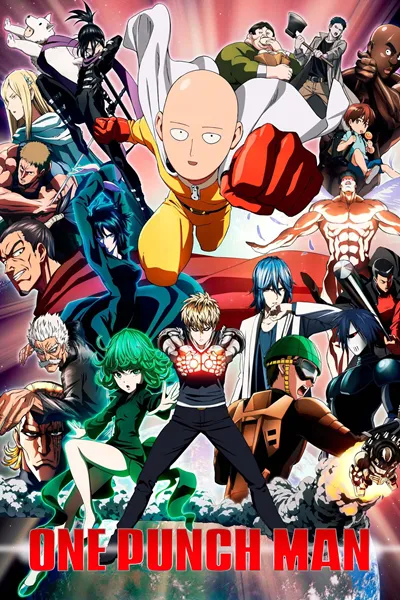
Season 1
Name(s): One Punch Man / One Punch-Man / One-Punch Man / OPM / ワンパンマン
Format: TV series (12 24-minute episodes)
Studio(s): Madhouse
One Punch Man (OPM) is an anime take on the Superhuman Condition: if you’re always written to win, what do you have to look forward to for surprises? Saitama lives in a society where people can become daily heroes who routinely fight new villains, each with a wide variety of different powers. Saitama is one of those heroes, but a significant exception: He always defeats any opponent with a single punch. On top of that, he’s limitlessly agile and indestructible. Saitama has become blasé with boredom, going through the motions as a hero while hoping a strong opponent will come along to rekindle his fighting spirit.
He becomes a mentor early on to Genos, a cyborg boy who tells Saitama about the official Heroes Association where the two register and fight to raise their hero rank among the association’s hundreds of other unique heroes. It’s surprising it’s taken so long for an entire show to be made about the mockery of the “main hero can never lose” trope. The trope itself has been made fun of before, but usually through referencing it by the fourth wall or merely mentioning it. No one has really taken the joke this far. Possibly because they figured there’s only so much you can do with one punchline. One Punch Man learns this is true early on and delves into some further mockery of standard character archetypes and stories, but to its detriment it can never get away from its source material no matter how hard it tries.
More evidence of One Punch Man being late to the scene with its parodies is how much of it is, and is able to be, played as completely straight shonen. Saitama is the center of the show and reliably where most of the humor is, as always expressed through the dull look on his face regardless of crisis and his immediate belittlement of whatever ridiculous thing is in his way which reflects the attitude of the show’s concept as much as what his unstoppable power has done to him. But Saitama’s role in the story becomes repetitive so much attention is given to endlessly building around him with a society of heroes that are strong but are at risk for losing and have unpredictable fights, but when these characters are on display you end up with likable, but ordinary shonen characters.
One Punch Man wants to bank a lot on its absurd, broad character designs and powers but it came out in an era where so much of that is the genre standard already. Hunter X Hunter is not something people would call a comedy show, unlike One Punch Man, and yet it features even more outlandish superpowers and character designs. One Punch Man doesn’t go far enough in this day and age to be able to highlight what it’s making fun of, but it’s equally unclear how much it’s even interested in making fun of anything.
As said before the entire show flip flops (always dictated by whatever the tone of dialogue is at the moment) on how seriously the show wants to treat its characters and setting. When Genos is introduced he gives an extremely token introduction about wanting to avenge his parents, find the true meaning of justice, etc. etc., and it’s all quickly blown over with an increasingly fast delivery and endlessly redundant phrasing about simple philosophy while Saitama looks bored. It’s obvious he’s a parody of the “serious” hero type found in anime and they’re already making a joke of how hyperbolic their personality is. Then in most later scenes, everything about Genos’ personality is framed completely seriously exactly like any of the anime it would’ve just mocked. He’s completely heroic and sacrifices himself to save civilians, and this is seen as tragic with attempted genuine weight that the tone of the show isn’t interested in building to.
There’s clever concessions like this to have the show maintain a sense of progress and risk when the power cap has already been reached, but some ways suit the show better than others. One of these is the ongoing joke that Saitama, despite being the most powerful character who kills all the villains, is not recognized by the public as the one responsible and very few people believe his strength is real. Saitama’s development as a character, then, is not his abilities but rather his reputation. It’s satisfying to see him upstage other heroes but frustrating and empathetic at the same time for how none of his accomplishments are seen as good enough because he’s too strong to believe and has bad luck.
There are hints of promise like that in One Punch Man that make it engaging, but it’s still too early in the game to call them anything other than hints. The first few episodes are the hardest to get through by following the same formula: new villain is hyped up, Saitama takes a long time to do anything for some reason, villain monologues about how it’s unbeatable, the joke is that all of the hype was meaningless because Saitama wins in one punch. Repeat four times or so.
Technically, I guess this repeats the entire show, but a supporting cast is eventually built up to make the non-Saitama parts more interesting. Or less interesting depending on your perspective, because for how very well-animated and choreographed these countless fights between side characters are, they are still standard high-speed, swish slash, puncha puncha boom boom shonen fights which isn’t at all what’s prominently advertised and is getting away from the series’s unique perspective.
When all’s said and done the generic shonen here is still by any standards good (not great) shonen, but as One Punch Man itself should have the self-awareness to realize, there’s not a particular need for that in anime. It’s difficult to tell where the series could go from here. Will it continue building up its random world and characters in an attempt to string a more dramatic story together kept separately from the parody whenever its convenient, or will it be able to stay true to its concept? It doesn’t look promising for the latter, but even the generic angle would still be pretty watchable as it has been already.
I really, really don’t understand the reverence for this show. It was fun and entertaining, sure, but being in the vast minority of people who think there’s little more to it beyond that is an unusual position for me to be in. Lampooning shonen tropes isn’t necessarily a noble goal, or even a new one, or even a thing never indulged in by the genre’s own standard series. The punchlines get inevitably repetitive because much of the show’s premise is built around how shonen tropes are so limited. When it has nowhere else to go, it just gives in and becomes a merely decent battle shonen written around characters originally designed to be jokes. It’s incredibly sloppy, held together by the hint of Saitama’s gradual public acknowledgment of his strength and the humor that comes from that.
This aspect is still the small center of what’s largely not a very clever or particularly well-done shonen. Have a problem with the tropes of shonen anime? Then write something better instead of slapping a veneer of self-awareness and superiority on top of it. Given Mob Psycho also devolving into shonen battle tropes, it seems likely that ONE is just too limited of a writer to do such a thing. He’s as constrained as the thing he’s mocking, albeit playfully and with obvious respect for the genre. There’s something weirdly meta about that, and I can’t imagine it’s intentional.
With all that said, I still like this show. Being likable and entertaining is perfectly fine, and I’m on-board for another season of fun. But I can’t give this more credit than I think it deserves. If you think it has top of the line battles, characters, and jokes, then more power to you. I just wouldn’t place it in that tier.
One Punch Man 2nd Season (2019)
AKA: One Punch-Man 2 / One-Punch Man 2 / OPM 2 / ワンパンマン / One Punch Man Staffel 2 / One Punch Man Temporada 2 / One Punch Man Saison 2
Format: TV series (12 23-minute episodes)
Studio(s): J.C.Staff
Related: N/A
Published: July 11, 2019
Source: MyAnimeList
This went the direction I hoped One Punch Man (OPM) would after the first season. ONE wasn’t clever enough to keep the manga going as a gag manga, and quickly wrote Saitama out of a bunch of scenes to just play it as a straight shonen. Yeah, it’s over-the-top and the powers can be kooky, but neither of those traits are anything close to uncommon in shonen. There’s been self-aware shonen since JoJo’s Bizarre Adventure, but I digress.
Saitama continues to be used as a sort of tension-relief, with the pattern being that powerful opponents are set up outside of his reach, and satisfaction is continuously derived by characters who think they’re hot shit inevitably running into Saitama and getting knocked down a few pegs. It’s simple and nothing outside of what Dragon Ball Z did constantly, but it’s amusing nonetheless. Saitama’s invincibility is essentially a fact at this point, and always knowing that a comeuppance is around the corner leads to the anime’s most fun moments.
This has the unfortunate side effect of making any scene without Saitama usually fail at any attempted drama. The results of every fight are known not to matter, as if the villain is to succeed and progress in fighting heroes he’ll inevitably be destroyed by Saitama, and if anything of permanence happens, either a villain will die simply before Saitama makes it happen, or a hero will die. Problem there is, OPM puts so much work solely into its character design that none of those heroes have any backstory that makes victory or failure have any meaning beyond its impact on the plot.
The bright side is that season 2 admitting it’s just another shonen series means that it has to fall back on more conventional storytelling to make the characters who aren’t Saitama compelling, as they necessarily need to pick up most of the slack as he’s usually never around. Both characters introduced in season 1 and new characters alike get more defined personalities, motivations, and weaknesses. This transition isn’t as effective as characters who have these things from the start, though (i.e. most shonen works), as ONE is forced to play catch-up with defining a huge cast he set up almost at the start of the series. The consequence is that a lot of these moving parts of the story still haven’t gotten additional characterization—there was simply too much to get to in this amount of time. So there’s still a bunch of people running around who are literally nothing more than their character design, which I find as dull as I did in season 1.
The new villain Garo is the star of the show here, a powerful man who fights nearly anyone he comes in contact with, overcoming them with sheer tenacity and brute force. His love for combat, his desperation to overcome his inadequacies, abrasive personality, and feeling like he’s fighting for underdogs makes him a stark contrast for Saitama. Though the two don’t end up establishing a relationship in this batch of episodes, the switching between of their opposite perspectives keeps the season’s pacing and tone, dynamic and gripping. Garo is a ton of fun to watch, but I find the emotional core of his story to be mostly ineffective. Garo fancies himself on the side of the monsters, emphasizing as a child the fact that they’re unpopular underdogs always destined to lose. It’s an interesting concept, but OPM’s world completely fails to ever make the monsters sympathetic.
One of Garo’s flashbacks has him claiming that an aquatic monster is just “trying to protect the ocean,” and he reacts with horror at the fact the heroes mercilessly destroyed the monster’s eggs. It certainly sounds awful if true, making the heroes out to be more bloodthirsty than the monsters, but this is never supported by literally anything else in the series. OPM had an opportunity to be morally ambiguous here depending on how it portrayed its monsters, but trapped itself by always wanting to characterize them as stock evil as possible in order to properly parody its genre’s melodrama. This season goes even further in committing to that one-sided portrayal of monsters with another subplot that very clearly demonstrates that becoming a monster turns you into a bloodthirsty psychopath with no instinct control. It needed to show the audience just a single time that monsters were capable of more complexity, but it completely neglects to do so. This results in Garo’s passion and motivation making him look like an idiot if examined with any scrutiny. When looking at his claims fairly, all we have are his perspective (demonstrated to be formed by bad logic) and a single anecdote from when he was a child that, if true, is so astronomically in the minority of monsters that it’s virtually irrelevant. Garo wants to be on the side of the underdogs who always lose, but fails to acknowledge that 99.9% of the time monsters are being slain because they mercilessly kill and devour powerless humans, who are objectively speaking the biggest underdogs in this entire equation, meaning by Garo’s own logic the heroes are more morally just than he is. It’s an incredibly simple conclusion to come to that goes completely unaddressed and it has the effect of making Garo look like a huge idiot, burning away goodwill towards the character that’s the primary focus of the entire season.
I’m sure there are people that argue this nonsensical backstory is another intentional gag, but I see zero reason to believe that. It seems to me that this is played straight in attempting to make Garo look like a sympathetic anti-hero, as there are additional scenes that go out of their way to establish Garo does believe in a moral code (his caring of kids) that would back up the belief that he takes his mission seriously. Not to mention that the basic idea of making the emotional core of your main character an intentional joke goes against all basic common sense ideas of writing. The tension of virtually any scene involving Garo relies on believing that both Garo and the heroes he fights are both victims who believe in justice, and you’re supposed to sympathize with both sides of the battle despite the idea that only one is supposed to come out victorious. Unless you’re willing to admit that these scenes are designed to be inconsequential, devoid of thrills, and pointless, you need to acknowledge that you’re meant to take Garo’s beliefs seriously in order for all of these scenes to have any meaning. And I find it impossible to believe that ONE didn’t want these scenes to be exciting, unpredictable, and having you root for both sides. If they weren’t, no one could possibly have any investment as to what happens in this series, as it would all amount to having the depth of just watching a laser light show. It’s one of the classic fatal flaws of trying to argue One Punch Man as above its genre, and yet if you humble it down to conventional storytelling you’re forced to admit how bafflingly underwritten certain aspects of it are. I had to take quite a skip and a hop to argue why Garo’s backstory is ineffective and stupid despite it being incredibly obvious, but I just know some sections of the fanbase will still attempt to argue in favor of it, so I felt like I had to. This is why I tend to dislike discussing OPM in any critical way, because I usually end up having to run a marathon of justifications for a mostly really basic show that’s just dumb fun.
But it IS fun, I’ve never not admitted that, even if I don’t think it’s genius-level fun. Garo may not be used to his full effectiveness, but he’s still a joy to watch. The jokes may often be obvious and repetitive, but they still evoke smiles. The fights are emotionally and strategically nothing special, but fast-paced and exciting in their scale. All of this amounted to a series I burned through in almost a day once I got into it, and I was disappointed there wasn’t more (especially since it ends on a horrifically unsatisfying cliffhanger in a way the first season didn’t). To OPM’s credit, I thought the character King was maybe the best joke the series has come up with thus far. The idea of a character who’s incredibly weak just coasting by off intimidation via a fake reputation is nothing short of brilliant. Shonen works absolutely love establishing a future character’s power by having those in-the-know immediately respond to them with immense fear, and the result is often not getting to see this character’s power until far into the series’ future, building hype that can carry a serialized work for a long time. It’s a typical trick, but OPM’s parody of it is a million times more clever than acknowledging that the main character always wins. Alas, I still have some issues with execution. I think OPM brings this joke to a conclusion far too quickly, when it could’ve had much more use. King is immediately established as being a phony both to the audience and Saitama. It could’ve been hysterically funny if Saitama was desperate to see a display of King’s power, but King always denies him by posturing and saying something like fighting is always a waste of time for someone as powerful as him. It would’ve given Saitama a character relationship he didn’t have, and the dramatic irony between the audience knowing King is weak yet the invincible Saitama taking him seriously would’ve probably worked well. It also could’ve been a lot of fun to have King fully take advantage of his reputation. King doesn’t deny his false victories, but he doesn’t deliberately make use of it either. King always wants to avoid fights because he’s actually a coward, which is funny, but you could still have that be his internal character while also having him be vain and greedy enough to attempt to scare off people far stronger than him just by posturing. A new villain shows up that’s completely unstoppable, King makes a rare appearance and stares him down with his intimidating face, the villain is aware of King’s reputation for being one of the most powerful heroes and believes it when seeing his demeanor in person, the villain runs away or surrenders without even a fight and King’s fearful reputation grows even further. I think that would’ve been an amazing character, but as he is now King is one joke that’s resolved in no time. He’s a coward that only is famous by accident, and he’d rather just be left alone and play video games. King’s an immensely likable character nonetheless, but it bothers me that such a genius concept goes underutilized. Again, I’m forced to conclude that ONE is just limited as a writer.
Season 2 also introduces Fubuki, who is given a decent enough backstory to start with, but then basically never does anything again for the rest of the season. Boy, she sure is hot, though, right?
I’d be remiss to end this review without talking about the series’ change of studio. The first season was well-regarded for its high quality animation relative to other contemporary anime, and in that regard I’d say the critical consensus was right on the money. For reasons that I’m sure aren’t good ones, the second season shifted creative hands. Many people were worried that one of the first season’s best traits would be lost by this transition. And they were right! Season 2 doesn’t look anywhere near as good as the first. In-betweens are absent all over the place in action scenes and characters outside of center frame are often hideously off-model, for starters. The sad thing is, season 2 probably still looks better than most anime these days, but unlike season 1 that’s more indicative of how dire the quality of animation is in modern anime rather than any sense of accomplishment. If season 1 looked like this it probably would’ve gotten away with it, but now that season 2 invites direct comparison the whole attempt just comes across as kind of pathetic. Something season 2 revels in that I fucking hate (and don’t remember happening in 1) is the recently popular technique of applying a dimming effect to the entire frame to make action scenes look more dramatic. It essentially looks like someone turned the brightness down on their screen for a few frames. It looks like fucking dogshit, and I cannot believe anyone in the industry or fandom thinks this looks better than no additional editing at all. It’s an utter joke any professional can think this is effective. Lighting is supposed to enunciate certain parts of the frame, and that requires that other parts of the frame are lit differently in order to create contrast. You wouldn’t think the purpose of contrast would go unknown by professional artists, but here we are.
It’s at least obvious why studios want to use this technique: it’s way easier to turn a slider down in a video editor than it is to color individual frames in a way that simulates natural lighting. But not being capable of putting in the second of thought to realize highlighting only works when not everything is highlighted is nothing short of amazing to me. It’s like someone hands you a long document and for the sake of organization they used a yellow highlighting marker to show someone the most important parts at a glance. In this case, you’d be getting that document with every line of text drawn over with bright yellow. It would be useless in its intent to focus you on certain parts, and it would look like shit. And thus is the same result of this animation “technique.” Lastly, the audio mixing in some action scenes can be downright trashy. For some reason there are a lot of impact sound effects that seem as though they’re mixed super low in comparison to the music. This muffled sound takes away all the power of punches, etc., and I have no idea why it was done seemingly at random. There are multiple fight scenes where the screen dims, a powerful character throws multiple punches with the force of cannonballs, and yet each hit sounds like the person on the defensive is being hit with wet sponges. Exhilarating!
It’s bizarre to finish a One Punch Man season enjoying its story more than its animation, which was the exact opposite reaction I had from season 1, yet here we are. It’s a shame, because this season could’ve had both and have been an easy improvement over the first, but the staff just weren’t ready to go that extra mile. We can only hope a possible season 3 will turn things around, but I know I at least will be paying attention should it happen. At this point I’m always ready for some more dumb fun. Because that’s what One Punch Man is. And more power to it now, I say.