








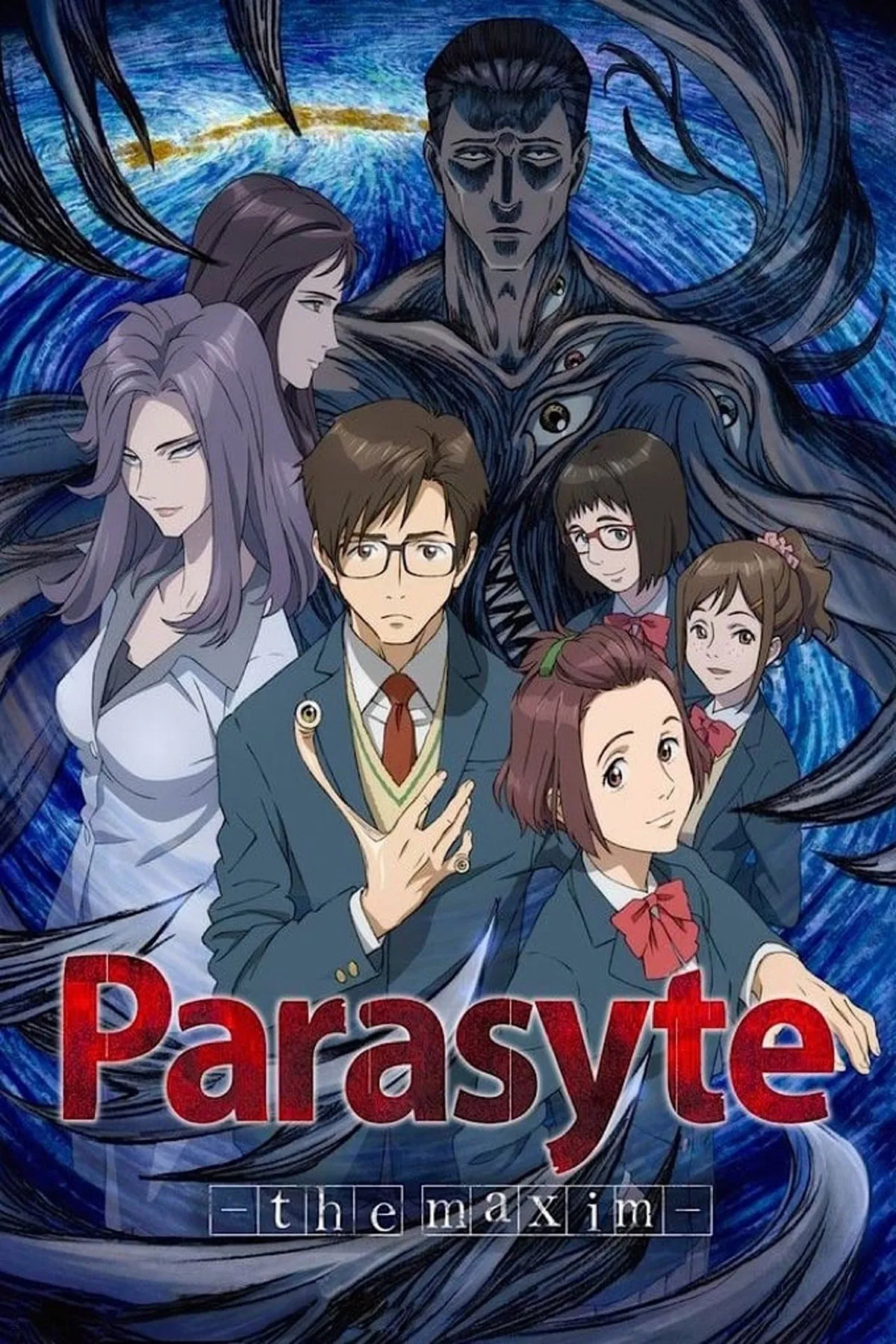
Name(s): Parasyte: The Maxim / Parasite / 寄生獣 セイの格率 / Parasyte -the maxim / Parasite -la maxime-
Format(s): TV series (24 23-minute episodes)
Studio(s): Madhouse
This sounds like something you might think would be right up my alley, or at least you should, but I ignored it for a while based on a few things. One was that it deviated considerably from the manga in some undesirable ways. Another was that images and posters of the series looked too bright in tone compared to what I’d seen of the manga. I worried it wouldn’t get the most mileage out of its horror concept. Now having seen Shiki, I’ve unintentionally run into far worse ill-fitting character designs, and I loved the show despite that. Parasyte‘s barrier of entry for me dissolved, and like many things, I started it on a whim after thinking its premise sounded cool.
Parasyte: The Maxim (seriously, what is with that subtitle) is about Shinichi Izumi’s encounters with a race of alien parasites that enter human bodies and attempt to imitate them while devouring others for food. Shinichi’s parasite fails to take over his brain, and as it remains in his arm and threatens to harm him if he doesn’t cooperate, the two enter a symbiotic relationship to survive while encountering other Parasytes.
There’s not much of an overarching plot here, though there is constant progression and flow there is no end goal in mind. Shinichi doesn’t have a heavy intention to wipe out the other Parasytes, nor is his right hand “Migi” on board with that with his cold, self-centered logic.
Instead, Shinichi tries to balance his normal life and the safety of his family and friends with the dangerous situations he’s constantly drawn into, as Parasytes can detect others within a certain range and the majority see Shinichi as a threat due to being a human that knows of their existence. There’s a light arc structure that tends to focus on a different Parasyte entering the scene under different circumstances that Shinichi will have to deal with somehow, but as Shinichi and Migi gradually grow as a characters, relationships evolve, things that can’t be taken back occur, and other humans become aware of Parasytes, things become increasingly complicated and some need for resolution in the distance always feels inevitable.
This is actually a really diverse show in tone and style, and I’m very impressed that all of these ideas conflict with each other so little that Parasyte ends up feeling like a completely uniform blend of horror, action, and drama rather than a messy hodgepodge of trends. Though I initially had this pegged as a horror thriller and as a whole that’s the best way to describe it, it kind of sells the broad appeal short. It’s clear Parasyte: The Maxim takes many influences from John Carpenter’s horror masterpiece The Thing, with much of the Parasyte’s physiology being copied from that titular monster. The initial shock of the grotesque, body horror imagery, which is always very fluidly animated without blatant 3D effects, sets the tone of the series up as something of a tragedy.
The “body snatchers” plot is one of the most naturally unnerving ideas to people for obvious reasons, but once that shock of what Shinichi is going through and how deadly the monsters seem normalizes, the remainder of the show doesn’t expressly attempt to frighten the viewer. Shock, sure, because there’s ruthless violence and tragedy throughout the show, but it’s either projected (because Shinichi can fight well and sense Parasytes) or handled as emotional drama with a sympathetic backing score and a constant focus on how Shinichi is a victim. So what begins as feeling like mostly horror turns into a very bizarrely-sourced character drama, where the the unique setup and perspective of the Parasytes keeps things interesting.
There’s also a surprising amount of action in the show, which is very unexpected as it can be both lengthy as well as fast-paced in motion, which you might suspect would conflict with what sounds like a concept that lends itself to slower, psychological horror. And I must admit it took a while for me to get used to that weird punctuation of Shinichi stands still with his right arm slinging a hand scythe against another Parasyte’s scythes as fast as any Dragon Ball Z characters can punch, but the show reveals this level of action early on enough that it feels like a part of what Parasyte: The Maxim just is rather than it getting off focus.
Despite Parasytes generally having the same powers and attacks such as using steel blades, the series keeps action set pieces always interesting by moving the setting, what’s at stake, or adding other handicaps that call for other strategies against each Parasyte that haven’t been seen before. Early on the show displays how fearless it is to kill off anyone, and until the final episode I was willing to believe anyone could be sacrificed, which made Shinichi’s turmoil and the tension feel real.
I do have a few frequent issues that plagued the show. One was that the logic of the characters wasn’t sound at all times. This was mostly an issue in the beginning, but I always wondered why Shinichi didn’t at least try to make sure authorities saw a Parasyte’s corpse or something, for example. I also felt that the rules regarding Parasytes and their vulnerability were contradicted. You’re taught that Parasytes can only control the parts of the bodies that are taken over, but one of them moves vital organs it’s stated he can’t control. There are also multiple examples of wounds being inflicted that for some reason aren’t healed, and other times where they are with no explanation. But generally speaking, the show’s forgetfulness isn’t too egregious.
There’s also some trite and platitudinous philosophy scattered out that I wasn’t very interested in hearing. All of it is the most obvious topics you might expect the show to tackle: “Humans are the real monsters,” “humans kill animals for food too,” “humans also care only about their own self-gratification,” “don’t Parasytes deserve to live too,” etc. It should all be stuff you thought about as a 14 year-old. That might sound like an awful drag, but this philosophical dialogue and monologue isn’t frequent or centered on enough to every divert the show’s main attention away from being an excellent, inventive action horror/thriller.
It’s just very simple, and the desire to feel like it has to go highbrow without having the creativity to really say anything fresh while having the creativity to express it with a solid premise actually makes it looks less intelligent. It’s literal posing, and I reject the idea that a work of art doesn’t have intelligence if it never directly preaches to you about human nature, even if the way a lot of people treat horror seems to imply that they feel that way.
Parasyte: The Maxim is generally well-animated. The resolution is constantly crisp, movement isn’t ignored for the sake of budget, it’s the minimum of what you should expect. Keyword there being should. Even a generic Madhouse production with its always glossy, overly clean look and basic character designs is above the typical anime production, even though these elements don’t do much to elevate the show beyond the point that it should be in the first place. Even still, it’s better to be average than detrimental I suppose.
The opening and ending songs sound like every other one after the mid-2000s, complete with the injection of a few screaming parts in the opening to show that Parasyte: The Maxim‘s a bit more hardcore than your usual action series. The backing soundtrack, however, is a different story. I don’t think it’s the kind of thing I would listen to on its own, but its presence is really stressed just by how much variety there is in songs.
The only particular part of the soundscape I want to give kudos to is the inspiration taken from some ’80s horror soundtracks (such as John Carpenter, who else) with an attempt to modernize it by even mixing in pop dubstep drops. That idea should sound terrible to a lot of people, but instead the dubstep replicates the pulsing risen heartbeat that you used to hear from those older synthesizers in something like Escape From New York. It’s a very tasteful update of a classic horror sound.
Well, I’m good. I’m not sure how much I’m going to be looking back at Parasyte now that I’m done with it, but it’s one of the most entertaining shows I’ve seen in a while along with having some significant ambition at trying all the things it wants to be and usually succeeding. It doesn’t wear its ideas thin thanks to a constant influx of creative new scenarios and is gripping throughout, even if its potential might not have been maximized.
Leave a Reply