






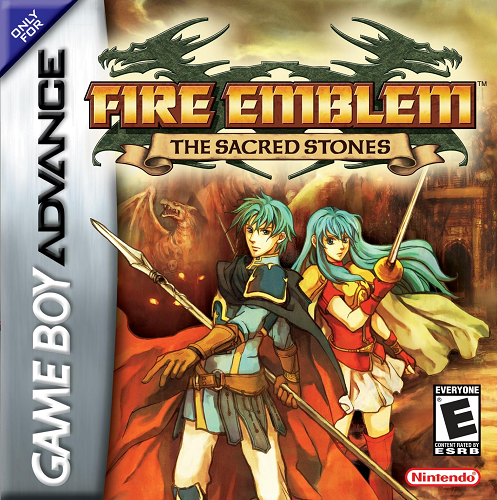
Fire Emblem 7 (FE7) was the first Fire Emblem game ever released outside of Japan, and it proved to be a huge critical and commercial success and was one of the best games for the Game Boy Advance (GBA). I was a huge fan of it myself and the game almost never left my GBA. It was a good time to be a portable gamer, I do say. About a year and a half later, The Sacred Stones was localized and released in the US, the second Fire Emblem to be localized, but in actuality the eighth entry in the series as far as Japanese players were concerned.
I remember reading about The Sacred Stones in Nintendo Power. Yeah, you bet I was fucking stoked. I remember Nintendo Power saying there were now classes that could use both weapons and magic. A load of shit, I soon found out. I don’t know why, but I got incorrect information from Nintendo Power about Fire Emblem games all the time. Did anyone actually check their facts? At no point in Sacred Stones‘ development was there any say or evidence of there being such a class. Propa-fuckin-ganda!
The Sacred Stones is obviously Intelligent Systems capitalizing on the new-found success of Fire Emblem in other countries. In Japan the game came out only 13 months after Fire Emblem 7. To my knowledge this was the shortest gap ever between Fire Emblem games. There was a two year wait in Japan between Fire Emblem 6 and 7. And let me say just now that it shows that Fire Emblem 8 was a rushed game. As far as game length goes, it is by far the shortest of three GBA Fire Emblem games, or hell, any game in the series, speaking relatively (as in, the NES games had an excuse to be shorter).
I’m not saying The Sacred Stones is a bad game, so just let me explain. How could it be bad? It’s fucking Fire Emblem! One of those series that has such good base ideas that it’d be pretty hard to truly fuck it up, and Sacred Stones certainly doesn’t do anything wrong. It just don’t do enough, at worst.
Fire Emblem is a strategy RPG series and the first of its kind. You move an army of soldiers and go from chapter-to-chapter completing certain objectives, usually defeating all enemy units. Good strategy is required to complete the stages, and game mechanics such as player characters permanently dying when defeated ensured that chapters were always intense and forced you to think ahead as to not lose one of your units.
It’s a series that rewards patience and thinking ahead, and is a very fair game—most of the time. If you want a more in-depth overview of how the series is played, please refer to my review of Fire Emblem 7, simply called Fire Emblem in countries outside of Japan. In this review, I’ll only be highlighting the things that changed from Fire Emblem 7 to 8.
Like most Fire Emblem games, The Sacred Stones features a storyline independent from other games in the series. The story takes place in a new continent with a completely different cast of characters. This time around your main characters are the prince and princess of the nation known as Renais; prince Ephraim and princess Eirika.
Right at the beginning of the game, the continent’s largest and most powerful nation, Grado, invades Renais while Ephraim is away. Eirika has to abandon her home and her father to the invading forces in order to escape with the experienced knight, Seth, and seek shelter and aid from a friendly nation. Of course, shit ends up hitting the fan and Eirika has to end up amassing an army to oppose Grado because it turns out there’s some underground plot that involves resurrecting an ancient dark god because this is Fire Emblem and this happens in literally every single game.
My first complaint with Sacred Stones is with the storyline itself. Even ignoring the usual Fire Emblem cliches: playing as royalty, a more powerful nation attacking other nations out of nowhere, the dark god or some other powerful monster resurrection; the storyline is still presented poorly for the series. It’s just uninteresting. There is no plot mechanic in Sacred Stones that hasn’t been done before in another Fire Emblem and better, or another JRPG in general.
The main objective of the heroes in The Sacred Stones is to go to each nation, which has its own Sacred Stone, and collect them all. You see, the nation of Grado wants to destroy all of these Sacred Stones because they are what is keeping the Demon King sealed, and Grado wants to use his power. That right there. The “go collect a bunch of magic objects that are keeping X thing sealed or needed to seal X thing.” That is one of the biggest, most boring cliches in the book. Everyone knows that. It’s just lazy. And you KNOW right from the moment these Sacred Stones are mentioned that by the end of the game the Demon King will still become unsealed and you will have to fight him as the final boss. It’s obvious.
But yeah, even with all those cliches in mind, Sacred Stones just doesn’t tell the story convincingly. Everything feels like a retread, very uninspired, and the main characters are absolute bores and impossible to care about. They did try and shake things up a bit by introducing a surprise villain and tried to make him seem like a guy who’s not so bad and was just misguided, which is nice because most Fire Emblem villains actions are completely evil and not defendable. But the villain is just so unlikable and such a drag and is just boring that it really doesn’t impact you in the way they probably intended. Plus, even though he had motivation for his actions that weren’t selfish, you can’t help but feel there had to be a much easier solution for what he was trying to do, making him look melodramatic and stupid.
What else is there to the plot? Honestly, not much. You know your objective right from the beginning of the game. The plot takes very few turns so there’s almost no building tension or suspense. The other villains of Sacred Stones are well-designed, but they’re just not as memorable as the Black Fang from Fire Emblem 7. In fact, they kind of remind me of a lot of villains from Fire Emblem 4… but I might be stretching that, personally.
I also find it funny that Eirika is literally Lyn from Fire Emblem 7 reincarnated. She has the exact same personality as Lyn and even the exact same kind of fighting style. Ephraim is basically Eliwood with more balls, which sounds good at first, but it makes him a much more boring character. Eliwood’s sensitivity was part of his personality, now Ephraim’s just this bread-and-butter go-getter hero whose best moments (like him taking on Grado alone in the beginning of the game) are not even seen by the player, other than one chapter.
There’s also a moment later in the storyline that everyone will know what I’m talking about where Eirika does something incredibly stupid for no good reason that nearly dooms the world. I won’t spoil what exactly it was, but it was pretty infuriating.
Actually, I did forget to mention one thing Fire Emblem 8 does differently in its plot. In addition to normal human enemies, there are also now monsters you can fight. The weakening seal on the Demon King is causing shit like zombies, giant spiders, hellhounds, gargoyles and a bunch of other shit to pop up all over the continent and wreak havoc on everything. That’s fine. I’m down with that.
But like, they really could have been more creative with the how the monsters fight. Not being limited to a human body or weapons they could have had a completely unique fighting styles that brought something new to the series. A variety of ways to move and attack. You know what I mean? The closest they came to doing something was making monster weapons (claws, fangs, etc) unbreakable and some having a poisonous effect, like the giant spider bites.
Some have magic spells they can use to petrify your units, but other than that, nothing. The monsters are also much weaker than human characters, so they are really boring to fight. That’s no fun. Everybody wants to fight big strong monsters, not little fleshy wimpy zombies for God’s sake. Naturally, you cannot recruit monsters to your side, but by using a glitch you can steal their weapons (which is pretty funny because they’re a part of their bodies) and give them to Myrrh, who is of the returning Mamkute class. Mamkutes are half-dragon and are able to transform and perform very powerful attacks with a Dragonstone, but once the Dragonstone is used up they are normally useless.
Other than all of that, I just don’t like the characters. I’ve already said the main characters are very stock, but so is the rest of the cast. As far as character designs go, the cast looks great. In particular, Joshua is my favorite male Myrmidon/Swordmaster in the series, for example.
The problem with the characters of The Sacred Stones is that everyone has a gimmick. In Fire Emblem 7 each character had their own personality that you usually got to learn through support conversations. In Fire Emblem 8, each character also has a unique personality, but its so pronounced. The characters felt very human in 7, but in 8, they feel like caricatures. Every character acts in such a specific way that they’re less likable. It reminds me of how the Phoenix Wright series went, how after the third game the character gimmicks overshadowed their normal, human personality and made them kind of annoying and difficult to empathize with.
Even underneath the gimmicks of FE8‘s characters there’s only a generic personality that has been done before. Fire Emblem is hardly a series known for particularly original writing or characters, its just extra noticeable this time around.
Another thing that really got on my nerves was that half the fucking cast had a nickname. I don’t think the writers realized this by the time they finished the game, but if you move your info cursor over a character’s name, a lot of them have a nickname. Gerik is the “Desert Tiger.” Marisa is the “Crimson Flash.” And all the villains are especially guilty of this. Valter is “Moonstone,” Glen is “Sunstone,” Reid is “Blood Beryl,” Selena is “Fluorspar,” Duessel is “Obsidian.” Like really? Cut me a fucking break. I’m sure I missed some, too.
Last but certainly not least, the biggest problem with Fire Emblem 8 is the pacing. Fire Emblem 8 only has 30 chapters. That is including everything. The route split in the middle and the one sub-chapter. That is every stage in the game. By comparison, Fire Emblem 7 has 31 chapters on Hector’s mode, and I am not counting any sub-chapters.
Even without the sub-chapters, one play of Fire Emblem 7 is longer than two plays of Fire Emblem 8 (the route split, remember). Because the game is much shorter, you can be assured that there is less plot build-up because they have to cram the storyline in less space.
They could have helped this somewhat easily by not even changing the game much. Just combine both routes into one game. Not only is this better because the player gets to use all characters at any given time, but it allows the plot more build-up. More stages also means more levels, which means enemies become stronger too, so the stakes keep rising and by the end you have a more powerful and memorable experience than you’d get by splitting the game apart for no reason.
It’s artificial game-lengthening because outside of the split route you’re replaying stages you’ve already done. It’s cheap and not worth the cost of a stronger main game. The first impression is always the most important, and its weakened when you have to uncover the entirety of the game by replaying the game again and playing a few new stages and seeing more of the game’s storyline you already know the outcome of, just in more detail. One thing I thought was especially weird was in the game’s only sub-chapter, 5x, you play as Ephraim. He even gets his own stage music which is never used in any other chapter of the game. Go figure.
While they already had that done, maybe they should have made a tutorial mode with Ephraim. Have the first ten chapters be played as him, like Lyn mode in Fire Emblem 7 trying to find out the truth about Grado’s recent strange actions. Then, by the time Grado invades Renais it will be later in the game. The player would be more involved with the story and this would be a more significant twist.
It would also surprise the player even more because it would suddenly shift the player from controlling Ephraim to controlling Eirika. The player will want to keep playing to find out what happens to Ephraim and the switch to a new character will keep things interesting and help the player not get bored with the storyline. This could also tie into my complaint about wanting to get rid of the split route. A 10-stage tutorial and 29 chapters after would make the game much longer than the predecessors.
While this is a good thing, its unnecessary because the storyline doesn’t have the depth as is to justify such a long game and we’re trying not to change things too much. By just changing a few events in the story chronologically and not actually altering any of the end results of those events so the plot and what happens still remains the same, you can still get rid the split route chapters and instead work them into those first 10 tutorial chapters.
You can even use some of the same maps, just obviously dumb down the enemies a bit to account for lower levels. By requiring almost no extra work to be done, The Sacred Stones now has a plot with better pacing and more suspense, which of course also makes completing the stages more rewarding because the player will get to see more of a storyline they hopefully care about now and are invested in. Bam. Give me money.
Of course, there are still no sub-chapters which helped add more detail to the plot of previous Fire Emblem games, but that’s different, as that would require more effort on Intelligent Systems’s part. Effort they SHOULD have put in though, because a higher standard was set by Fire Emblem 7 which was on the same system and used the same game engine.
Ideally, Fire Emblem 8 should have fixed its pacing in the ways I explained and added sub-chapters to give the story more depth, flesh out the characters, and help both not feel as dull and cliche. This should have been done by simply spending more time on the game instead of releasing it in a rush to grab more cash from (primarily) the western market. A little integrity is all I’m asking for. The audience was still gonna be there by the time the game was released. In fact, the game came out in May.
If they released it in December, they would have gotten the sales boom from the holidays as well as having more time to make the games better and actually earn their revenue. Know what I’m saying? Fire Emblem 8 was the final Fire Emblem game released for the GBA and should have met the standards the previous games set, if not exceeded them.
But, wait! What about the changes Fire Emblem 8 made to the series gameplay? Maybe they’re good enough to redeem the game? Maybe the game pushed all the boundaries in gameplay and that’s why the game length and storyline were more ignored than usual. Well, unfortunately, that’s not really the case. The changes Fire Emblem 8 makes to the series are very minor and now that I think about it, none of them were ever used again. To the game’s credit, that’s kind of a bad thing because there were some good ideas here.
The biggest and best change was the addition of class trees. When you promote a character, you now have a choice between two different classes. For example, the Mercenary class normally promotes to the Hero class, but now upon promoting you can choose to promote to either the Hero class or the Ranger class.
The choices are, of course, different depending on the class promoting. A Myrmidon can now promote to either a Swordmaster or a Assassin, for example. There’s only one problem with this idea. It’s hard to get the benefit of a game with more depth from class trees because the classes in Fire Emblem 8 are as unbalanced as ever.
Every single promotion choice has a class that is clearly superior than the other. Why would you promote an Archer to a Sniper instead of a Ranger? Not only do Rangers have access to swords, which aren’t the worst weapon in the game, but they also are on horseback, which is a humongous advantage to any unit. Snipers have the advantage of an increased hit % with their class skill (more on that later), but any character who can become a Ranger has naturally high hit, and swords are the easiest weapon in the game to hit with.
The Swordmaster vs. Assassin choice has a similar issue. The only advantage Assassins have over Swordmasters is the chance of dealing an instant-kill on a critical hit. As I said in my Fire Emblem 7 review, most units are going to kill anything in one shot with the triple damage from a critical hit anyway, and because Swordmasters get a critical chance bonus, they are still going to end up killing more units than an Assassin will with their special skill.
Assassins can also use Lockpicks to open doors and chests, but there are so many other ways to get those open that you will never need an extra Assassin to do so. Even if you did, it probably wouldn’t be worth it. While the class trees aren’t as good as they could’ve been, that is not a fault with the idea itself (which is a great idea), but with a general problem with the series that’s been around forever.
The class tree system is progress, which is enough to make me happy, but there needs to be more refinement in the classes themselves before it can be used to its full potential. As it stands, all it does is give more personal choice to a player. Maybe someone just has more fun using Assassins than Swordmasters? That’s fine. And this is a good thing for them, because now they have more options to use a team of their favorite units, and I do think that’s the most important thing.
It just would be nice if the system favored both sides and thus made everyone happy. Players would have to think more about their team and who to promote and what to, and people who just wanted to use their favorites wouldn’t feel screwed over, I guess I’d say.
As I briefly mentioned above, there are also more class skills this time around. The GBA games took the innate character skills of Fire Emblem 4, removed them, and turned some of them into skills that were specific to character class, like the Swordmaster and Berserker classes getting a critical bonus. Not all classes have a special skill though, and they still don’t, but there are more. Unfortunately, none of them change gameplay much.
Snipers sometimes have a skill activate that makes their hit 100%. This is almost totally useless, like I said. Anyone who is or can become a Sniper will have naturally high hit % and even moreso than other classes or weapons because they are never at a weapon triangle disadvantage. This skill will likely never activate when you need it, if you ever even do need it, so it’s useless. The Sniper class is still by far the worst in the entire game.
Bishops now deal x2 damage to monster enemies with their Light magic. Only issue here is that monsters already have very low resistance so the Slayer skill is just overkill. There are some boss monsters very late into the game where the Slayer skill can possibly come in handy, but by then you have a bunch of ways to dispose of those sorts of enemies.
The Slayer skill is meant to be the class’s advantage over the other possible class choice, which is the Sage class. But the Sage class can now use both Anima and Light magic and also has better maximum stat caps, so the payoff is not equal.
The new Wyvern Knight class has a Pierce skill that can sometimes nullify an enemy’s defense, which is cool but does not justify getting the higher stat caps of the Wyvern Lord class and being able to use swords. Also the game freezes if you’re watching animations and your Wyvern Knight does two Pierce attacks in a row. How the fuck did they miss that? That’s a big fucking deal considering the game auto-saves. You have to restart if that happens.
The last skill I can think of is the General’s Guard skill, which occasionally completely nullifies an attack. The chance for this to happen is based off your skill stat, which Generals rarely have much of, and it’s not very useful considering Generals will block most attacks with their high defense anyway.
This is only really useful against blocking magic attacks, but that’s too situational. The good thing is is that the other possible class, the Great Knight class, does not have a big advantage over the General class. One more move and access to all the same weapons, and slightly lower max stats. That’s as equal as class choices come.
There are also some changes to old classes. The skills, as mentioned. Generals can use swords again like they were able to do in older games. I’m in favor of this because Generals need every advantage they can get to justify their terrible movement.
Sages can now use Light magic which is a little unnecessary and I think makes them a little less “special,” but whatever. Statistically there isn’t enough of a difference between Anima and Light magic to really benefit from having a choice of both, and there are barely any enemies in the game that use Dark magic for some reason.
Druids can now use both Anima and Dark magic. My thought on this is mostly the same as the Sage, but Anima is actually a useful alternative to Dark magic because Dark tomes are very heavy and magic users have low constitution, so that’s good, at least.
Paladins can no longer use axes to account for the new Great Knight class, which is fine because Paladins are way overpowered. Valkyries now use Light magic instead of Anima magic. I’m fine with this, another class that can use Light magic is good. It also makes sense considering the Valkyrie characters in this game are very pious. I think that covers all the changes made to old classes.
There are a couple of new classes, but nothing really interesting. Pegasus Knights and Wyvern Riders can choose to promote to the new Wyvern Knight class, which has the Pierce skill. This is the obvious superior choice for the Pegasus Knight considering the higher stat caps, but then you can’t use the special Triangle Attack with the three Pegasus sisters in the game. The Triangle Attack isn’t very good though, so whatever.
Cavaliers and Knights can choose to promote to a Great Knight instead of their normal classes. Great Knights have an average six Move but access to all weapon types and good maximum stat caps. While a boring class aesthetically, it is the best addition as far as gameplay is concerned. It’s a mostly equal choice when compared to the Paladin or General class and helps not make the Paladin class so dominating as it was in all the other Fire Emblem games.
The Mage Knight class is pretty much the Valkyrie class from the previous games because you get a horse and can use Anima magic. This was the class Nintendo Power said could also use weapons. It can’t. It is also the superior choice to the Sage class because there’s little advantage to being able to use Light magic instead of Anima magic, and the additional move from the horse as well as the bigger constitution bonus from promotion means that you can reach other units faster to heal them and hold heavier tomes without as much speed loss.
I think the last truly new class is the Summoner class. Summoners can only use Dark magic and Staves, and have lower stat caps than Druids, but can summon Phantom units to the field for you to control. Phantom units are weak, only have one point of HP, can only use axes, and only have five Move. You can also only have one on the field at the time, so that’s not very fun. Needless to say, the Druid class makes the Summoner class almost useless.
Well, there’s also the Trainee classes. Those are new. You get three Trainees in the game. One that uses axes, one that uses lances, and one that uses Anima magic. Trainees start out incredibly weak but gain EXP fast. Once they hit level 10 they will automatically promote to a new class on the next stage, and you will of course get to choose which depending on the unit type.
The classes you choose from are the normal base classes for another units, the ones that can promote into another class. Because of this, Trainees technically have 50 levels for growth and will usually end up as the strongest units despite having to have more work put into them.
My only question is this: how is this any different from other Fire Emblem games where you get a low-leveled unit late into the game that while taking more time to raise, ends up with better stats than other units due to ridiculously high growths? It isn’t. This is only an aesthetic change, not a true addition to the series.
The final fucking difference of Sacred Stones is the world map system. You follow a linear path like always, but you can go and fight optional battles on old maps where monsters have spawned for more experience. This means that technically experience is completely unlimited and you can max out every character’s level.
There are two optional dungeons the player can visit for similar reasons called the Tower of Valni and the Lagdou Ruins. These were Intelligent Systems’s excuse for the shorter main game. These optional dungeons which are full of nothing but monsters thrown randomly all over extremely plain-looking stages that are poorly-designed and require no strategy due to most of them being open areas with no special terrain types.
Each area has eight total stages and at the bottom of each one is usually a rare item like a gem that can be sold for money. This is a poor excuse for game lengthening because these stages are super fucking boring to play and require almost no strategy. They are simply time-consuming. Because there is no storyline or anything interesting that would make you want to play these stages like normal chapters, the only reason you ever would play these stages is for experience points you don’t really need or to get the Trial Map characters.
After beating the game, you can play “Creature Campaign.” There are no more chapters you can play, but you can travel around the world map fighting randomly placed monsters on old stages that will easily fall to your super powerful end-game characters. Yay! Isn’t that fun? It’s not, trust me.
By beating the two dungeons repeatedly you can unlock characters you can use in this mode. These are usually boss characters and other NPCs you normally can’t play as. Unfortunately they are very weak and the only one really worth getting is the final one, who is the final boss who comes with his special weapon with unlimited uses and his own class.
That’s kind of cool, but it’s not worth getting him just so you can use him on these generic stages fighting hordes of weak monsters. Plus, you have to defeat each dungeon up to three times to unlock every secret character. Again, artificial game lengthening. It’s not like the dungeon gets harder each time you beat it. If you’ve beat it once, you can fucking do it again. Just more wasting of your fucking time for a reward that isn’t really a reward.
And you can’t do this forever, mind. Eventually all of your weapons are going to break and you’re going to run out of money. Monsters sometimes drop bags of gold, but the amount is hilariously pitiful, like ten gold (not even kidding). Your only hope is to keep getting the gems at the bottom of each dungeon and selling them for money, but it’s truly not fucking worth it. You can’t even use the secret characters in the Link Arena, which is bullshit because they have no particular advantage over any other character that justifies not allowing them to be used (in fact, their stats are awful).
This whole mode is a joke and instead of working on it at all they should have just added a sub-chapter for each floor of the bonus dungeons they removed. Again, requires little more work than what was already done and improves the game a lot. One thing I found weird is that there is one spot on the map where monsters can spawn and you can fight on a map that is used nowhere else in the game. It’s still boring, but it’s just weird. This is the regular world map too, not the dungeons. Why code that map in if you’re not going to use it for anything? Why not make it another chapter considering how fucking short the game is already?
And this segues into the biggest complaint people have with The Sacred Stones: the difficulty. This is, by far, the easiest Fire Emblem game ever made. There’s almost no challenge. This is Fire Emblem for babies. This was because everyone complained about the last Fire Emblem game being too hard, when in fact it was just fight and probably had the most balanced difficulty out of any Fire Emblem game.
Now, enemies are weak as hell. Their stats are hilariously low throughout the whole game and you can just absolutely mop them up, and like mentioned experience points are unlimited on the bonus maps. On the bonus maps you can retreat at ANY time during the map. You don’t even have to clear it. There is no risk for an endless reward.
As if that wasn’t enough, the growth rates for the characters in Fire Emblem 8 are the highest in the series. Jesus. I think I’ve made my point. Oh yeah, I haven’t said it yet but I like how one of the lords uses lances as his primary weapon. Just wanted to say that. Game’s still super easy though.
Oh, and I didn’t even mention that they ADDED an easy mode, even with all of these changes. If you still need that, you are the worst. There’s a hard mode too but it’s barely harder than the normal mode of Fire Emblem 7. And that’s only if you don’t abuse the unlimited experience points.
I beat the hard mode of this game and the only time I remember being frustrated was the chapter covered in fog late in the game. You know the one I mean, if you’ve played the game. Due to the game’s easy difficulty, you feel less accomplished for beating a chapter. And because it takes much less work to do so, it makes an already short game go by even faster.
Fire Emblem 8 just has a weird feel to it. It almost feels like a fan-made Fire Emblem game, just with really good production values. I attribute this to the really generic story, characters, poorly designed game mechanics, and overall lack of professionalism.
When you get right down to it, that’s what it is: a game for the fans. It was released for the fans to get their money. Sure the graphics are a little nicer and the class branching system is progress, but everything else either fails to live up to a standard set by its predecessor or is a change that does not benefit the series at all. There’s even less music tracks in this game than the last one. And wouldn’t you know it, they got rid of the best thing about Sacred Stones (class trees) in the sequels.
Fire Emblem has always been one of those series where the pieces to the best possible game are scattered throughout different games in the series. It’s generally a series that goes two steps forward and one step back. In the particular case of Sacred Stones though, it goes one step forward and like, ten steps back. Thank god this turned out to not be a trend and we got a worthy successor and future to the series with Fire Emblem: Path of Radiance for the GameCube, the ninth installment.
It’s natural to be very disappointed by it, but despite being terribly flawed, Sacred Stones is a game I still enjoyed and do not regret playing or purchasing. I’ve beaten it several times and I’m sure I’ll replay it in the future. It just brought the least to the series out of any of the games and is not the quality you’d expect from the series given the seven games that came before it. Disappointing, but the addicting tactical gameplay is still at the core of the game, even if it isn’t brought out very well by game elements surrounding it.
Leave a Reply