





It’s not easy making people who aren’t Nirvana fans understand. In fact, I’m inclined to say it’s downright impossible. You have to hear them at just the right time, at just the right moment in life to feel what they’re trying to say in their music. For a comparison, it’s like The Catcher in the Rye. Understanding its greatness is directly equivalent to how much you empathize (not necessarily agree, though there’s a correlation at first love of the book) with Holden Caulfield. I choose this example because they’re both prime representations of teenage angst and alienation in popular culture through different mediums, and because Nirvana rely heavily on literature through their lyric writing as well.
Now, I’m fairly young (21 as of writing). Guitar Hero II came out when I was 13, and as far as I can remember, that’s when I first heard Nirvana. Heart-Shaped Box was the song, and it was one of my favorites to play. Funny enough, that cover was terrible when I look back at it. The vocalist’s drawl practically turned it into alternative country. When I looked up the original song there was a time where I stuck to the cover out of familiarity. Blech.
When I got a deeper interest in music and started to listen to full albums instead of passively hearing songs on the radio, I decided to check out the Nirvana discography because they were a pretty big deal or something. Ignorance caused me, as ignorance often does, to pretend I knew more than I really did and immediately disregard Nirvana as “angsty music” for the “emo crowd” due to a large section of their fanbase, with little separating them from bands like Green Day (whom I also found out also had some good tunes) and, uh… what’s another popular band I hadn’t listened to and assumed were bad through annoying fans? …Fall Out Boy. Yeah. Fall Out Boy. Nirvana were like Fall Out Boy. Q.E.D. “This is going to be so annoying, but at least it’ll be educational,” I thought as I started Nevermind for the first time.
I was floored. My tastes were never the same. Nirvana had done for me what they had done to the world in their time. Out with the hard rock, and in with the alternative (hard) rock. Gone was the classic rock superiority of my younger days. I resisted at first, convincing myself it “was just dime-a-dozen pop rock,” but in reality this was platinum material. I couldn’t be without hearing “Smells Like Teen Spirit,” “Come as You Are,” “In Bloom,” anything for any long period of time.
Nirvana became my drug, and I started every day with my fix. Here was a band that wasn’t just playing music that touched me, but music that spoke for me. Kurt Cobain sang about vague, often repulsive subjects, but for some reason it all made perfect sense to me. They were the emotions I was feeling but never know to express. Turns out I was one of those “emo kids.” Actually, I was extremely angry, depressed, and lonely, without close friends and cycling through therapists whose words would simply bounce off me. I thought I was alone, but for once my life I truly realized I was going through what many others go through, or in this case, have been through.
I’m going to use the cop-out excuse of “it’s near impossible to explain” again when it regards Nirvana’s lyrics, but this time I mean it doubly. I don’t connect with Nirvana’s lyrics anymore like I did when I was at peak fandom. Asking me what they meant now is like asking someone to translate a foreign language that they haven’t spoken in years. My attitude and ways of thinking have changed a lot since then, so Nirvana are no longer my emotional mediator.
Still, Nirvana spawned my love of obscure lyrics. Generally, I have a distaste for lyrics that are literal, that try to tell stories and things like that. I find it much easier to connect with lyrics that have ambiguous meaning because it’s easier to wrap those loose words around your own experiences and create your own interpretation. Lyrics that are too literal are like stone for me and difficult to pass through.
Even still, there are good obscure lyrics and bad obscure lyrics. I love the band Blondie, but their lyrics are typically slapdash and lack perceivable meaning. Kurt Cobain actually is trying to express something. It’s something deeply internal, and like I said before it’s something that can’t be expressed through conventional sentences. Cobain doesn’t say how he feels through direct statements, but rather through the vocabulary he chooses and the natural connotations of those words, often stringing together phrases that seem meaningless when taken literally but still convey a general feeling of disgust, alienation, disillusionment, or general apathy.
The dissatisfied groan he inflects on every word only strengthens the intent. The theory about good/bad obscure lyrics supports itself, really. Going back to Blondie, millions of people speak of how Nirvana’s lyrics affect them, but as for a band that’s particularly popular in their own right, when’s the last time you ever heard someone say they identified with Blondie’s lyrics? Never?
But enough talk about depression and all those grey things. Nirvana didn’t present themselves as a group of burnout sadsacks. Nirvana were equally fun. They were downright badass. Nirvana were the last rock band in popular music to truly not give a fuck. For some reason the punk fans have denied Nirvana as a punk band (despite being such an undeniable thing), but it takes some guts to go on Top of the Pops on national television and deliberately give an enthusiastic crowd one of the worst performances of all time… but people loved it.
It was hilarious and infinitely more memorable than a typical live performance of the song would’ve been. Popular media-darling bands just didn’t do things like that, and they still don’t do things like that, and most importantly it was a huge middle finger to the tight suits of the world. How classless! Don’t you want to be just like them? When you’ve been rejected enough the only response left is to take pride in it. Nirvana helped the meek inherit, ironically through not being meek at all.
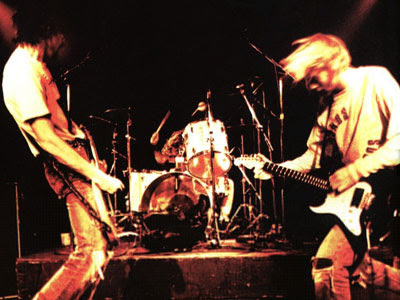
Kurt Cobain was a kickass guitarist too. He couldn’t play a power metal solo or anything like that (or even his own solos), but he could convey feeling through his instrument with the best of them. There’s more to playing a song than written chords. There’s a certain tone to the guitar and a way of strumming and pressure on every chord that ensures no single chord sounds exactly like another.
It’s like a guitarist’s fingerprint. People who deride Nirvana like to say things like “anyone could play a Nirvana song,” but ignoring that that’s simply not literally true, it’s a lot easier to say you can play a song when someone else has already played it for you. Just listen to the rippling chords of Nevermind, bored and moaning in an empty room, moving away from anything else that gets near them.. but then all of a sudden they get upset, loud, and angry.
Where did it come from? Maybe they were always upset and got tired of bottling it up and pretending they didn’t care. There’s certainly something darker under their apathetic demeanor. On In Utero those chords return, but they never found the right outlet and the enabling of their anger has given it an atmosphere where it can boil over. The short angry outbursts have become the standard, indiscriminately yelling at everything in sight and occasionally shaking, breaking down and weeping from lack of direction. If Nevermind‘s chords are the sound of someone trying to avoid coming to terms with their depression, In Utero is the sound of that neglect that has dissolved the outside barrier and is now bleeding out of a broken wound.
Kurt Cobain is the voice of a generation, but people take that claim the wrong way. He’s not the voice of “generation X” or whatever the hell, he’s the voice of something more universal, an entire age group and mindset that’s always been a part of human life and culture. Nirvana have remained immensely popular since their conception and continue to rope in new fans every year, and they’re almost always teenagers. They weren’t just for the ’90s. They weren’t just for “grunge.” Hell, weren’t just for people who are now in their forties. They’re for everyone
Every day another teenager going through their apprehensive phase hears Nirvana for the first time and discovers they’re not alone. Nirvana helped me through a very difficult time in my life, and I’ll never, ever forget that. It was a more personal relationship with a band than any other I’ve had. You might have never gone through the teenage angst phase, or maybe you did but you’re past it now and you find Nirvana equally passe, don’t sweat it. Nirvana are there for people who need them. If you’re not one of those people, then go search for some other music you belong in.
In thousands of years of music history, few artists have arisen that have proven to be important to the development of music through innovation and influence. Nirvana were of an even rarer breed. Nirvana weren’t just important for music, they were important to humankind itself.
Album Ranking: Nevermind > In Utero > Incesticide > Bleach
Top 5 Songs: “Smells Like Teen Spirit,” “Come as You Are,” “Heart-Shaped Box,” “Lounge Act,” “In Bloom”
Leave a Reply