








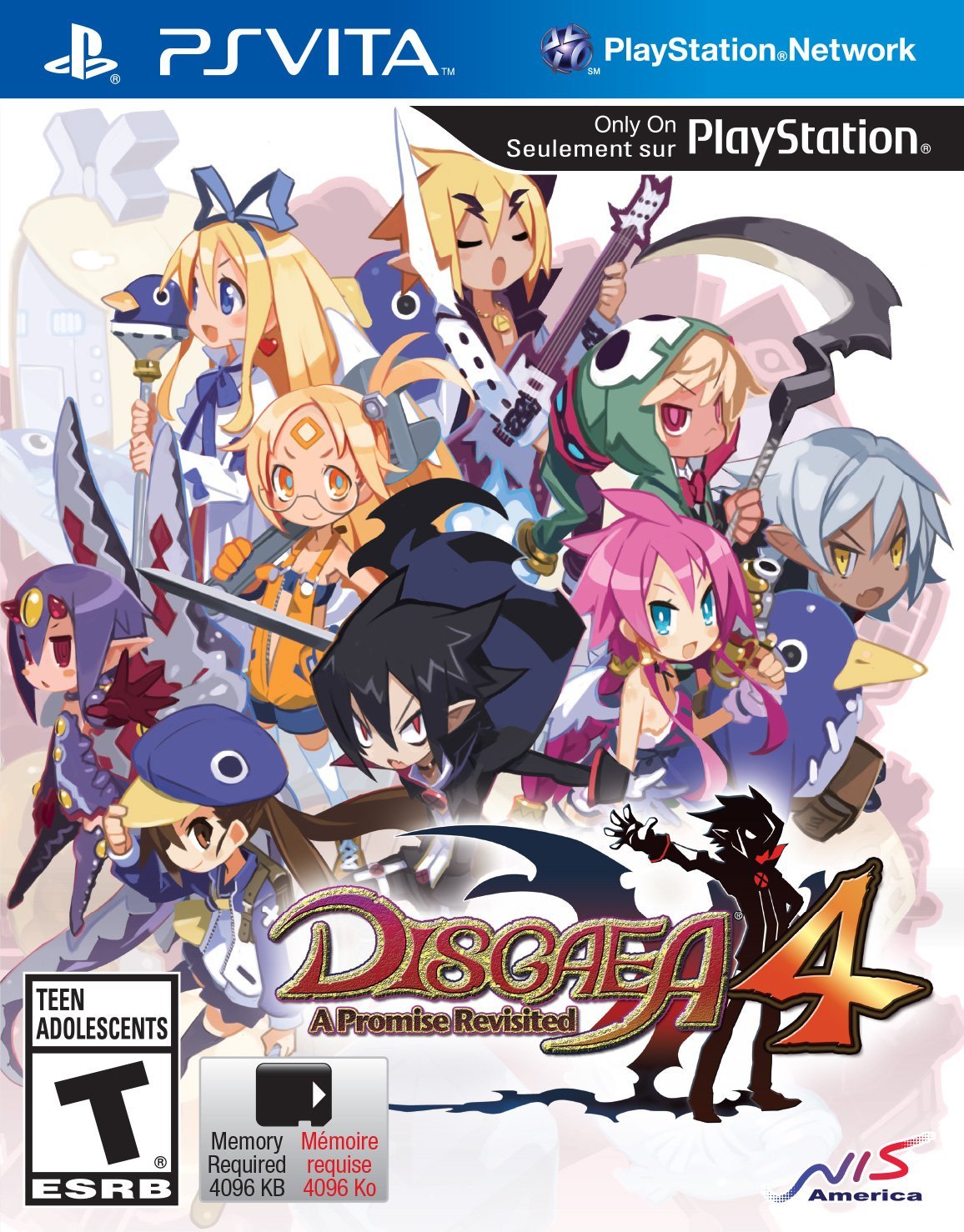
NAME(S): Disgaea 4: A Promise Revisited / Disgaea 4: A Promise Unforgotten / 魔界戦記ディスガイア4 / Makai Senki Disugaia Fō / Disgaea 4 Complete+
PLATFORM(S): PlayStation Vita
DEVELOPER(S): Nippon Ichi Software
PUBLISHER(S): Nippon Ichi Software (Japan) / NIS America (Worldwide)
GENRE(S): Strategy RPG
RELEASED: January 30, 2014 (Japan) / August 12, 2014 (North America) / August 29, 2014 (Europe)
The last Disgaea I played was technically the PSP port of Disgaea 2. I don’t say it much, but Disgaea 2 is one of my favorite games ever made. There was a long period after playing it where I downright called it my favorite ever, and while old favorites ended back on top with some distance because they’ve proven themselves to be more rewarding, I still hold Disgaea 2 in extremely high regard. Out of all of Nippon Ichi Systems’ games, Disgaea 2 is the most well put-together and has the company meet all of their quirks in one game and polishing it to the point that it was clear the company was past their amateur days.
Why am I bringing Disgaea 2 up? Because playing the bevy of additional stories added to ports of the PS2 games and realizing how awful they are, going back to the old games, and seeing where even more serious attempts like Disgaea 4 fall short has given me newfound appreciation for NIS’s glory days. Disgaea 2‘s writing is unique to NIS upon investigation but at a first glance seems perfectly in-line with them. In actuality they have never before or since tried to balance a serious story (in the sense that there are goals and risks) with blatant absurdist comedy.
NIS has done dramatic stories like Phantom Brave and Soul Nomad, but both of these are very, very low on humor and are opposed in tone: Phantom Brave is warm and friendly, Soul Nomad is bleak and apocalyptic. For all of Disgaea 2‘s constant gags it manages to keep half of itself in reality and make its plot and characters feel real. They all have an insane perspective as a result of being in such a ridiculous world for so long, but deep down they have humanoid traits and actual self-awareness, the latter being almost entirely absent from any other Disgaea game.
Better yet, it often directly relates the jokes and the reality. In the very first scene of Disgaea 2, Adell’s mom is using her family’s life force as ingredients for a summoning spell. Taken seriously, this is a very severe thing, but Adell’s mom laughs at it off as a joke “because [she] IS a demon, you know”, and Adell sarcastically calls her a terrible mother.
Playing serious things off as an inconsequential joke is something you see all the time in Disgaea, but Disgaea 2 does something different with it as a result of being more ambitious: shortly after the game starts you get another cutscene where Adell explains to Rozalin how awful it is to have his human world turn into a demon world, not because it’s grotesque and more violent like initially assumed, but because it also changes the personalities of everyone he knows into amoral monsters. All of a sudden that initial scene actually means a lot more to the setting and plot motivations, and it actually gets to have its joke at the same time.
There are a lot of small details in Disgaea 2 like this that give it a light Gothic touch, but it never makes any of this too blunt which would make the whole thing tonally awkward. This evidently succeeded, as Disgaea 2 is mostly remembered as a game written in-line with the rest of NIS’s work and is seen as another fairly light-hearted and colorful outing. Which it mostly is, and all the great for it because that’s NIS’s style and it’s wonderful, but it has some twistedness to it that isn’t just the result of irreverence as a joke.
There are a lot of cool moments in Disgaea 2 as opposed to just goofy ones. One that I recently realized I never thought about was that the background image when selecting an optional super boss is an otherwise unused picture of a vast wasteland with a bunch of laying corpses and weapons sticking out of them. It’s suitably ominous, and that’s what’s so fascinating about Disgaea 2‘s atmosphere and writing. It can be unexpectedly ominous without losing itself in it, which gives its world an intriguing pull to it.
Disgaea 2‘s plot itself doesn’t approach the greatest depths in video games, but it takes all of a developer’s unique strengths, puts them in one game which would never be done again, and becomes their most special game because of that. Again, why am I bringing this up? Because Disgaea 4‘s plot sucks. But it curiously sucked.
When you imagine bad NIS writing you probably jump straight to really cringeworthy jokes about flat chests and stolen panties, but Disgaea 4‘s writing isn’t really embarrassing in that sense. It’s just completely boring and uninspired, coming from a developer with some of the greatest imaginative minds of its generation that were so amazing at what they did because they had complete confidence in the virtual worlds they created, never fearing to be too eccentric or unapproachable.
Disgaea 4‘s plot begins with the vampire Valvatorez and his loyal servant werewolf Fenrich. Valvatorez used to be an all-powerful demon who lived life however he pleased, but his extremely noble personality he still holds on to caused him to make a promise he can’t undo: he can no longer drink human blood, and thus has lost almost all of his power and shrunk down to a skeletal frame. Fenrich somehow still believes in him and supports him like an insane fanboy, but is incredibly rude to absolutely anyone else. Val works in the underworld as a “Prinny Instructor,” teaching newly dead members of the Netherworld how life works down there.
This is actually all quite a promising start. The immediate thing to notice is that Disgaea has roped some of its identity back in aesthetic design. After the first game, the series capitalized on the random, absurd aspects of its setting and became kind of a wild hodgepodge of fantasy tropes in Disgaea 2, and then tropes of whatever they wanted in Disgaea 3. D4 gets back in touch with the Halloween-inspired horror of the first game, initially bringing it to even more distinctive levels. The first two main characters are a vampire and werewolf, which is great, and the setting they work in looks like a very traditionally simple rendition of Hell, complete with lava, cobblestone, and chains. The Gargoyle monster class is suitably brought back as well, even though they forgot the Jack Skellington-inspired pumpkin men.
But hints of what’s going to go wrong throughout the game are dropped immediately. Most of Disgaea 4‘s humor in the storyline’s writing has NIS giving into their actual worst writing trait: run-on gags. Valvatorez’s is that he’s obsessed with sardines. Yes, the fish. Why? Because for reasons never elaborated on Val believes them to be the greatest source of nutrition possible. This kicks off an endless assault throughout the game of Val shouting the word “SARDINES!” at people and bewildering them, and going off on tangents about sardine facts.
They can change the actual sardine fact all they want, but the punchline every time they do this is exactly the same. The joke is that none of us or the people in the game care. They got so wrapped up on mining the latter that they forgot how true the former was. I feel like I shouldn’t have to explain why a joke gets less funny the more used to it you are, and even more so when it’s not used sparingly enough to seek out the proper timing, but I’m well-aware this sentiment is not actually common. You’re on the internet; you know what a meme is.
Every single character in Disgaea 4 has a personality gimmick or run-on gag. Notice how I used “gimmick” instead of “trait,” because there is a difference. Let’s go back to Disgaea 2. A main character of that game is Rozalin. She has an archetype to be sure: she’s a haughty princess, self-absorbed, and condescendingly mocks everyone for much of the game. This is her personality. She’s a person, and these traits color all of her dialogue to a certain flavor because that’s what a strong personality is.
Valvatorez and company also have personalities. Valvatorez’s can be very endearing. He himself is somewhat of a royal type, but unlike Rozalin he’s extremely charismatic and noble. This is uncharacteristic of a demon and why Valvatorez has this perspective however is never explained, unlike Rozalin who has a reason because of her upbringing. What also separates these two besides more attention to background detail is that aforementioned gimmick. Val’s is the sardine bit. This is never used sparingly, so not only are you frequently bombarded with a pre-worn joke, but this pushes opportunities to flex his actual personality in cutscenes and between other characters out of the way.
Let’s assume writing and dialogue in a game are always limited, because in a sense, due to budget and deadlines, it pretty much is. Then we realize how frustrating it is that NIS chooses static sardine gags other than genuine jokes as a result of eccentric characters in constantly changing circumstances that could naturally co-exist with dialogue related to the plot.
A personality trait is a flavor that you can mix with anything and get moderately different results depending on what you mixed it with. A gimmick is an already-constructed meal that naturally tastes the same every time. Fittingly, it’s a comfort zone, a tether for every character to identity themselves with for the audience, instead of letting the audience assume their own more rewarding meaning and humor from more complex jokes where every connotated word of dialogue means something to the joke’s set-up.
It’s an extremely lazy thing to fall back on, which makes it all the more annoying because some of Disgaea 4‘s characters are already likable enough with their actual personalities. What they actually put effort into constructing is good, but NIS feels the need to push it out of the way for a lowbrow pedestal they don’t need. In all honesty, they were probably simply trying too hard to be what the fanbase’s perception of them is. Which almost never benefits any writing because it’s forced, like forcing sardine jokes into dialogue as much as possible.
Almost every single main character in Disgaea 4 has a personality gimmick. Val has sardines, which was already covered. Fenrich has his “all is for my lord” catch phrase, but this barely works as a joke on its own so it’s a minorly tedious thing. For the most part, Fenrich is one of the most well-rounded new characters, and his consistent disdain for everyone other than Val stays amusing because it’s a natural response from him and deserved/expected from him whenever it’s brought up in dialogue.
Similarly, Fuka is very likable. She’s also self-absorbed and rude, but in a more passive way in line with her teen age, and she and Fenrich give the plot the very little serious perspective it needs by having mostly believable responses to everything. Unfortunately, Fuka has her own gimmick in that she’s constantly remarking that she believes everything is happening in her dream and that she never really died. This is easier to ignore than Val’s sardine interjections, but it’s nonetheless worn-out quickly and not sensible in any context of the storyline. The joke is Fuka believes this is all her dream but this contradicts her role in the storyline where she is clearly treating everything seriously and with full attention.
Ignoring the simple fact it’s just plain stupid to keep this gag up after the character’s been “dreaming” for one hundred hours, it would’ve been better to just let it lie because it doesn’t play off Fuka’s general personality. It’s a contradiction, but NIS keep appealing to their fans’ baser instincts anyway.
But this never gets any worse than with Desco. Desco is the worst character ever in a Disgaea game (think about what that means). Desco is a living weapon created to be a “final boss.” Without spoilers, that title doesn’t even match Desco’s true intended role that’s later revealed, so we have another contradiction although much more slight.
Desco’s character design is great, that of a harmless little girl but with very monstrously grotesque features more suitable of what she’s supposed to be, but no one is more dominated by their gimmick than Desco. Every, literally every line of dialogue Desco gets, is the same joke. Either that she’ll “do anything for her big sis” (Fuka) or something about how she wants to be a final boss. “Ooh, fighting this boss will get Desco closer to being a final boss!,” or “Oh, the power of love! Desco must take notes because she is a final boss!”
You get the idea, and yes, as if matters couldn’t get any worse, Desco always refers to herself in the third person. Desco is not a character, Desco is a joke. If Val inserting sardines into dialogue was egregious, then we have that same principle on a much greater scale by virtue of being a part of every scene. Every Desco interjection is inherently fourth-wall breaking because of the final boss punchline, which is harmful to the world’s cohesion and since every line she has is this joke you’ll hear it at least once per cutscene. Desco has no motivations besides this thing the game only jokes about and blindly following what Fuka decides to do. She’s as bad as Nippon Ichi Systems writing ever gets. If she ever got mad over her flat chest, we’d have the full package of awfulness.
Even better is that there’s a direct 1-for-1 example of this same joke existing alongside a full personality. In Makai Kingdom, one of the first characters introduced is Dark Lord Valvoga. But there’s a twist to Valvoga. That’s not really who he is. Valvoga is brought up as someone who’s summoned to other Netherworlds to “act as a final boss character.” When you look at him he’s even intentionally designed to look like a generic final boss. He’s big, menacing, dark colored, and has three separate faces that you’d probably target individually if you were to fight him because one of them keeps fucking healing the main core or something.
But in Makai Kingdom, that’s the end of the final boss joke even though the punchline is the same as Desco’s for the entire game. It’s funny, and that’s all that’s needed. The main joke is how the game goes even further to make fun of how Valvoga is made up of three separate parts that are forced together. The biggest, top part that controls the body is actually named Micky who’s effeminate and sensitive, and is easily bullied into doing what the other two parts of his body want who have their own personalities. It’s brilliant and has a lot of potential for a variety of dialogue and jokes, and yet it’s still all based in that final boss concept design.
The remaining two characters in Disgaea 4 are Emizel and Artina. Emizel is a spoiled brat and a recurring boss in the beginning of the game. He’s the son of the Netherworld’s president and acts entitled and all-powerful because his father is. Okay, that’s fine, but in this instance we have no joke whatsoever. Emizel is bland at best and annoying at his worst, and he never becomes anything interesting. His only role in the writing is to act as the story’s straight man, but Fenrich and Fuka do that well enough while being more entertaining, so he’s only slightly less useless than Desco.
He’s also supposed to be Death, like THE one and only grim reaper, but he’s only shown to do this role twice in all of the game’s cutscenes, and if this is an important job then why is he sent to hunt Val? You don’t need to be Death to kill anyone in Disgaea as we already know, and if there are things unique to what he can do then why is he wasting his time doing the things that aren’t? What does Death do in the underworld? Everyone’s already dead. None of this makes any sense or was thought out at all.
Artina is the final party member and someone Val used to know. This is technically a spoiler, but trust me, it’s really not. In something that couldn’t even qualify for foreshadowing, the plot tries to keep it a secret that this character named Vulcanus who looks exactly like Artina and explicitely yet accidentally reveals she knows Val from before, is not Artina. The mystery is gone from the moment you meet her, but the party members in the game somehow accept Vulcanus’s denial as plausible. Now you’ve got one of the most important things in the plot so far already revealed and robbed of all its build-up.
This whole part of the story is now pointless until we get to Vulcanus outright admitting she’s Artina. Artina herself is an all right character. She has no gimmick other than being money crazy for Celestia’s sake, and while others turn this into a run-on gag by making fun of how greedy she is (as if she doesn’t have legit reasons), Artina herself is just kind of boring. Her whole significance to Val is how pure she is, so she’s just blandly supportive of everyone because they can’t dare to upset that motivation by doing something unexpected. NIS seems to have realized this because Artina barely gets any dialogue ever.
Unfortunately, her romantic implications with Val are still treated as important despite the two almost never interacting, and the resolution of this feels completely undeserved and hollow. Compare this yet again to Disgaea 2, which has a romance plot but literally every scene in the game builds this up.
Axel from Disgaea 2 comes back too, because NIS really wants to feed me every justified comparison possible. It’s really easy to be a critic for this one. Axel, my favorite Disgaea character, is back. Or not. This is not Axel. This Axel looks like Axel and talks like him, but he’s a very different character. Axel in Disgaea 2 is a washed-up super star who clings onto his glory days despite a part of him coming to terms with the fact that no one wants him anymore. This is actual complexity.
Axel in Disgaea 2 is a moron, but despite his personality flaws he’s endearing because he constantly has misfortune thrust on him that he doesn’t deserve, and he struggles with being seen as valuable. This leads to a lot of funny situations, but at the same time it’s precisely why he’s relatable as an unlucky underdog, and further places the setting in some sense of reality. Axel has big goals that we can empathize with as being meaningful, but in how he achieves them and reacts to things the game is still allowed to have a ton of humor at his expense. It all clicks.
In Disgaea 4, Axel is the warden of Hades for no reason ever explained or any mention about his past life, further distancing him from his original personality. He’s still stupid in similar ways of denial, but now he’s a sycophant. Axel sucks up to anyone in a position of power to get some himself, which in a way is the total opposite of his goals in Disgaea 2 where he wants to be number one, not second-in-command. It’s disappointing to see one of NIS’s most lively characters reduced to this. Axel has gone from pathetic but fighting against it, to pathetic and relishing in it. What happened? There’s no reason given in the storyline. NIS has just lost touch with themselves.
That covers the characterization, and that lack of humanity or sense in it can all be reiterated in what’s wrong with the plot at large in Disgaea 4: -nothing- ever feels like it matters. Nothing. Val’s voice actor delivers every line with far too much bravado to the point where you question constantly whether he believes in what he’s saying his motivations are because it feels like it’s all being played off as a joke by the voice, and thus the plot lacks a feel of genuineness or drive to it made even worse by how the ideas it has aren’t great to begin with or delivered upon in rewarding ways.
The characters grow marginally at best while some don’t change at all, and there’s no central antagonist to the plot until the main one shows up, who has one of the most boring designs ever to the point I immediately suspected he’d be killed off screen and we’d never fight him. When the true villain suddenly shows up and matters to the party out of nowhere, it’s even dumber and his whole motivations and the final act are the most generic thing you’d possibly imagine in a JRPG. To quote a certain other Disgaea character, “it’s the power of love!”
Disgaea 4 is not without its funny jokes, but they’re almost all outside of the main storyline. I think it says something about the game when my final party consists of characters all from different games with the exception of Fuka, who would still be one of the first to go if there were someone better. At first I was relieved to see Disgaea 4‘s writing wasn’t cringeworthy like some of their other recent attempts, but now I truly realize NIS has lost the spark they had and can only barely get by through superficially recreating it.
The heart of Disgaea 4 is eccentric as it has always been, but it’s lifeless. What life remains is what’s been appropriated from older games. Many people remember NIS for their convoluted battle systems and “grinding,” but it’s clear from what’s missing here that they had something that was much more special and important to gaming.
Leave a Reply