








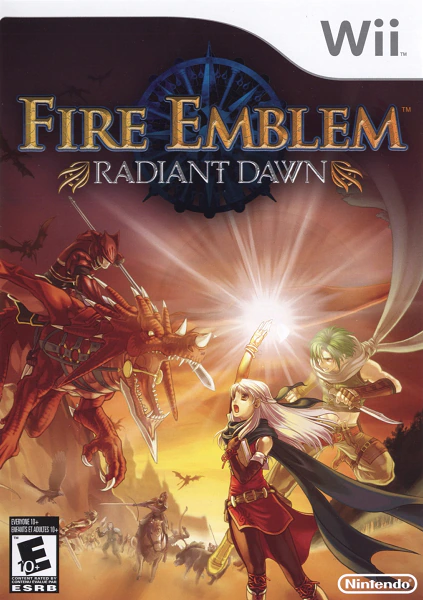
NAME(S): Fire Emblem: Radiant Dawn / Fire Emblem: Akatsuki no Megami / ファイアーエムブレム 暁の女神 / Faiā Emuburemu: Akatsuki no Megami / Fire Emblem: The Goddess of Dawn / Fire Emblem 10 / FE10
PLATFORM(S): Wii
DEVELOPER(S): Intelligent Systems
PUBLISHER(S): Nintendo
GENRE(S): Strategy RPG
RELEASED: February 22, 2007 (Japan) / November 5, 2007 (North America) / March 14, 2008 (Europe) / April 10, 2008 (Australia)
Technically the first real Wii game I beat, and I wouldn’t have had it any other way were I able to afford a Wii back then. Truth be told, I wasn’t that excited for Fire Emblem: Radiant Dawn. Path of Radiance‘s plot wrapped up fine, and though it obviously laid seeds for a sequel from the very beginning, it was mostly in small details that could’ve been dealt with in its own game. and the unanswered questions such as the Black Knight’s identity were hardly making me lose sleep. That, for example, would either only be significant based on details we don’t yet know, or it would be revealed to be a bland side character in the first game with as simple a background and motivation as we were already told. It pretty much turned out to be the latter.
One of the cool things about Fire Emblem is something it has in common with Final Fantasy. The settings are even more familiar, and the series has developed its own traditions, but always setting the games in a new world opened up reasonable experimentation with the gameplay and a new cast that could always carry the shortcomings based off nothing more than a little freshness on a tried and true addicting style of strategy RPG gameplay. They had a winning formula from the very first game and refined it dramatically until finding a very stable system with Fire Emblem: The Binding Blade that would be the basis of future games, only teetering slightly for better or worse.
The idea to build a game based around an adherence to plot was actually something very new. FE3 was partially a sequel but also contained and rewrote the first game to make it a consistent package, and since Fire Emblem: The Blazing Blade was a prequel of events barely defined by FE6‘s very basic plot and writing it had all the excuse it needed to essentially stand on its own.
Fire Emblem has never been a series known for its storylines. Many people like them, including myself, but they’ve never been a draw to the games. They’re only solid intermission entertainment between the gameplay to increase attachment to the characters and add weight to each chapter’s goals. The plots have typically been frequent with cliche, lacking in shock, and were all around generally based in settings and plot concepts defined and done better by earlier works of art. And yet, despite this, they’ve made every game past the simplicity of FE3 significantly more fun. There’s something to be said for Fire Emblem‘s writing because of this, and this isn’t achieved simply by throwing any half-assed arrangement of words to form a purpose and fluff out the game.
I’ve played a lot of JRPGs by now, and beyond that have an even greater familiarity with Japanese-styled fantasy stories, and though I’ve seen many great stories with more creative and ambitious worldbuilding, surprising plot developments, and more complexity and innovation when it comes to combining story and narrative into gameplay, I’ve almost never seen any series as consistently down pat with tone as Fire Emblem has been. Throughout all of its entries I’ve played, though I’ve felt underwhelmed, I’ve never cringed at an awkward moment of it or found anything disagreeable.
This isn’t for any lack of trying, as Fire Emblem has gotten progressively wordier but this hasn’t ever changed. Fire Emblem‘s writing has always had a nearly unparalleled high amount of respect for itself, a perfect balance of seriousness and lighthearted humor that are always placed precisely where they should be, full of characters with stock personalities yet many of which come across strongly but never oppressively annoying. They’re so unabashedly easy to take in that calling them generic doesn’t work because it’s an insult that implies things that Fire Emblem‘s plot holds the series back from which it never particularly has.
There’s absolutely room for Fire Emblem‘s stories to improve and I do believe they should be more daring, but there’s something to be said about that lack of risk as well. So far it’s maintained an excellent balance and has been able to be entertaining and enriching while sticking in familiar territory simply for how the standards of decency are met over and over, throughout every single game. If there’s a lesson to be learned from Fire Emblem‘s writing there’s only one and that’s common sense values in how to tell any linear heroic story. They don’t go off the beaten path, but unlike many other stories that don’t, the Fire Emblem series has known exactly how to tread it. It’s somehow never boring that way.
And yet for the first time in series history, we’ve hit a conflict of interest between the story and gameplay. To begin with just the story, Radiant Dawn takes place three years after its predecessor and initially follows previous character Sothe and new main character Micaiah as they fight Begnion’s oppression over Daein. It’s certainly an interesting start to fight for the side you were fighting against in the last game, and Radiant Dawn‘s writing exhibits the qualities of Path of Radiance. With new home console space and standards, and needing to meet the level of storytelling introduced in Fire Emblem 7, Path of Radiance had more dialogue than any prior Fire Emblem by far. Text boxes could now fill up a much bigger screen and they absolutely used that space.
Though a greater focus on plot may seem like a misstep, Path of Radiance avoided it by keeping it all skippable as always and not having any maps require story knowledge. For people who liked the story, this increased space allowed time for more side characters and more detailed pre-map scenarios. It was the same quality as before, only made heavier just enough to be multiplied and not a lump sum of content. Radiant Dawn needs this space more than ever not only to focus on the cast and situations it already set up, but also all the new ones. The cutscene length when combined with Base conversations can be extremely tiring at points in Radiant Dawn, although in the end I didn’t regret reading any of it.
The real conflict of interest arises when in the story’s desire be at a bigger scale demands the gameplay to work with it. A major plot detail of Radiant Dawn is villains plotting to plunge the whole continent into a war in order to awaken a sleeping Goddess trapped in the titular Fire Emblem. In order to convey the range of chaos across the continent, Intelligent Systems don’t take the player through a linear journey but instead switch perspectives throughout the game in different parts of the continent with different characters. Though this aids the storytelling by making us have firsthand experience with how violent and large the conflict has gotten, it brings several unfortunate side effects that threaten the stability of the gameplay appeal that the series has been working around for so long.
By forcibly altering our parties constantly, old fans are limited in their long-held enjoyment of having the freedom to choose a team of favorite characters to take through the game and watch gradually grow. For when this does exist through several chapters focusing on the same group of people, its momentum is routinely halted by perspectives suddenly shifting again and we eventually stop forming as much of an attachment to our characters as there’s not much of an opportunity to, and the scale of difficulty and power is no longer linear and building to a climax, but instead all over the place for half of the game.
Because Radiant Dawn brings in old, experienced characters among new ones, it’s obligated to do both the fans and world realism a favor by making returning characters significantly stronger than new ones, and then having to make important characters with a greater plot reason to be strong such as the Laguz kings even stronger.
There’s a huge gap of power between characters in Radiant Dawn, and since these are dotted around rather than given to you at a linear, reasonable pace, the game’s enemies are forced to grow much stronger, much faster than several units on your team as more and more of the aforementioned powerful characters come together for plot reasons. These powerful characters also give the designers a lazy excuse to make traditionally-played maps unfair for your weaker units because using the powerful ones is always an option.
But this is cheap way of getting around difficulty, as opposed to another Fire Emblem game possibly giving you some sort of terrain advantage or alternate goal to defeating the enemy force that’s more powerful than you. And that feels a whole lot better than just tossing a superpowered unit at them and then pulling them back so they don’t steal all the EXP.
You’re practically punished for trying to make full use of the already restricting range of available party members, and using many relatively weak units relying on them to grow over time and become strong isn’t as much of an option this time. Pre-promoted characters eventually plateauing in stat growth can’t be done because there’s on obligation to also make these characters good because they’re hyped up by the plot and they’re fan favorites of the players.
Experience can’t afford to be divided among all your weak units when there’s limited chances to get it before that character is taken away, and killing enemies to get those said characters experience is even harder once enemies are forced to meet the greater number of powerful pre-promotes, which further increases demand for getting experience fast. You’re at best forced to use just the right combination of weak characters among stronger ones, or no weak characters at all.
The Bonus Experience mechanic introduced in the last game seems like the ideal fix for problems like these, but for probably no half-thought out reason BEXP now only gives out three stats per level every time. This is an average level up that forgoes the opportunity of getting anything better.
When used on the weak characters who need it most, it undermines their inherent potential of growing due to the amount of possible levels they can get by eliminating their possible talent with so many rolls at level ups. BEXP already has a cost by virtue of it being limited and encouragement to use on certain characters. Increasing that need to use it while getting rid of the positive advantage for characters who are arbitrarily disadvantaged from the start is a very poor, backwards decision.
In another of Radiant Dawn‘s attempts to show the increase of the story’s scale to the player through gameplay, the maps are bigger than any game other than FE4, and the enemy count can get absolutely ridiculous. The difficulty in FE games is decided by its map design. Enemy grunts are always made weaker than the player because the player is encouraged to use strategy to get over the much greater advantage of superior disposable enemy numbers.
An enemy that only deals 4 damage on an attack while you do 10 isn’t threatening at all at first, but add in an AI that can afford to lose units and has more chances than you to land an attack, and suddenly everything’s not so simple. Fire Emblem beats the player by exhausting them, but the player typically can’t just play defensively because there are rewards and requirements to finding the ideal pace.
These rewards can be getting items before the enemy destroys them or retreats while having them, or recruiting characters before they are killed, and many other things. These are essentially artificial turn limits in addition to the occasional forced turn limit that put pressure on a player expected to think much more complexly than an AI. You can’t just hold down a chokepoint and heal every turn while small groups of enemies come at you, in these situations you need to put yourself in the middle of danger and figure out how to mitigate that danger as much as you possibly can. These moments are the pinnacle of strategy RPG gameplay, and the closer Fire Emblem gets to them the better its map design is.
Radiant Dawn‘s ways with which it conveys story scenarios to the player contradict these basic values. Begnion is known to have the largest army on Tellius, so instead of simply implying larger-scale fights through dialogue, we’re put against gigantic forces ourselves while the size of our team remains the modest usual.
To compensate, enemies must either A. be weaker so the overwhelming army doesn’t have a guaranteed victory or B. have the AI order them in a scripted way so the player isn’t charged all at once, even though this is compromising the story with gameplay which should’ve been more of a value to begin with so this didn’t happen. This also has more of an effect on the kinds of maps the player fights on. In order to accompany a lot of units while still having a high number of maps to play on in order to move the plot along at the desired pace, the maps must be kept a reasonable size and thus very open in order to fit all the units.
This creates clutter where the player is either discouraged from moving forward or unable to, either by not wanting to make a huge force of enemies move in on them or they’re blocked by the high amount of enemies that already have. Because the player’s advancement through a map is forcibly slowed so much, the various sub-goals that used to fill tightly constructed maps are all but done away with because they’d demand a pacing that wouldn’t fit with the new enemy layouts.
Fire Emblem 9 already had a problem with the latter part of the game’s maps being filled with too many unchallenging cannon fodder enemies for the sake of its storyline. FE10 only makes this problem much, much worse. Maps have a tendency to be time-consuming and undynamic with a lack of excitement and risk once the initial threat of the imposing enemy force size is understood and gotten under control by the player.
This excessive bloat makes FE9‘s comparisons to FE4‘s design philosophy feel completely meaningless in relation. The equivalent of holy blood units who could wield legendary weapons in FE4 and destroy the enemy army are now the pre-promoted characters who come with incredible stats that completely eclipse everyone else’s. Using the non-holy blood characters is about as difficult as using the severely under-leveled characters, and when it comes right down to it there’s ultimately no reason to raise up the weaklings when you’re handed the most powerful units already ready to kill everything.
There’s a pseudo-generation system with transferring your Path of Radiance data, and wanting to display scale of conflict through map and enemy count is the same deal, although even a game as old as FE4 did it with more grace. However, Radiant Dawn‘s more detailed plot would never fit in such a format without huge trimming and rewriting.
FE4 and FE9‘s skill system is also back and improved to gave both the player more customization and making the skills more useful in general. These are some of the best new ideas in Radiant Dawn, but I have to raise a complaint with how the skills attached to units from the beginning don’t use up skill point space yet can be removed and transferred to another unit.
This is a really lame incentive not to remove some individuality off units, but instead of this maybe the developers should’ve considered why the hell they were putting Cancel, an ability to cancel enemy counterattacks, on an archer unit of all things. Make every skill count or the customization aspect is downplayed and it sidesteps the problem of transferring being introduced in the first place because some default skills were stupid and useless. Everything is going to be taken off of a unit the player doesn’t use anyway, so why encourage keeping it so weakly?
Laguz also of course make a return. I thought this concept was stupid to begin with because Japan handles discrimination themes with an inexperienced childlike perspective and tameness, and primitive half-animal people is super-cliché and a bit out of place in Fire Emblem‘s magic medieval setting.
Regardless, they’ve never bothered me that much and some of my favorite units are even Laguz, which makes it more unsettling how they’ve never been implemented well. Giving the Laguz unique mechanics as to how they fight means you need to balance maps around two kinds of combat which isn’t really feasible, and this has only been ignorable because the Laguz aren’t good enough to have a major influence on maps.
Because of this, Laguz should’ve been very similar to humans somehow stat-wise and combat-wise, but instead we get this simplistic restraint where their stats are very high but they can’t fight when they’re untransformed. Progressing on a map based around when your Laguz units are going to transform next isn’t worth it when your humans can fight well enough on their own, which also means you don’t necessarily need their increased power.
Just fuckin’ make them normal. Instead of doing this, Intelligent Systems allowed both Laguz and stave-users to attack while untransformed. Not only can they only counter-attack which is a pointless restriction when you take into account how much lower their stats are, but those stats are so much lower that their attacks do zero damage most of the time so this new feature is totally pointless.
Laguz are screwed even more than human units when it comes to joining under-leveled, as they get absolutely microscopic amounts of EXP from every kill and will essentially only level up from massive amounts of bonus EXP, which also means that their innate advantage of having high transformed stats is totally undermined by their weak starting stats and difficulty growing.
To add even more of an insult to a large part of the game’s cast, the late-game Laguz royals are actually all extremely powerful. Not only can they transform whenever they want indefinitely, but both their stats and stat caps are absurdly high so a normal Laguz you put a ton of effort into raising can never match them in power or usability. That just isn’t fair.
Biorhythm, the dumbest mechanic of FE9, is made more important than ever. As turns go on your bipolar squadron and the enemy’s team will have their biorhythm go up and down in a wave. When it’s good, your attack and evade increase, and when it’s bad the opposite happens. When you take into account you can be attacking an enemy in worst biorhythm while their biorhythm is at best you can have a Swordmaster having a low hit chance against a Warrior.
This idiotic mechanic throws a random element into a game centered around planning that already has a healthy dose of randomness with its RPG mechanics and takes it too far because it’s not really something you can mitigate in any way. Biorhythm is simply a thing that exists that will sometimes fuck with you and sometimes won’t. It isn’t like having to weigh the regular odds and risks of hit percentages because adjusting for those is much simpler.
Another new feature that has a big impact on these percentages is how height is now factored into attacks. Units on a higher level will get an accuracy and attack bonus based on how much higher they are than the unit they’re attacking, while lower units have a much lower chance of hitting. I think this is a fine addition, although the impact it has on hit, avoid, and power can be far too severe for as long as they’re arbitrarily designing maps based around whatever setting the story happens to be set in.
It felt like I was almost universally disadvantaged by this mechanic because so many maps have you ascending. Also, units can move down levels with much less movement loss than a unit who is trying to climb up a whole level, which can lead to harsh open points for the enemy that can’t always be dealt with.
Support conversations are redone so that there are no longer unique conversations and anyone can support anybody. The latter is good because it means certain units don’t get an unintentional innate advantage based on the storyline, but the former forgoes that storyline completely.
The returning characters from FE9 are mostly fine because they had support conversations in their own game that developed them, but for the new characters this means they have nothing to them other than what little part they play in the story when they first appear. A compromise where certain support pairings netted in-depth conversation should’ve been the solution, but I have a feeling that they were also giving themselves a break due to the high amount of text already in the main plot.
Finally getting back to that plot, the scale Intelligent Systems sets up thankfully turns out to be effective in this regard. This turns out to be the most complex Fire Emblem plot yet, with several different sides with their own politics, characters, and motives. It’s interesting to see where previous characters ended up after the last events, and there’s more background on world lore given that made me realize I didn’t even know I wanted it. Unfortunately, though Fire Emblem‘s plot is now bigger than ever it still doesn’t have much interesting to say, which makes this whole exercise and sacrifice of map design and game balance for it not really worth it.
For all of its large scale, Radiant Dawn doesn’t really have a flair for the dramatic. Several important characters are written out of the story for huge stretches and no explanation such as Izuka, and several important plot reveals and story moments are handled very dryly despite the game’s usual wordy tendencies.
The identity of the Black Knight, one of the most hinged on plot details of the previous game, is tossed out in an aside at the end of a chapter when the Black Knight isn’t even present. Some death scenes lack weight, and though the series usually has main villains who have complex histories and conflicting motives, for almost all of the game the main villain’s identity is hidden and you have to deal with Fire Emblem‘s stock ridiculously evil and psychopathic villains.
Because the story focuses so much on the perspectives on whatever protagonists you’re playing as this time, we get almost no scenes of the villains to develop them or even make them entertaining. It’s unfortunate that the best villain in the game turns out to be the first one, Jarod, simply because he has the most engagements with the player even though he’s one of the stock psychopaths.
The ending is also surprisingly very weak and seems as if it were finished as quickly as possible. The aftermath reel of all your units is back but a lot of the text tells you nothing about that unit’s far future, and a lot of the scenes described should have been shown in actual cutscenes like the awakening of Reyson’s father but instead you get almost no cutscenes period. After how much text the rest of the game had, what the hell happened here?
Despite an extremely rough beginning and never completely abandoning its flaws, Radiant Dawn starts to get its act together in Part 3, where the Greil Mercenaries make their return. Now you have a party full of characters on an equal power level, and map design becomes much more consistent as a result. No one you get from this point on leaves, allowing you to emotionally invest time and effort into units again without questioning when it’s arbitrarily going to be taken away, and the game starts to resemble a classic decently designed Fire Emblem.
The most prominent issue remains the huge cannon fodder enemy count, but all this time spent is almost a relief now that it’s with a team you want specifically. There are still times where the game intervenes and forces deployment of units that have literally no reason to be a forced deploy when you could use someone you want, and there’s a particularly egregious instance where three characters from the beginning of the game rejoin just five maps from the game’s end with literally not even a single story reason to explain their absence. All of these characters are now completely useless by this point in the game without a huge amount of bonus EXP invested.
The graphics of Radiant Dawn are improved over Path of Radiance, but barely. This would be a high standard for an RPG on the GameCube, but obviously that’s not what this is. There are some nice small details added in like birds on the map flying away when you move a unit over them, but they’re not very noticeable. Cutscenes now have this ridiculous border around the characters and text boxes to make the characters not look too far away I guess, but it’s awkward and stupid.
The battle animations are as average looking as ever, but I keep them off anyway. The OST is actually one of the biggest downgrades compared to the previous game, which was a contender for having the best music in the series. Radiant Dawn really lacks passion in its compositions, and that’s the only way I can think of to describe how unmemorable they are.
Field map songs typically lack the hustle of previous songs like Greil Mercenaries and Crimea Attacks, and cutscene songs are similarly too soft to the point of being unmoving. I hate to rely on the word so much, but they really are undynamic without much peak moments or varying structure. It’s a wash of gentle string arrangements.
Though Radiant Dawn had its heart in the right place, its ambition opened up wounds that weren’t there before, or bled out previous problems more than ever. The decision to design the game around plot first turned out to be a poor one when using the base of a system that never had to adhere to such a thing. The most frustrating aspect about all of these missteps is that Radiant Dawn and Fire Emblem could have kept most of its new and old values if it were just more willing to compromise story and game design.
For example, keep multiple perspectives but decrease the amount of time spent on each one in order to make more room for time with our full party. Keep the characters that join already powerful but put them in more appropriate places or have these characters be the ones that aren’t available sometimes for plot reasons.
On that note, instead of writing a character out of the team, come up with a reason they don’t have to that adds as much to the plot as them leaving would, especially when so often their reason for leaving isn’t substantial to begin with because we see none of their actions in any cutscenes after they leave.
Despite a myriad of issues, Radiant Dawn is still Fire Emblem. The core of the gameplay has been mangled through the shredder known as plot contrivance, but it isn’t in pieces. The values of what makes these games so endlessly fun to play are there throughout, just not optimally handled.
Radiant Dawn was as much of a blast to play as it could be annoyingly designed, and in a sense it’s liberating to see Fire Emblem finally take its one and possibly only chance at making a very lengthy, epic, full-blown RPG adventure that strategy RPGs almost never, ever reach. Radiant Dawn feels like Fire Emblem hitting the big screen, and although it lost something for it it at least ended up as another fresh yet familiar take on tried and true gameplay. Intelligent Systems saw an opportunity for an unprecedented style of Fire Emblem and bravely took it.
Leave a Reply