








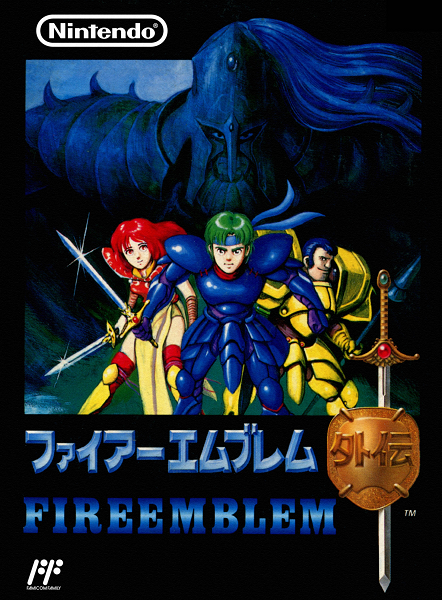
NAME(S): Fire Emblem Gaiden / ファイアーエムブレム外伝 / Faiā Emuburemu Gaiden / Fire Emblem Side Story / Fire Emblem 2 / FE2
PLATFORM(S): NES
DEVELOPER(S): Intelligent Systems
PUBLISHER(S): Nintendo
GENRE(S): Strategy Role-Playing Game
RELEASED: March 14, 1992 (Japan)
The bah-ing I’ve been hearing nonstop for the past week belongs to a certain “black sheep,” that of one of my favorite video game franchises: Fire Emblem. It now feels like I’ve had a long history with the series, especially when I think back and remember Fire Emblem Gaiden might have been the first Fire Emblem game I ever played. Fire Emblem 7 seems more likely to be so, but Gaiden came either shortly before or after when that may have been.
When I was a kid, I had my mind blown by a new site that had just went up that allowed you to play the NES library online in Java. I was browsing for games I’ve always wanted to play and I saw their only Fire Emblem game, Fire Emblem Gaiden. Whether I recognized the name from Super Smash Bros. Melee or Fire Emblem on the Game Boy Advance at the time, it was enough to get my attention.
But those were primitive times in every way. I could never get saving to work on the site, this was years before the game had been fan-translated, and its outdated design failed to keep my attention. Nonetheless, it was quite a treat to be playing a new Fire Emblem for a while, and to this day I remember that memory the fondest out of all the time I spent on that site. Well, maybe it was Wonder Boy in Monster Land. It’s close though.
I never beat the game, but now I’m a Fire Emblem veteran. And I take being a fan of everything I like seriously, so the time had come to complete the series further with the nearly forgotten Fire Emblem Gaiden (FEG). Fire Emblem Gaiden has all but been lost to time. The modern fans don’t want to go back to such older mechanics, and Intelligent Systems has done almost nothing deliberate to honor its legacy in the decades since its release, despite the first game receiving two remakes in that time. It doesn’t help that FEG is known among those who have and haven’t played it as being a Fire Emblem game that’s “barely a Fire Emblem.” It’s regarded as a failed experimentation and departure from the first game that would be rectified in the third game’s return to form.
Perhaps the most surprising thing about playing Fire Emblem Gaiden is how much of it feels like any other Fire Emblem game. In fact, it shocks me that it’s knocked for being a departure. Gaiden fits perfectly within the Fire Emblem franchise and I wouldn’t doubt if for a second. Every Fire Emblem is a little bit different from another, and Gaiden doesn’t go so far off that trend. At its core are the same principles that unite all games in the series. This is not The Legend of Zelda II: The Adventure of Link. This is just another Fire Emblem—no one’s redheaded stepchild.
For starters, the story is comfortably exactly the same as any other Fire Emblem game. Two neighboring kingdoms get wrapped up in a war, the bigger kingdom is the evil one and it turns out that underneath the political scheming there’s actually a cult trying to resurrect an evil god toblablablawhatever. If you have played nearly any other Fire Emblem game—and if you’re looking at Fire Emblem Gaiden, I seriously hope you have—you’ve seen every trope of Gaiden‘s storyline before, only above NES standards.
There’s very little dialogue throughout the entire game, and all of it is only to advance the basic plotline that doesn’t really change or to provide a joining character a short reason for fighting. The supposed “twists” are anything but because there’s barely any details in the story to not infer exactly where story’s going. Fire Emblem Gaiden‘s story isn’t worth playing the game for or even talking about. The simple point is, it’s Fire Emblem. You play as two young lords who have to restore peace to the land by slaughtering everyone of a different color.
Wait, two? That’s the introduction to Fire Emblem Gaiden‘s most major twists on the formula. In this game you watch over two separate parties with their own leaders, at first taking turns between them and then having to manage them separately at your own discretion. This is all done via a large world map where you select each lord and move them around to different linked locations such as towns, dungeons, and forts. Most of these just feature a battle, but Fire Emblem Gaiden also has the unique ability to be able to explore certain areas.
At first this is very exciting, because partly due in thanks to Fire Emblem, the strategy RPG genre has been able to keep low standards by staying away from exploration which would require developers putting more work in to flesh out their worlds and characters. However, Shining Force this is not.
There is almost nothing to do in any of Fire Emblem Gaiden‘s exploration segments. There are an average of three people per town to talk to and learn things about the plot you already knew, and often there’s nothing to do other than talk to a character to recruit them or open a treasure chest in plain sight. There’s nothing else to examine and the graphical design and layouts are extremely basic to the point where, sadly, this exploration might as well have not existed.
When having to explore, the slow walking speed and lack of anything to look at or do will make you wish that was the case. Oh, the irony. Speaking of irony, I played Shining Force CD right before Fire Emblem Gaiden, one of the only Shining Force games to have no exploration. Then I go to the only Fire Emblem to have it at all. Crazy. Anyway, the Fire Emblem series should still bring exploration back because Shining Force proved how much it could add to a strategy RPG (or any RPG…), but I don’t see it happening because Intelligent Systems knows they’d certainly have to do a much better job than they did in Fire Emblem Gaiden.
Back to the world map, the design is mostly linear and you’re simply moving from one battle to the next, but there are also sometimes forced encounters on certain squares that you’ll have to painstakingly clear every time you cross them, and every move you make on the world map has the chance of causing an enemy fort to spawn an enemy group that’ll move in turn with you on the world map until it reaches you and attacks, further wasting your time. I appreciate how they were trying to add a layer of strategy and efficiency to the world map segment itself, but these “random battles” of both kinds are so tedious and frivolous that they become incredibly frustrating and the worst thing about the game.
Fire Emblem Gaiden is slow to begin with, being an NES RPG, and you’ll be forced to clear these battles over and over and over for almost no experience points or items. It’s a painful experience. Fire Emblem: The Sacred Stones would bring this world map back but on a smaller scale that offered the player a way out of the optional fights. It also helped that The Sacred Stones was a much faster, more fun game. Still, I repeat that Fire Emblem Gaiden has another good idea here with the world map strategizing, it just needed better execution. But like the exploration, it was never really given the chance, which is a shame.
Starting in Chapter 3, you must control Alm and Celica’s parties on the world map at the same time. They can’t communicate in any way other than transferring items, but even this is limited to a certain number of times. By talking to a special person, the party can send a single item to the other party. Once this is done, that special person is gone. This is so strict that there’s a strong incentive to never trade items at all because it could be too necessary at some point, but instead the opposite happens and the feature may as well have not been in the game as a single item is unlikely to really affect anything.
Party members can be swapped only by having that party member die, then reviving them with the other party at a Lion Head statue. Lion Head statues are scattered throughout the exploration segments and generally allow a limited amount of stat boosts or revival to a character of your choice. It’s fun to have this control over your characters, and they’re not abusable. Again, the dual lord system mimics that of The Sacred Stones, but in that game you couldn’t control both lords simultaneously. Instead, this idea was only fully used again in Tear Ring Saga for the PlayStation, a Japanese-only game that’s a Fire Emblem game in everything but name.
The battles of Fire Emblem Gaiden play identically to the rest of the series, so I won’t go into heavy detail. On most major battles (not the random ones mentioned above), you’re able to use your entire party, similar to Fire Emblem: Genealogy of the Holy War for the SNES. Each unit can hold one weapon or item, but in Gaiden weapons never break, are never lost, and there’s no store. The goal of almost any map is to destroy all enemy units without losing any of your own, because revives are very limited.
There’s a convenient auto-move option where you can either command all units to attack the enemy, or to follow Alm and surround him. I would’ve greatly appreciated a command to avoid all enemy units, but it’s still very nice to have this auto-move option and it makes me wonder yet again why it took so long for it to appear in another Fire Emblem. Combined with my emulator’s turbo button, it made Fire Emblem Gaiden‘s slow speed bearable when I might have not been able to stand it otherwise.
What really gives Fire Emblem Gaiden its “personality” are the extended design quirks. Unit promotion is here, but level 20 is a ridiculous level to reach this time around and it’s encouraged to promote earlier as any low stats will be brought up to that class’s pre-determined base stats instantly. Also, certain classes have more than one promotion, and I really don’t understand the logic there. It gives specific units an unreasonable advantage while giving no benefit to regular classes.
There’s a Villager class which is reminiscent of The Sacred Stones‘s Trainee class where the unit can promote into any base class, but why would anyone choose the Knight class over the clearly superior Mercenary option? The Mercenary class can promote, literally, an unlimited number of times as the final class is Villager again. With enough leveling any unit with the Mercenary class available to them will always end up with perfect stats. Every other class is screwed.
But of course, the real problem is infinite promotion being in the game to begin with. Not only that, but the Slayer class before Villager has a very high movement and grants a huge magic defense bonus that’s almost impossible to get otherwise. It’s such an unfair choice. These oddities aside, promotion functions like it does in all Fire Emblem games, and branching promotion options is another thing that should be in every Fire Emblem.
Bows are actually useful in Fire Emblem Gaiden with a 1-3 range that increases even further on promotion. If so many of your Archers didn’t have garbage growth rates it’d be a devastating class, but although it’s overpowered I much prefer Bows being useful in this iteration unlike almost every Fire Emblem after where they’re at a huge performance disadvantage compared to every other weapon because they can almost never counterattack.
All magic now costs a fixed amount of HP whenever it’s used, which isn’t exactly unfair as it’s often the only reliable damage output. The only magic spell that costs no HP is the Sister class’s Nosferatu spell that drains HP. This might sound very overpowered, and it mostly is, but it’s mitigated somewhat that the spell chosen determines hit chance and Nosferatu has very low accuracy.
Since there are no Tomes to equip for weapons, characters learn spells by leveling up and the spells are tied to character, not class, so two Sisters will have slightly different spells even at max level. Different spells have different accuracy, range, and effectiveness against certain enemies. Sisters can also summon AI-controlled Phantom units to fight on your side, and the type and strength of these are also determined by the character.
Still, this is one of the best examples of Fire Emblem Gaiden‘s ridiculous balance issues. The summon command’s success varies with how many units it summons (up to a whopping 10), but it can be used repeatedly as long as the unit has enough HP. Even if they don’t happen to kill anything, these units are invaluable for distracting the enemy, and a certain character who joins early summons Slayer class units that can utterly demolish almost every map in the game. There’s no stopping it either. Just summon away. A Summoner class would later appear in The Sacred Stones, but it would only be able to summon one Phantom at a time.
The difficulty of Fire Emblem Gaiden is all over the place. Map design is more often than not extremely bland, with some maps being almost entirely barren or close to it with a random assortment of trees and stone walls. There’s often no logic to either the environment or enemy placement, turning many maps into a simple free-for-all rather than something encouraging a specific strategy.
It’s a relief when you actually play on a map that resembles something, like a fight alongside a river or inside a castle. But the bottom line is Fire Emblem Gaiden isn’t won through the subtle and balanced risk-reward tactics of the best Fire Emblem games, but rather by whether you or your enemy can pull off a cheap strategy first. The usefulness gap between units is enormous and only gets wider over time, so it’s always a good idea for many maps to just use a Sister’s Warp spell to transport your strongest unit close to the enemy so they’ll suicide attack him and leave your weaker units you were forced to bring along alone. Of course, there’s always spamming Phantoms too.
Luck plays a bigger factor in Fire Emblem Gaiden than I’ve seen in any other Fire Emblem. The right amount of luck makes a strategy game unpredictable and more tense by forcing you to improvise at times, but in Gaiden luck is consistently integral to winning. The most major factor is that the hit chances in Gaiden are unbelievably low, hovering around 50% for the entire game. Even your fastest units can’t be trusted, and because the low hit chance is nearly universal there’s no true risk-reward mentioned above due to you having no choice but to play those odds.
Every attack I made in Gaiden felt like a series of coin flips and I could never feel confident about the way a battle was going to go. You really just pray and hope for the best. Problem is, since you’re outnumbered, the enemy is going to have way more of those coin flips go their way. A unit that can’t hit in Gaiden is as good as dead, as these barren maps make it easy for any unit to become targeted and surrounded. Naturally, a unit that can’t hit will also never gain levels to have a better chance at hitting. It’s an endless cycle for certain units.
Equipping a weapon increases hit chance, but weapons are scarce and in high demand by your entire team. Damage output in Gaiden is also low even when a hit actually does connect, so the dragging pace of battles can encourage you to take even more risks when you can’t believe you just missed the same dying enemy 20 times in a row as your blood comes to a boil. Units with weapons equipped will be among the few with a certain unfair advantage that makes them able to compete with the enemy’s unfair advantages and these units will be the only ones gaining experience and growing, with no opportunity for the others to catch up.
Sure, you could go grind them in random battles, but what’s the point when most units in Gaiden have terrible growth rates anyway and you’re better off just focusing on the few good ones? Though you can usually bring every unit into battle, you’ll be lucky if you have the experience, resources, and stats to divide among even half of them.
It’s just not efficient when you need units with a weapon who are capable of being able to hit the enemy while taking far more hits in return, and also need to deal respectable damage when they do hit. The units that can do this are very small in number, as I learned around the halfway point when most of my team stopped growing and continuously missed or dealt 1 point of damage to the enemy. Usually both.
Enemies have several unique tricks up their sleeves as well. As you can guess, weighted hit chance is among them. Enemy Witches are unique in that they can warp anywhere on the map free of charge while you can’t, and then pound you from any direction for significant damage because the Magic Resistance stat is almost impossible to increase.
Maps with a lot of Witches can also come down to nothing more than luck, hoping that the enemy simply decides for no reason not to kill you. Enemy armies can also have their own Summoners, which endlessly summon hordes of monsters for no HP cost. These monsters are pathetically weak and do absolutely nothing but waste your time, because while they can’t do any damage they can of course take a million hits to kill with very high defense.
Monsters are the worst enemies in the game simply because of how worthless they are both to the challenge and pleasure of killing. The exception are the Dragon Zombies, which have extremely high movement, attack, and can only be harmed by certain weapons and spells. Again, those aforementioned units that don’t have special advantages will be doing nothing but running for their lives against dragons.
Despite all this, Fire Emblem Gaiden is pretty easy once you figure out your own cheap methods, as mentioned earlier. A simple method is equipping the Angel Ring to a character with good growth rates and having them solo maps, as the Angel Ring restores some HP every turn and doubles any stat gains as long as it’s equipped. This can easily turn the right unit into a monster strong enough to solo the game, which is exactly what you should do, if you don’t want to lose your mind.
The enemy can slow you down with all the random battles, convenient dodging, high defenses, endless healing spells (forgot to mention!), summons, and teleporting Witches it wants, but if they can’t deal damage to you it doesn’t matter if clearing a map happens to take an hour. The AI is also very stupid, sometimes not going for the kill on a unit, or not moving at all during their turn for no reason despite being surrounded by your units.
One of my favorite things is how when an enemy unit is close to dying they will inexplicably not do anything their next turn, leaving you able to kill them. They usually don’t run away or even get a last attack in. They simply give up and wait to die. Oddly, if you ignore them another turn they’ll get impatient and happily kill themselves by suiciding into you.
The majority of the game’s balance problems come to an irritating head towards the end of Chapter 4, where Celica’s number of maps are few and easy while Alm has far more and no reliable grinding spot to gain levels. The enemy strength on Alm’s route increases disproportionately to yours and even your few reliable units will need a lot of luck to make it through until the last battle where you finally have access to Celica’s superior units again in an NES-styled anticlimactic ending.
What else is there to say? The music was pleasant enough, but I don’t think there are any classics here. It was a nice surprise to notice that the battle theme was the same one remade for Fire Emblem 7’s arena battles. The graphic design is extremely repetitive but with a nice amount of detail, and an improvement over the first game that reused character portraits several times. Replay value? Nope, no thanks.
I’d never regret completing another game in one of my favorite franchises, even if it’s an easy contender for being the worst of them. Fire Emblem Gaiden has a lot of ambition, and that’s simultaneously what’s most respectable and humiliating about it.
Its unique ideas come to nothing in its own game compared to the simplicity of the first game, and it bears little honor of being the game where the designers would learn from its mistakes and improve them for a more successful sequel, because these ideas were never fully integrated into the series or used to their full potential when they briefly returned. It’s a game that wanted to go somewhere, didn’t, and then only served as a reminder of what Intelligent Systems has been trying to cover up because they’re afraid of committing that hard again.
What did I say earlier? That Fire Emblem Gaiden wasn’t a redheaded stepchild? Okay, it may be redheaded, but it’s still no stepchild. Fire Emblem Gaiden may be a failure compared to the rest of his family, but he’s family through and through. That family has even appreciated him from time to time, because deep down they know he belongs and had his heart in the right place. Maybe one day they’ll learn from his spirit and start trying as hard to avoid complacency and not fear failure. And now, please enjoy an NES-styled anticlimactic ending to this review.
Leave a Reply